
Red and Black Speaker Wire: Which Is Positive?
Quick Answer / Summary: Red and black speaker wire uses color coding to ensure correct polarity: Red connects to the positive (+) terminal, and Black connects to the negative (-) terminal on both the amplifier and loudspeaker. Maintaining this alignment across all speakers prevents out-of-phase bass cancellation.
In home theater audio installations, car stereo speaker wiring, and commercial audio systems, red and black speaker wire represents the universal dual-conductor color code standard designed to guarantee foolproof acoustic polarity. Because loudspeakers operate on alternating electrical current, maintaining consistent positive-to-positive and negative-to-negative connections across all channels is essential to keep all speaker diaphragms moving in acoustic synchronization, preventing devastating bass cancellation and collapsing stereo soundstages.
Acoustic Phasing and Why Speaker Polarity Matters
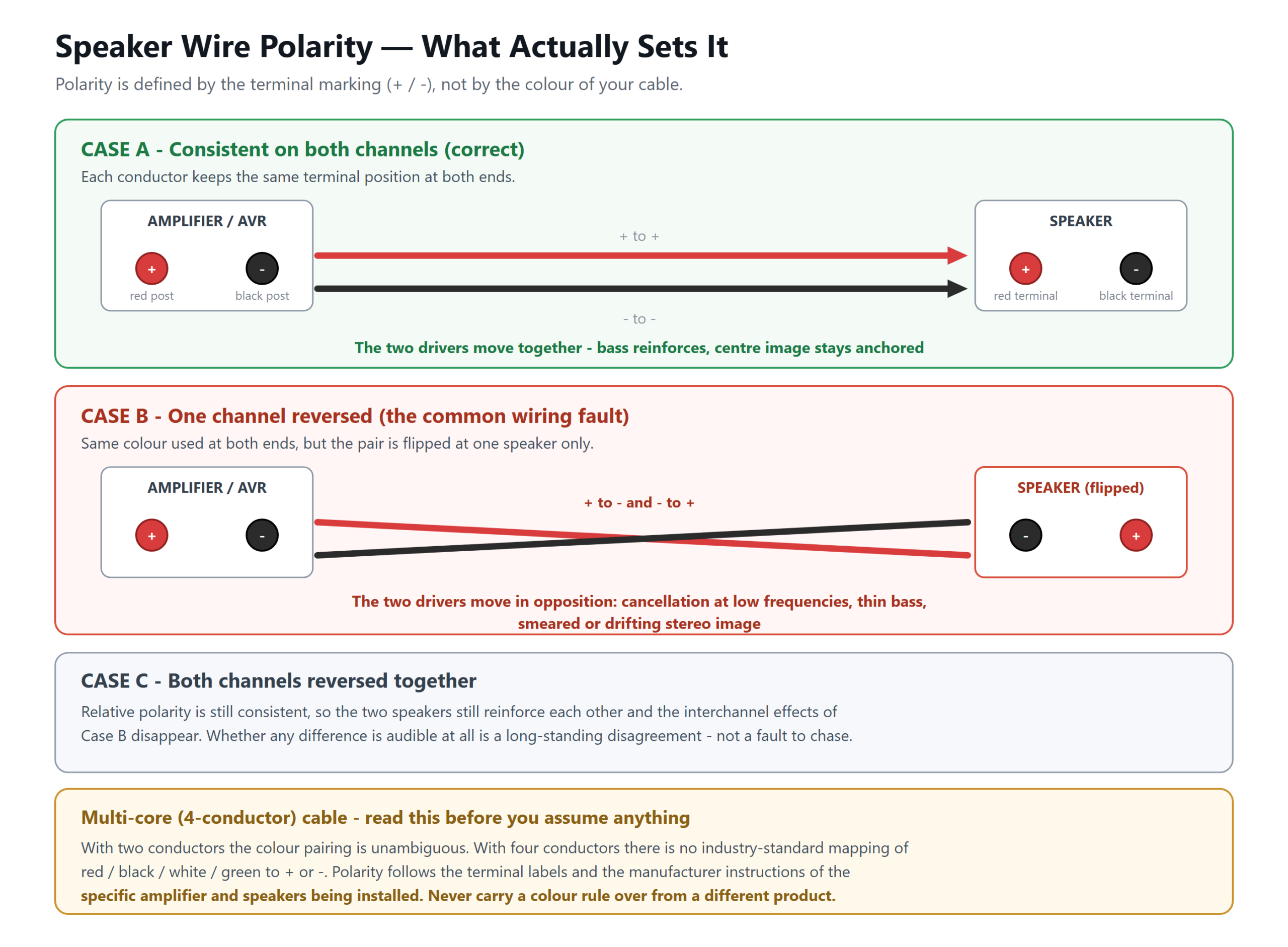
Why reversing speaker wire leads destroys soundstage and low frequencies: 1. Cone Excursion Dynamics: When an audio amplifier sends an electrical impulse representing a kick drum or bass guitar note, the voltage rises positively; if wired correctly (Red to Positive, Black to Negative), the loudspeaker’s voice coil pushes the woofer cone OUTWARD, creating an acoustic compression wave in the room; if wired in reverse, the cone pulls INWARD (rarefaction); 2. The Acoustic Phase Cancellation Hazard: If your Left speaker is wired in-phase (pushing outward) and your Right speaker is wired out-of-phase (pulling inward), the sound waves from the two speakers collide in the air and cancel each other out; the resulting audio sounds thin, tinny, completely devoid of deep bass, and vocals sound like they are floating vaguely outside the speakers rather than anchored firmly in the center; 3. Visual and Tactile Polarity Standards: Red and black speaker wire eliminates confusion through distinct PVC jacket colors; in clear or transparent ‘zipcord’ speaker cables where both jackets look identical, manufacturers incorporate subtle markers—such as a continuous white printed stripe, a black dashed tracer, or a raised tactile extruded ridge running along the positive conductor’s edge.
The AA Battery Click Test for Unknown Wire Polarity
If speaker wire is hidden inside walls without color markings, touch one wire to the negative terminal of a 1.5V AA battery and touch the other wire momentarily to the positive terminal; if the speaker cone pushes outward, the wire touching the positive battery terminal is the positive lead.
Color Standards in 4-Conductor In-Wall Cables
In 4-conductor speaker cables used for bi-wiring or running stereo pairs through a single in-wall run, industry standards specify: Pair 1 is Red (+) and Black (-); Pair 2 is White (+) and Green (-).
Does Reversing Speaker Polarity Cause Hardware Damage?
Reversing speaker wire polarity does not damage the amplifier or the speaker; it only degrades the acoustic sound quality; simply power off the amplifier and swap the red and black leads on the back of one speaker to restore full bass response.
Speaker Wire Polarity Identification Methods and Standards
| Cable Style | Positive (+) Marker | Negative (-) Marker | Primary Industry Usage | Identification Ease |
|---|---|---|---|---|
| Red & Black Dual PVC | Solid Red Jacket | Solid Black Jacket | Automotive audio, home theater receivers | Foolproof (Instant visual) |
| Clear Transparent Zipcord | Silver Copper Core / White Stripe | Bare Copper Core / Plain | Budget bookshelf speakers | Moderate (Requires close inspection) |
| Ribbed Molded Zipcord | Raised Tactile Ridge along edge | Smooth Round Surface | In-wall & behind-furniture routing | Excellent (Identifiable by touch in dark) |
| 4-Conductor In-Wall Cable | Red (Right+) & White (Left+) | Black (Right-) & Green (Left-) | Bi-wiring, multi-room ceiling speakers | Standardized commercial protocol |
| Contractor CL2/CL3 Cable | Red Insulated Core | Black Insulated Core | Residential in-wall code installations | High contrast inside outer jacket |
Real-World Application Scenarios
Wiring home theater surround sound receivers, automotive car speaker installations, multi-room in-wall architectural audio, and passive PA stage monitor setups.
Frequently Asked Questions (FAQ)
Q: Which wire is positive on red and black speaker wire?
A: The RED wire is always Positive (+), and the BLACK wire is always Negative (-); connect the red wire to the red binding post on your amp and speaker, and connect the black wire to the black post on both.
Q: What happens if I connect red to black on one speaker in my stereo setup?
A: Your stereo system will be 180 degrees out of phase; you will lose almost all low-frequency bass punch, and the central vocal image will sound hollow and distant; simply reverse the connections on one speaker to fix it.
For run length and gauge decisions, see speaker wire gauge, polarity and jacket ratings.