【一、SEO Blog 基本信息与写作资料卡】
项目 | 详细内容 |
官网 | Home
|
文章主题 | Commercial AV Cable Selection: Resolving HDMI 2.1 vs 2.0 In-Wall Signal Degradation and Handshake Latency in Multi-Screen Facilities |
Primary Keyword | Commercial AV Cable Selection |
Secondary Keywords | HDMI 2.1 commercial installation, 4K 120Hz signal degradation in wall, HDMI handshake failure troubleshooting, EDID communication cable, professional AV cabling standards, HDMI ATC certified cable factory |
Long-tail Keywords | how to prevent HDMI black screen in conference room installations, choosing HDMI 2.1 vs 2.0 for commercial display walls, B2B wholesale custom HDMI cables OEM |
目标客户 | Commercial AV System Integrators, Corporate IT Facilities Managers, Hospitality & Digital Signage Project Contractors, Display Hardware OEMs |
对应产品 | ZONG Professional Series HDMI 2.1 / 2.0 High-Speed In-Wall Cable Assemblies |
相关链接 (已确认) | 产品类目: https://zh-zong.com/productlist/ | 资质证书: https://zh-zong.com/certifications/ | 商务联络: https://zh-zong.com/contact/ | 国际站: https://zong.en.alibaba.com/ |
目标市场 | North America, Europe, Australia, Global B2B Projects |
权限等级 | L1 公开级 (Public) – 商业价格阶梯与具体交期需人工确认 |
【二、SEO 元数据与发布规范】
SEO Title: Commercial AV Cable Selection: Solving HDMI 2.1 In-Wall Signal Loss & Handshake Latency | ZONG Cable
Meta Description: Learn how to eliminate HDMI 2.1 signal degradation, black screens, and EDID handshake delays in commercial AV installations. Engineering insights and cable selection criteria by ZONG Cable.
URL Slug: commercial-av-cable-selection-hdmi-signal-degradation-handshake-guide
H1: Commercial AV Cable Selection: Solving HDMI 2.1 In-Wall Signal Loss and Handshake Latency in Multi-Screen Deployments
【三、完整 Blog 正文】
Introduction
In modern enterprise environments—corporate boardrooms, high-density command centers, higher-education lecture halls, and large-scale digital signage networks—audiovisual systems have transitioned to uncompressed 4K at 60Hz and high-bandwidth 4K at 120Hz/8K at 60Hz. Under the HDMI 2.1 specification, physical data throughput increases from 18Gbps (HDMI 2.0) to a massive 48Gbps.
However, for commercial AV system integrators and IT infrastructure managers, higher bandwidth introduces severe physical challenges. In-wall conduit runs, architectural plenums, structural electromagnetic interference (EMI), and multi-vendor display handshakes frequently result in intermittent black screens, HDCP synchronization failures, and costly post-commissioning troubleshooting.
Why does a cable assembly that performs flawlessly on a workbench fail when pulled through a 10-meter ceiling conduit? The root causes lie in conductor resistance, high-frequency skin effect attenuation, capacitive loading on sideband channels, and structural impedance mismatches. This technical engineering guide analyzes the technical mechanics behind in-wall signal loss and EDID/HDCP handshake failures, breaks down the core physical factors governing high-frequency copper transmission, and outlines practical cable selection and factory verification criteria for mission-critical commercial installations.
What Is Commercial-Grade AV Cabling and Why Does In-Wall Routing Differ from Desktop Patching?
A standard desktop patch cord is engineered for short-distance, flexible, low-stress applications—typically connecting a laptop to a desktop monitor within 1 to 2 meters. In contrast, commercial-grade AV infrastructure cabling must endure harsh tensile strain during conduit pulls, maintain structural roundness around structural bends, satisfy building fire codes, and preserve differential signal integrity across runs that often exceed 5 to 15 meters.
The Architectural Transition: TMDS to Fixed Rate Link (FRL)
To understand commercial cable performance, engineers must distinguish between the signaling architectures of HDMI 2.0 and HDMI 2.1:
• HDMI 2.0 (18Gbps) utilizes Transition-Minimized Differential Signaling (TMDS) across 3 differential data lanes, accompanied by a 4th dedicated physical clock lane. Clock rates operate up to 3.4GHz, and line coding utilizes an 8b/10b scheme.
• HDMI 2.1 (48Gbps) transitions to Fixed Rate Link (FRL). FRL repurposes the dedicated clock lane into a 4th data lane, encoding the clock directly into the bitstream using 16b/18b coding. FRL steps through standardized bandwidth tiers (FRL1 at 9Gbps up to FRL6 at 48Gbps).
At 48Gbps FRL speeds, high-frequency digital square waves degrade exponentially faster than legacy 1080p or 4K30 signals. The physical tolerance window for signal jitter, insertion loss, and inter-pair skew shrinks to picoseconds.
Why Signal Degradation and Handshake Latency Paralyze Commercial AV Installations
In commercial spaces, cable failures manifest primarily in two ways: Bit-Level High-Frequency Signal Loss and Low-Speed Control Channel Handshake Timeouts.
1. High-Frequency Signal Degradation (The ‘Digital Cliff’)
Unlike legacy analog VGA where attenuation resulted in fuzzy text or color tinting, high-speed digital video operates on the ‘digital cliff’. If conductor attenuation or crosstalk degrades the eye diagram beyond the threshold of the display’s internal equalizer, the receiver drops entire video packets. Integrators observe this as intermittent display blanking, random single-pixel sparkle (‘digital snow’), or inability to establish higher refresh rates.
2. Sideband Handshake Delays and HDCP Lockups
While video data travels across high-speed differential pairs, display synchronization depends on the Display Data Channel (DDC)—an I2C serial bus operating at a modest 100kHz. The DDC line handles Extended Display Identification Data (EDID) and High-bandwidth Digital Content Protection (HDCP) authentication.
Standard I2C buses are strictly limited by bus capacitance (typically 400pF maximum). In long cable runs, parasitic capacitance between conductors increases. High capacitive loading rounds off the edges of digital square waves, turning sharp timing transitions into slow curves. When signal rise time exceeds the I2C specification, the media server fails to read the display’s EDID block or drops an HDCP cipher re-authentication, resulting in persistent blackouts or ‘HDCP Unauthorized’ error screens on commercial display walls.
Key Physical Factors Driving Signal Loss and Mechanical Failure
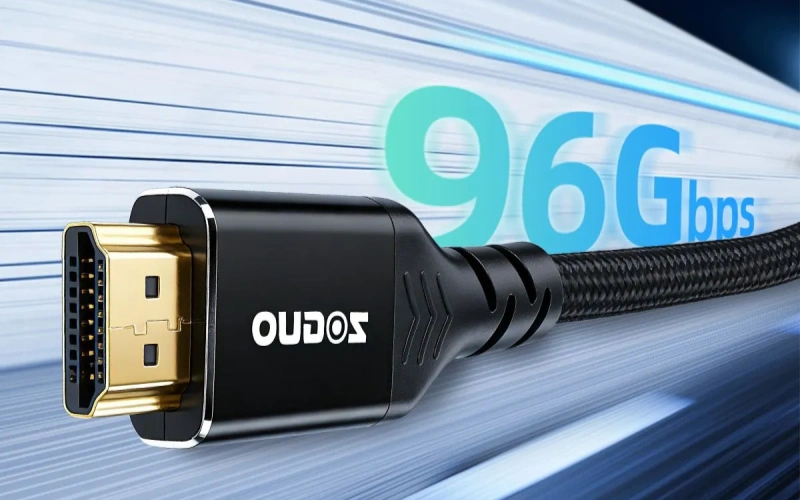
[推荐图片位置 1:产品核心参数图 – Product plus Core Parameters]
Alt 标签: High-speed commercial HDMI 2.1 cable assembly with core engineering specifications
1. Conductor Gauge (AWG) and the Skin Effect
As signal frequency increases into gigahertz ranges, electromagnetic current ceases to flow through the center of the copper conductor and concentrates along the outer perimeter (the skin effect). Using undersized conductors (e.g., 30 AWG or 32 AWG) across runs longer than 3 meters creates excessive DC resistance and severe high-frequency attenuation. Commercial-grade passive cables require heavy 24 AWG, 26 AWG, or 28 AWG Oxygen-Free Copper (OFC) conductors to preserve signal amplitude.
2. Multi-Layer Combination Shielding Against Structural EMI
[推荐图片位置 2:结构拆解剖面图 – Product Structure Explainer]
Alt 标签: Structural cutaway diagram of shielded high-speed commercial HDMI cable showing conductor, shielding and jacket
Commercial ceiling voids are saturated with electromagnetic noise from ballasts, HVAC motors, and power lines. True commercial-grade cables employ 100% overlap Aluminum-Mylar foil wrapping around each individual differential pair, supplemented by an overall heavy tinned copper braid (85% to 95% coverage) and dedicated ground drain wires to safely divert coupled RF noise to chassis ground.
3. Conductor Insulation: Physical Nitrogen Foaming vs. Solid PE
The dielectric material insulating differential copper pairs directly dictates signal velocity of propagation and attenuation. Advanced cable manufacturing utilizes skin-foam-skin gas-injected physical nitrogen foaming. The microcellular nitrogen bubbles lower the dielectric constant, reducing capacitive signal dissipation and maintaining uniform characteristic impedance (100 ohms ± 10 ohms).
4. Connector Termination and Strain Relief
During installation, field technicians pull cables through narrow drywall penetrations and tight 90-degree conduit bends. Commercial cable assemblies feature internal steel-shielded cans, automated precision micro-soldering, and high-durometer PVC inner molding beneath the outer backshell to withstand dynamic pulling tension without fracturing solder joints.
[推荐内链提示: 涉及走线穿过吊顶回风区域与系统接地时,可参考技术指南:What Is a Plenum Space? (https://zh-zong.com/what-is-a-plenum-space-cable-requirements/) 及 TIA-607 Grounding and Bonding (https://zh-zong.com/tia-607-grounding-bonding-guide/)]
How to Select and Specify Commercial AV Cables: An Engineering Decision Flow
[推荐图片位置 3:长度选型与部署图 – Length Selection Chart]
Alt 标签: Commercial HDMI cable length selection and infrastructure deployment guide for AV integrators
所需信号带宽 | 传输距离 | 推荐线缆物理架构 |
1080p / 4K @ 30Hz (<=10.2Gbps) | 1m 至 15m | 被动无氧铜缆 Passive Copper (28 AWG – 26 AWG) |
4K @ 60Hz 4:4:4 (18Gbps) | 1m 至 5m | 被动无氧铜缆 Passive Copper (28 AWG – 26 AWG) |
4K @ 60Hz 4:4:4 (18Gbps) | 7.5m 至 12m | 粗线径被动铜缆 Heavy-Gauge Passive (24 AWG OFC) |
4K @ 60Hz 4:4:4 (18Gbps) | 15m 至 100m+ | 有源光纤复合线缆 Active Optical Cable (AOC Fiber) |
4K @ 120Hz / 8K @ 60Hz (48Gbps) | 1m 至 3m | 超高速被动铜缆 Ultra High Speed Passive (28-26 AWG) |
4K @ 120Hz / 8K @ 60Hz (48Gbps) | > 3m 至 5m 以上 | 有源光纤复合线缆 Active Optical Cable (AOC Fiber) |
Strategy 1: Passive High-Purity Copper for Short Equipment Racks (1m – 3m)
Inside AV equipment racks and credenzas linking matrix switchers, audio extractors, and local media servers, standardize on ultra-high-speed passive copper assemblies [产品类目内链: https://zh-zong.com/productlist/] with tight 28/30 AWG construction to facilitate clean rack dressing while ensuring HDMI ATC certification compliance.
Strategy 2: Heavy-Gauge 24 AWG Passive Runs for Mid-Distances (5m – 7.5m)
For conference table patch panels linking to floor boxes or wall plates, passive 24 AWG OFC construction maintains adequate conductor volume to overcome insertion loss without introducing active electronic failure points inside closed walls.
Strategy 3: Hybrid Active Optical Cables (AOC) for Long Architectural Runs (10m – 100m+)
Passive copper is physically non-viable past 5 meters for 48Gbps. Deploy Hybrid Active Optical Cables (AOC), which embed micro-optical transceivers directly inside connector backshells, transmitting video over 4 multimode glass optical fibers while maintaining copper wires for DDC/CEC/5V handshake signals.
[推荐内链提示: 会议室多接口转换架构可参考:Video Adapters and Converters Guide (https://zh-zong.com/video-usb-adapter-converter-guide/)]
Factory Audit and Quality Control: How B2B Buyers Verify Cable Suppliers
[推荐图片位置 4:测试与质检流程图 – Quality Control and Testing]
Alt 标签: High-speed cable automated TDR impedance testing and Fluke network certification station in factory laboratory
When vetting an OEM/ODM cable factory, audit three critical manufacturing stages:
1. In-House Drawing, Stranding, and Extrusion Capabilities: Full-chain process control from in-house copper wire drawing to automated physical nitrogen foaming extrusion guarantees uniform dielectric core dimensions and conductor purity.
2. Time-Domain Reflectometry (TDR) and Eye-Diagram Testing: TDR measures differential characteristic impedance along every centimeter of the cable, ensuring connector solder points do not trigger impedance spikes exceeding ±10 ohms. High-bandwidth oscilloscope testing validates that jitter and bit-error rates comply strictly with specifications.
3. Traceable Accreditations and Real-Device Interoperability: Verify official ISO9001 quality management, official HDMI Licensing, HDMI ATC certification test certificates [资质证明内链: https://zh-zong.com/certifications/], and physical validation across real-world commercial display matrices.
Frequently Asked Questions (FAQ)
Q1: Why does a 4K HDMI cable work intermittently on a conference room projector but function normally on a standard desktop monitor?
A: Commercial projectors often feature internal input video processing boards with lower input sensitivity or higher trace attenuation than premium desktop monitors. When combined with a long, marginal in-wall cable run, the signal amplitude drops below the projector receiver’s detection threshold, causing periodic resynchronization loops (black screens).
Q2: Can an HDMI handshake issue be fixed simply by adding an in-line signal booster or repeater?
A: Not always. An in-line active copper booster only equalizes and amplifies the high-speed video channels (TMDS/FRL). If the failure is caused by excessive capacitive rise time on the low-speed I2C DDC lines (preventing EDID or HDCP key verification), an analog video equalizer will not resolve the handshake timeout. High-capacitance lines require dedicated bus accelerators or transition to hybrid AOC architecture.
Q3: What is the primary difference between CL2/CL3 rated cables and standard PVC jackets in commercial AV projects?
A: CL2 and CL3 are National Electrical Code (NEC) fire safety ratings for in-wall low-voltage wiring. CL-rated jackets are formulated with flame-retardant compounds that self-extinguish and resist fire propagation through interior wall cavities. Non-rated consumer PVC cables release toxic smoke and violate commercial building inspection codes when run inside walls.
Q4: Does an active optical HDMI cable support bidirectional audio and control signals like eARC and CEC?
A: Yes, provided the hybrid AOC architecture includes dedicated copper conductors alongside the optical fiber cores. In enterprise-grade AOC cables, optical fibers transmit unidirectional high-speed video/audio, while integrated copper wires carry bidirectional DDC, CEC, Hot Plug Detect (HPD), and eARC signaling transparently.
Conclusion & Strategic Procurement Summary
Selecting the proper audiovisual cabling infrastructure requires moving past consumer-grade assumptions and designing for the physical realities of high-frequency data transmission. By calculating distance budgets, specifying heavy-gauge conductors with multi-layer combination shielding, and deploying hybrid AOC assemblies for long runs, commercial integrators can eliminate signal dropouts and costly truck rolls.
Partner with ZONG Cable: Your Trusted B2B Manufacturing Specialist
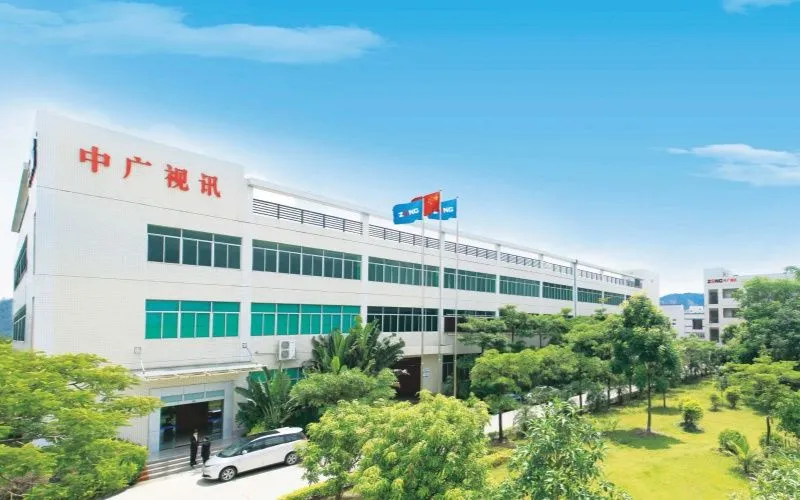
• 26+ Years of Cable Manufacturing Expertise: Deep production history originating from foundational wire operations in 2000, supported by an established industrial manufacturing base in Guangdong, China.
• Full-Chain Production Control: In-house copper processing workshops, raw-cable extrusion lines, precision molding facilities, and automated packaging.
• Verifiable Testing & Accreditations: Comprehensive ISO9001 quality management, official HDMI ATC Certified product ranges, VESA DisplayPort product listings, UL, CE-EMC, RoHS, and REACH compliance.
• Tailored OEM/ODM Capabilities: Custom wire gauges (24 to 32 AWG), custom lengths, specialized braiding, private tooling, customized color boxes, and bulk engineering packaging.
(Notice: Formal unit pricing brackets, custom tooling schedules, minimum order quantities (MOQ), and contract terms require human verification and written confirmation by our engineering sales team.)
👉 Contact our technical sales team directly at zongcarrie@zh-zong.com or submit your project bill-of-materials via our Online Contact Portal [https://zh-zong.com/contact/] for a prompt response within 24 hours.
👉 Browse our full certified product catalog and commercial capabilities on our official Alibaba International Storefront [https://zong.en.alibaba.com/].