Quick answer: Size surround cable by run length, not by channel label. Runs under 30 ft usually work with 16 AWG, runs of 30 to 60 ft are better at 14 AWG, and anything past 60 ft should be 12 AWG. Buy two conductor cable with a printed polarity trace, pull a spare pair to each corner, label both ends, and meter every run before the drywall closes.
The room is framed, the receiver is on order, and the drywall crew arrives Monday. That is when most surround installs go wrong: somebody buys one spool of thin cable, loops it around the room, and finds after paint that a back channel sounds thin or one side is silent. Long hidden runs are the hard part of surround wiring, and the decisions are cheap now and expensive later.

Why the rear channels fail first
Rear speakers sit furthest from the receiver, so their cable carries the same signal through far more copper than the front pair. Electrically a surround channel is nothing exotic: it is a passive speaker with its own amplifier channel, and the cable acts as resistance in series with that load. The longer the run, the larger the series resistance, and the more of the amplifier output is spent before the driver sees it.
Length decides more than the channel name
A centre channel two feet below the screen and a rear channel forty feet behind the sofa do not need the same wire. Measure the real path, including the detour up a wall and across a ceiling, then add slack at both ends.
The gauge number counts backwards
AWG works in reverse: 16 is thinner than 14, and 12 is thicker than both. Resistance per foot falls as the number falls, which is why the longest surround run in a room usually gets the thickest cable and the shortest gets the thinnest.
Choosing gauge from a measured path
Walk the route with a tape measure before ordering anything. A path that follows a ceiling void often turns out longer than the straight line on the floor plan, and that detour often decides between 16 and 12 AWG.
| Channel | Measured path | Sensible gauge | Failure to watch for |
|---|
| Front left and right | 8-12 ft, same wall as receiver | 16 AWG | Tight bend behind a skirting board |
| Centre | 6-10 ft, under the screen | 16 AWG | Conductor pinched under a plate |
| Side surround | 25-40 ft, ceiling route | 14 AWG | Staple driven through the jacket |
| Rear surround | 45-65 ft, two corners away | 12 AWG | Loose screw at the far plate |
Pulling cable without wrecking it
Most surround failures are mechanical, not electrical. A pull that needs force is already too tight, and a jacket cut by a sharp stud edge will read fine on the day of the install and open a month later.
Staples, holes and slack
Leave a finger width of slack at each staple so the cable can move with seasonal swelling. Drill holes sized for the jacket rather than for the conductor, and keep every bend wider than the cable is thick.
Sharing space with mains cable
Crossing a power cable at a right angle is normal. Running parallel to one for several feet in the same hole is not: it invites hum and makes later service confusing. Drill a separate hole and keep the audio bundle on its own path.
Test every run before the drywall closes
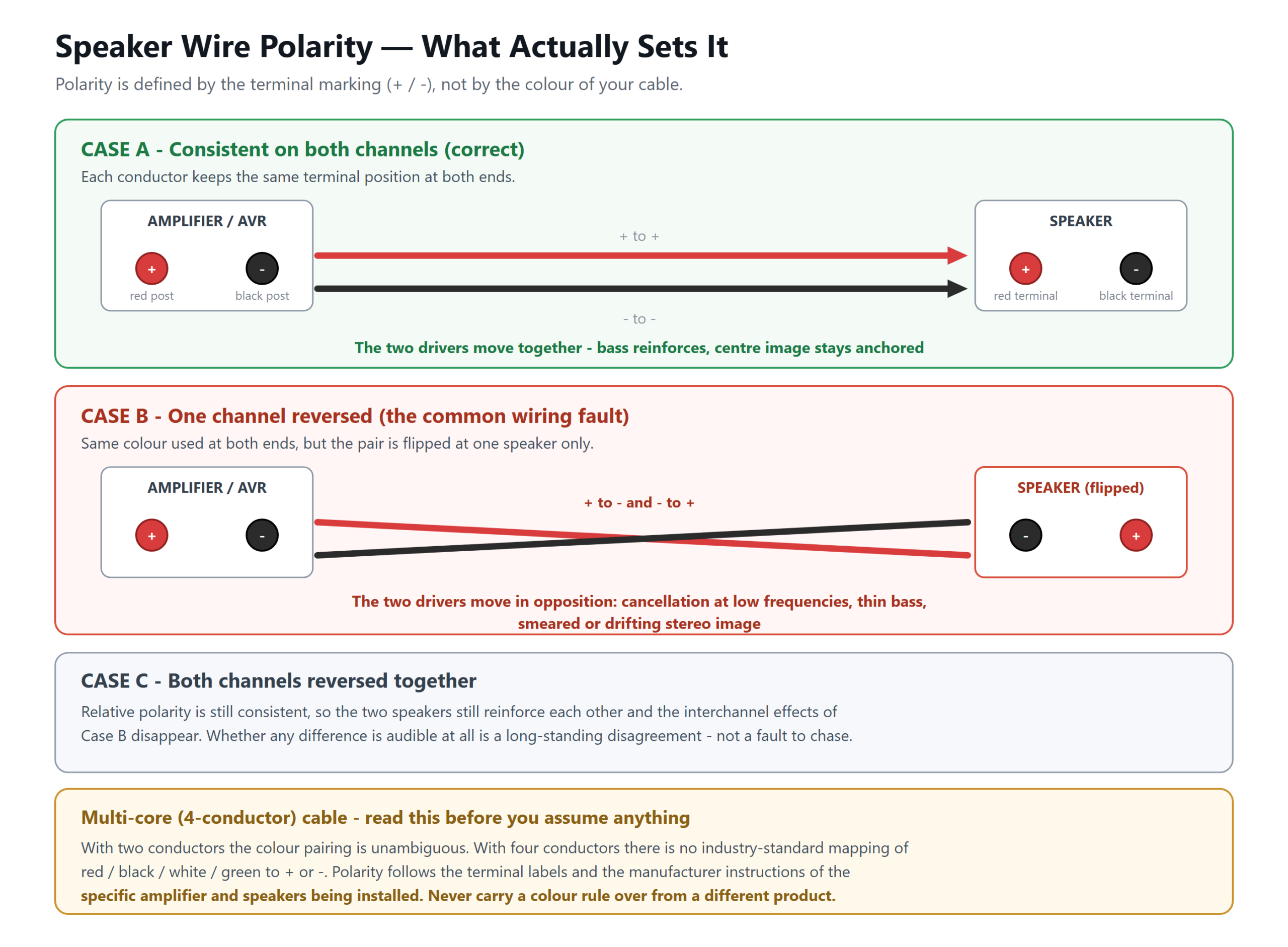
Testing is a five minute job that saves a weekend. At the receiver end, check continuity on both conductors, confirm there is no short between them, and use a battery with a small speaker at the far end to confirm which conductor is positive.
Label both ends and keep a record
Write the channel name and the room position on both ends, then photograph the wall before the boards go up. A sketch with measured lengths also tells the next installer why one rear run is thicker.
Practical scenarios
- Rented flat with a ceiling grid: lift two tiles, run the rear pair above the grid, and drop to a wall plate rather than cutting new channels.
- New build with open studs: drill and pull before inspection, add a spare pair to each corner, and meter everything while the framing is visible.
- Brick wall retrofit: use surface trunking at skirting height and accept a shorter route instead of chasing a long hidden path.
- Patio second zone: treat it as an outdoor run with a jacket rated for sun and water, even if it only sees rain a few times a year.
FAQ
Can every surround channel use the same gauge?
Only when the lengths are close. Two rear channels that differ by a couple of feet can share 14 AWG, but a six foot centre run does not need it. Size each channel on its own measured path.
Is it fine to run surround cable beside mains cable?
Keep them apart where you can and cross at right angles where you cannot. Separate holes cost one extra drill pass and remove both the induced hum and the confusion at service time.
Do I need four conductors per surround speaker?
Not for a single wired speaker. Four conductor cable earns its place when one pull must serve two channels, or when a cabinet has separate high and low inputs and you plan two pairs.
Next step
Start with the longest run and work back toward the receiver. For one pull to each rear corner, four conductor 16 gauge wire keeps the pair organised, quarter inch speaker cable suits plates and small cabinets, and anyone planning two pairs to one cabinet should read the bi-wiring cable guide before ordering a second spool.
See the matching cables and adapters