Quick answer: A headphone jack contains a tiny amplifier built for 16 to 32 ohm loads at milliwatt levels. A passive speaker asks for watts into 4 or 8 ohms, which is a different job entirely. Soldering speaker cable to a 3.5 mm plug does not create that power, so the output clips, heats and may shut down or fail. An amplifier or powered speakers belong between jack and driver.
The adapter looks like a good idea in a drawer of parts: a 3.5 mm plug on one end, two bare copper tails on the other, both soldered neatly. Plug it into a laptop, touch the tails to a bookshelf speaker, and the result is a faint distorted whisper that fades as the machine protects itself. Nothing was miswired. The output cannot supply what the speaker demands.

What a headphone output is built to drive
Headphones need a fraction of a watt. Thirty two ohms at a normal level draws a few milliwatts, so the chip behind the jack is a voltage source with a modest current limit and a small thermal budget. It swings about a volt and stays cool doing it.
The load a speaker presents instead
Four or eight ohms is four to eight times the current for the same voltage, and a speaker needs several watts for a normal level because sensitivity is quoted per watt at one metre. The mismatch is a power and current problem that no adapter solves.
Voltage and current together
One volt across eight ohms is about an eighth of a watt before losses. A small driver asked for a room filling level needs a multiple of that, which means more voltage and far more current than the jack can deliver.
Why the chip gets hot
When the load pulls more current than the stage can supply, the stage clips and the excess turns into heat inside a package with almost no heatsink. Thermal protection then mutes the output, which the user hears as sound that appears and disappears.
The damage path inside the output stage
The thermal route
Heat is the first route. Repeated clipping into a low impedance load raises junction temperature until the device degrades or protection gives up for the last time.
The shared return
On a three pole jack the sleeve is common to both channels, so wiring that ties one channel output to the other through a speaker creates a short across two outputs rather than a load. Bridge tied stages, where neither terminal sits at ground, make that a current spike rather than a signal.
The chain that actually works
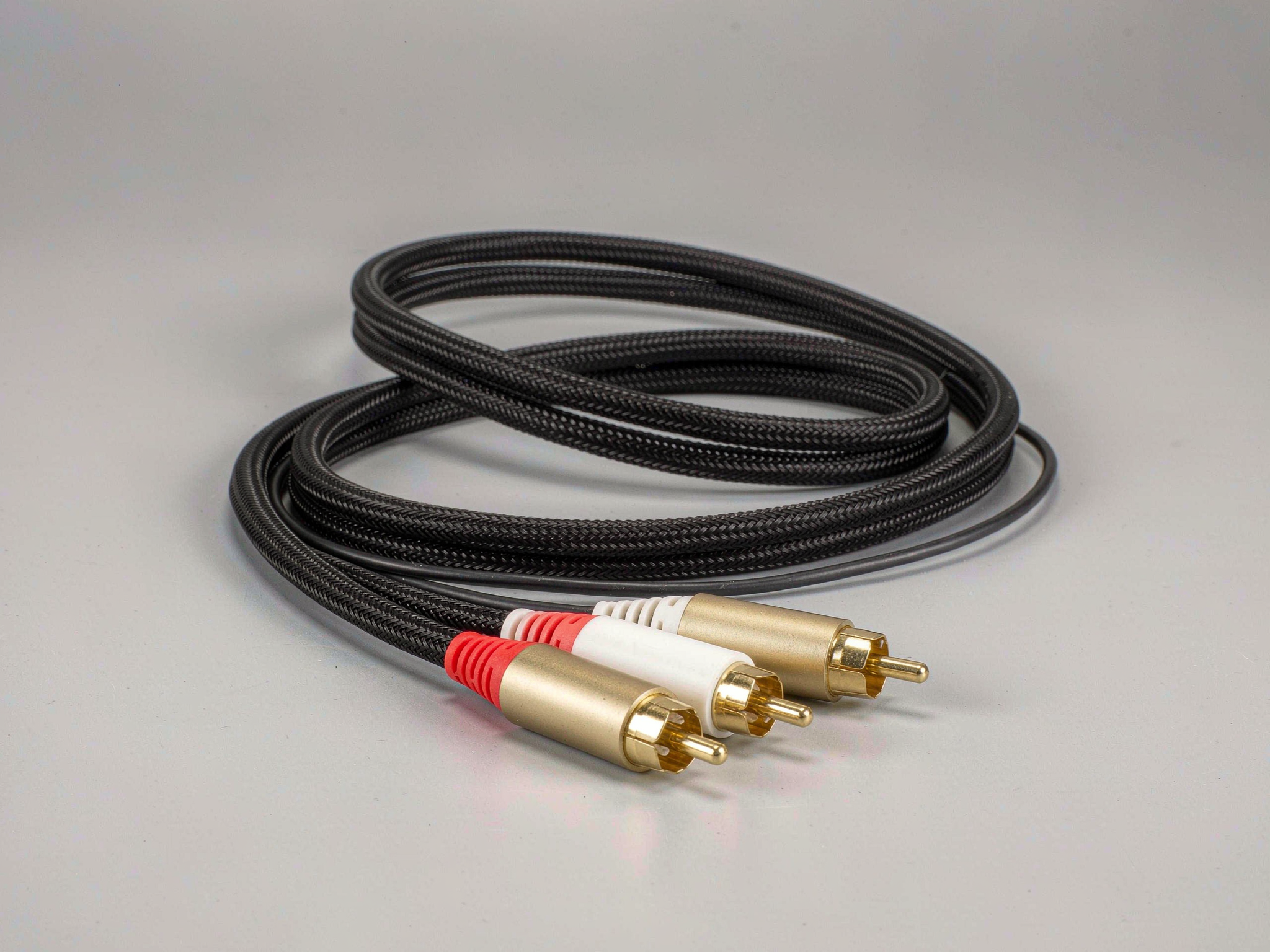
Keep the jack driving an input, not a driver. A stereo mini to dual RCA cable feeds an amplifier or powered speakers, and the amplifier output then feeds the passive speaker over two conductor cable. Each stage sees the load it was built for, and nothing runs hot.
Where a bare wire adapter is still correct
Adapters ending in bare conductors exist for a different purpose: connecting an audio output to a terminal block on an amplifier or a 70V line transformer, where input impedance is high and current is negligible. There the wire carries a signal and the load is measured in thousands of ohms.
| Source | Load expected | Power class | Into a passive speaker |
|---|
| Phone jack | 16 to 32 ohm | Milliwatts | Faint, then mute |
| Laptop jack | 32 ohm | Milliwatts | Clips, runs warm |
| Small desktop amp | 4 to 8 ohm | Watts | Built for the job |
| Powered speaker input | 10k ohm line | Signal only | Not applicable |
Practical scenarios
- Dorm room setup: A phone into powered speakers through a mini to RCA cable works, while a phone into a passive speaker never will.
- Garage pair: A small Class D amplifier turns the phone output into speaker level, and the phone only sees a high impedance input.
- Old stereo in the basement: The tape input takes the mini to RCA cable and the receiver feeds the speakers, which is the cheapest correct chain.
- Custom adapter order: Bare tail adapters are ordered for amplifier terminal blocks, not for connection to a driver.
FAQ
Can a phone drive a passive speaker quietly?
It produces a faint sound, but the output stage is outside its design load and the result is distortion rather than usable level.
Will this damage my laptop or phone?
It can. Small output stages that clip into a low impedance load heat up, and a shared return mistake can short two outputs together.
What adapter do I need instead?
A stereo mini to dual RCA cable into an amplifier, or a USB audio adapter feeding powered speakers. Both keep the jack at high impedance.
Next step
Build the chain in the right order and the plug question answers itself. The speaker cable to RCA wiring page shows how two conductors meet an RCA plug, the RCA cable as speaker wire page marks the limit of that substitution, and the headphone jack cable page covers plug sizes.
See the matching cables and adapters