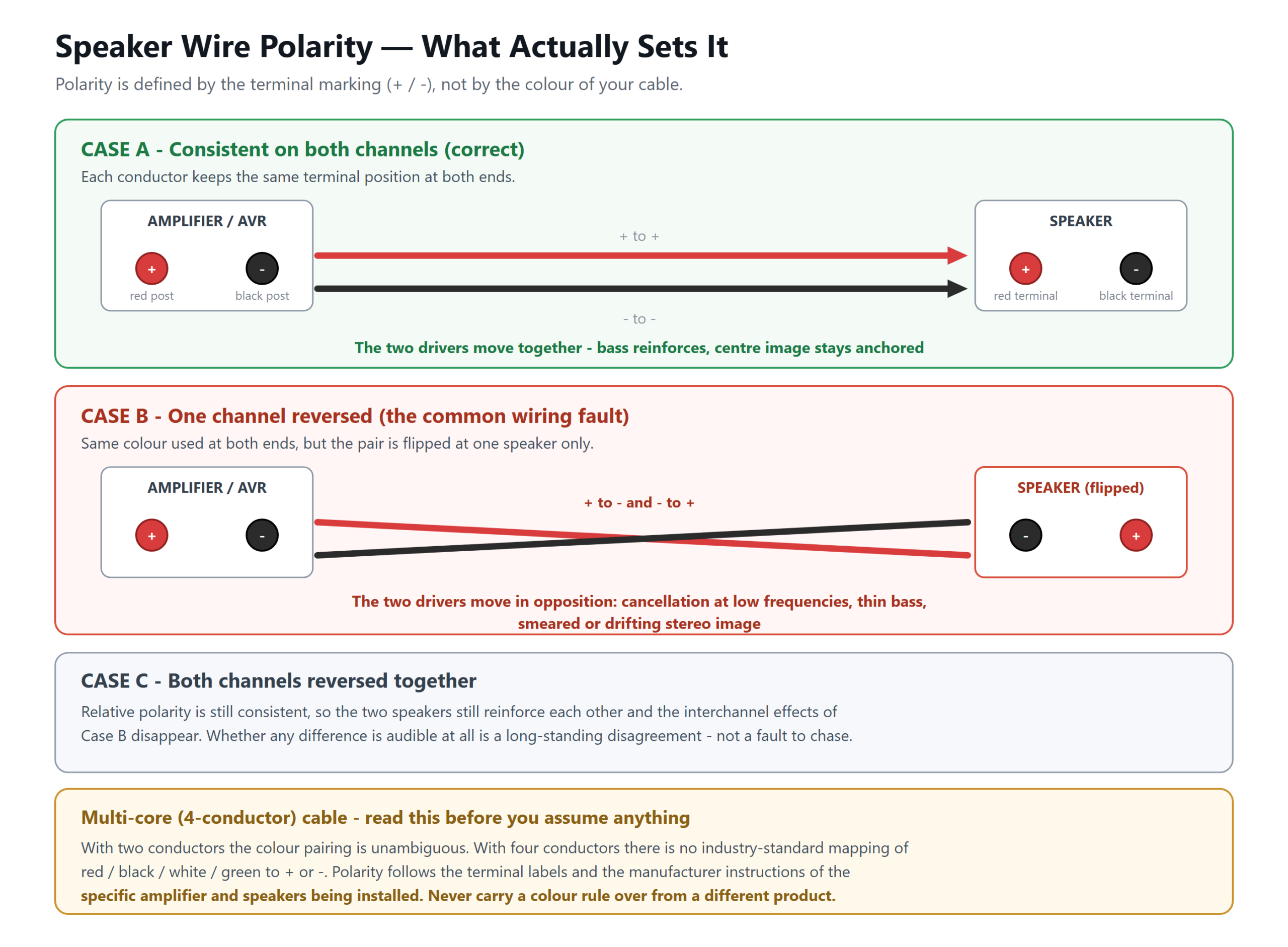
Quick answer: Red and black is a convention, not a guarantee. What matters is that one chosen conductor reaches the same terminal colour at both ends of the run. Mark it, confirm it with a meter, and repeat the pattern on every channel. Swapping the two at one end only puts that speaker out of step with the others, which thins the bass and pulls the image sideways.
A reel of twin lead sits on the table, the jacket is clear, and both conductors look like copper. One has a thin line printed along its side, the other has nothing. Twenty minutes later the cables are behind a cabinet, and nobody remembers which strand went to the red terminal. This is where a five dollar meter saves an afternoon.

What the colours actually promise
Nothing, on their own. Red and black are the convention most people learn first, and many cables follow it with a red stripe along one side. Others use a moulded rib, a printed line, one tinned conductor, or two identical strands with no mark at all. The colour tells you which is which only because someone decided so at the factory.
How the two conductors are marked
The printed stripe
A line, a dashed line or a repeating brand name runs along one side. It is easy to see on the reel and easy to lose once the jacket is stripped, so wrap tape around the cut end before trimming.
The moulded rib
One side of the figure eight has a raised ridge you can feel with a thumbnail behind a cabinet. This is the most durable cue on cheap cable, and it survives a hundred feet of pulling through a cavity.
The continuity check that settles it
Set a meter to continuity or the lowest resistance range, touch one probe to a conductor at the near end and the other probe to a conductor at the far end. A near zero reading means the same wire. A reading that stays open means the other one. Do it once per cable, write the result on a label, and never guess again. A beeping meter makes this quick on a long run where you cannot see both ends.
Why a single swapped end matters
Polarity only means both conductors are swapped the same way at both ends. If one speaker is inverted relative to the other, the cones move in opposite directions for the same signal, and low frequencies partly cancel where the outputs meet. The symptom is a thin centre and bass that appears to come from the corners.
When both ends are swapped
If both conductors are reversed at both ends of one cable, that speaker is still in step with its partner. Absolute phase is not preserved by most playback chains anyway, so the system sounds normal. Consistency between channels is the goal.
The tell tale at the terminals
Amplifier and speaker terminals are usually coded red and black, and the clip does not care which wire it grips. A stray strand bridging both terminals is a different fault: protection trips or a channel distorts instead of cancelling.
| Cue | Where it shows | Confirm with | Cost of ignoring |
|---|
| Red stripe | One side of jacket | Eyes, then meter | Mark lost after stripping |
| Rib | Raised edge | Thumb and finger | Wrong strand at far end |
| Print text | Every few inches | Read at the cut | Text faces away in wall |
| Tinned strand | Silver colour | Continuity test | Mistaken for quality |
Keeping one convention across the install
Pick a rule before the first cable goes in, then repeat it: stripe to red at the amplifier and stripe to red at the speaker, on every channel. Label both ends with the room and channel, and leave a service loop behind each plate. A job where every run follows one rule takes minutes to check.
Practical scenarios
- Bookshelf pair on a shelf: Two short runs, both marked at the plug, so a later move cannot invert one channel.
- Wall plate and in wall run: The stripe is unreadable inside the cavity, so the mark goes on at both ends first.
- Subwoofer and satellites: Each cabinet gets its own labelled pair, because a swap between cabinets is harder to hear.
- Ceiling speakers in a grid: Four identical cabinets need a channel number on every end, or an error hides for months.
FAQ
Is red always positive?
It is the common convention and matches most amplifier markings, but what matters is that your chosen conductor reaches the same colour at both ends.
What happens if one speaker is reversed?
The pair cancels low frequencies where their outputs overlap, the centre image blurs, and the effect gets worse as you sit further away.
Can I find the right strand without a meter?
On a visible run, follow the rib or stripe by hand. Inside a wall, a meter with a continuity beep is the only reliable method.
Next step
Once polarity is consistent, the next decision is how many conductors each cabinet receives. The bi-wiring overview explains the split, the bi-wiring speaker cable page covers the four conductor build, and the 12-4 speaker cable page deals with multi channel runs.
See the matching cables and adapters