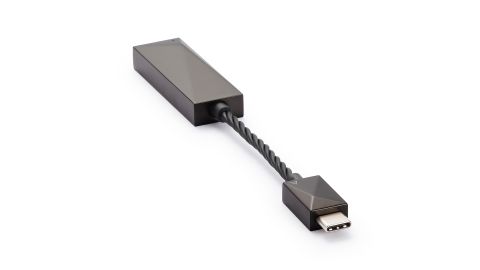
Quick answer: A 3.5 mm jack to speaker cable adapter only moves a signal from one plug shape to another. It does not add power, so it cannot drive a passive speaker, which needs an amplifier to produce sound. Use the jack into a powered speaker, a plate amplifier or a small amp, and run real speaker cable from that amplifier to the cabinet.
The cable arrives with a headphone plug on one end and two bare wires on the other, and the listing promises a quick way to connect a phone to a bookshelf speaker. You strip the ends, land them on the terminals, press play, and get a faint scratchy whisper. Nothing is broken; the adapter was never an amplifier.

What a headphone jack can deliver
A headphone output is built for headphones: small drivers close to the ear, needing a fraction of a watt. Its amplifier stage is sized for that job, with a few volts of swing and a limited current budget. A passive speaker asks for watts into a load of a few ohms, which is a different order of current.
Level is not the same as power
Voltage can look reasonable while current collapses. A phone may produce a volt or two into an easy load, but into 8 ohms that same stage cannot supply the current, so the output clips or folds back. The result is quiet distortion, not loud music.
Impedance in plain terms
Low impedance draws more current for the same voltage. Headphones sit in the tens of ohms, speakers near 4 to 8 ohms, and the amplifier has to be built for the lower figure. A speaker on a headphone stage asks for several times the current it can give.
The adapter does not add an amplifier
An adapter is copper, insulation and two plug shells. It changes the connector, not the circuit. Some versions include a resistor network to protect the source, which lowers the level further instead of raising it. If the box does not contain a power input, it cannot amplify anything.
Setups that actually work
The reliable pattern is always the same: the jack feeds an amplifier, and the amplifier feeds the speakers with proper cable. The amplifier can be inside the cabinet, inside a small desktop box, or inside a receiver. Once it is in the chain, the gauge question becomes normal again.
Powered speakers and plate amplifiers
A powered monitor takes the jack directly, because its own amplifier sits behind the driver. A plate amplifier fitted into a passive cabinet does the same job, turning it into a powered box with a line input. Both accept a normal aux cable, not bare wires.
A small amplifier between jack and speaker
A compact class D amplifier with a 3.5 mm input and speaker terminals is the cheapest correct path. Feed it from the phone or laptop, then run two conductor cable to each cabinet. Set the phone volume near maximum and control level at the amplifier to keep noise low.
| Setup | Cable needed | Result | Fix if it fails |
|---|
| Phone to passive bookshelf | Jack to bare wire | Faint, distorted | Add an amplifier |
| Laptop to powered monitor | Aux to aux | Works as intended | Check input switch |
| Phone to class D amp | Aux plus speaker wire | Full level, clean | Raise source volume |
| Phone to receiver aux | Aux to RCA | Works, amp inside | Select the right input |
Symptoms and what they mean
A whisper with distortion is a power shortfall. A hum that appears only when the charger is connected is a ground loop through the charging path. Hiss with nothing playing is gain staging, usually source volume too low and amplifier gain too high.
Wiring the adapter without damage
On a three pole plug the tip and first ring are left and right, and the sleeve is ground. Join the channels only if you accept mono, and never bridge a headphone stage. Land the bare ends on an amplifier input.
Choosing between the two adapters
A jack to bare wire lead is useful when the far end is a screw terminal block on a small amplifier, where no plug exists at all. A jack to jack cable is the right part for a powered speaker or a receiver aux input. Buy the one that matches the destination port, not the one that looks more flexible.
Practical scenarios
- Dorm desk: a phone into a small amp into two compact speakers is the least expensive working rig.
- Kitchen ceiling pair: use a plate amplifier in one cabinet and feed it from a tablet on the counter.
- Garage workshop: a phone plus an amp avoids running a long line back to the house receiver.
- Old stereo revival: a receiver with an aux input does the amplification, so only a plain aux cable is needed.
FAQ
Can I connect a phone straight to a passive speaker?
The cable will fit with an adapter, but the phone cannot supply the current. You will hear a very quiet, distorted signal and risk overheating the output stage.
Will this damage my phone?
A direct connection to a low impedance load asks too much current and can stress the amplifier inside the phone. Use a proper amplifier between them.
Which cable do I actually need?
An aux cable for any line input, or a jack to bare wire lead only when the far end is an amplifier input block, not a speaker terminal.
Next step
Start with the 3.5 mm cable basics, then read how a jack to speaker wire lead should be used, and finish with the aux cable comparison for line level gear.
See the matching cables and adapters