Quick answer: A bi wire set sends two conductor pairs from one amplifier channel to a cabinet with split terminals, and the metal jumpers between those terminal pairs must be removed or the two runs simply join at the cabinet. The measurable change is extra copper in the circuit, which lowers loop resistance a little. It is not a separate amp per driver, and it cannot add detail that the recording lacks.
You buy a used pair of speakers and find four terminals on the back instead of two, plus a pair of brass plates screwed across them. The manual mentions bi wiring, the cable seller offers a set with four conductors, and nobody explains what the plates are for. Start there, because those plates decide whether the second pair does anything at all.

What a bi wire set connects
A cabinet built for bi wiring splits its crossover into two sections, one for the low frequency driver and one for the high frequency driver, each with its own terminal pair. A bi wire cable is simply two pairs in one jacket, or two separate runs, that feed those two sections from the same amplifier channel.
Two pairs, one output
At the amplifier end both pairs land on the same positive and negative posts. Electrically they are in parallel, so the amplifier sees one load, not two. The split happens at the cabinet, not at the amp, unless you own two amplifier channels per speaker.
Why the jumpers have to come off
The brass plates connect the two sections so a single pair of cables can feed the whole cabinet. Leave them in place while bi wiring and the two runs meet again at the terminals, which turns the exercise into doubled copper. That is not harmful, but it is not what the cable set was sold as.
The measurable part is copper
Two parallel runs have roughly half the loop resistance of one, and for a low impedance load that is a real if modest reduction in the voltage lost before the driver. The effect shrinks as the run gets shorter and the load gets higher in impedance. Nothing here separates frequencies, and nothing here bypasses the crossover.
Claims worth ignoring
Descriptions that talk about bass and treble travelling in separate conductors treat a single wire pair as if it were a pair of lanes. Current in a loop is the same at every point in that loop. If a seller cannot describe a mechanism in circuit terms, the price premium has no basis.
Bi wiring against bi amping
Bi amping uses two amplifier channels per cabinet, with the crossover split so each channel drives one section. That is a different circuit with a different load per channel, and it requires either an active crossover or a cabinet designed for it. Bi wiring keeps one channel and changes only the wiring.
| Configuration | Pairs per cabinet | Jumpers | Copper in circuit | What changes |
|---|
| Single run | One | Fitted | Baseline | Nothing, it is the default |
| Bi wire, plates left on | Two | Fitted | Doubled | Lower resistance only |
| Bi wire, plates removed | Two | Removed | Split by section | Each section fed directly |
| Bi amp | Two channels | Removed | Separate per channel | Load per channel halves |
Choosing the set
Count the terminals on the cabinet first, then decide how the cable should reach them. Four conductor cable in one jacket keeps the run tidy; two separate runs give more freedom at the amplifier end. Gauge is still set by length and load, not by the number of conductors.
Four conductor gauge arithmetic
A four conductor cable labeled 14/4 contains four 14 AWG conductors, not one heavy one. When two are paralleled per polarity the effective copper is close to 11 AWG. Read the label that way and the marketing numbers stop being confusing.
Installing without a mistake
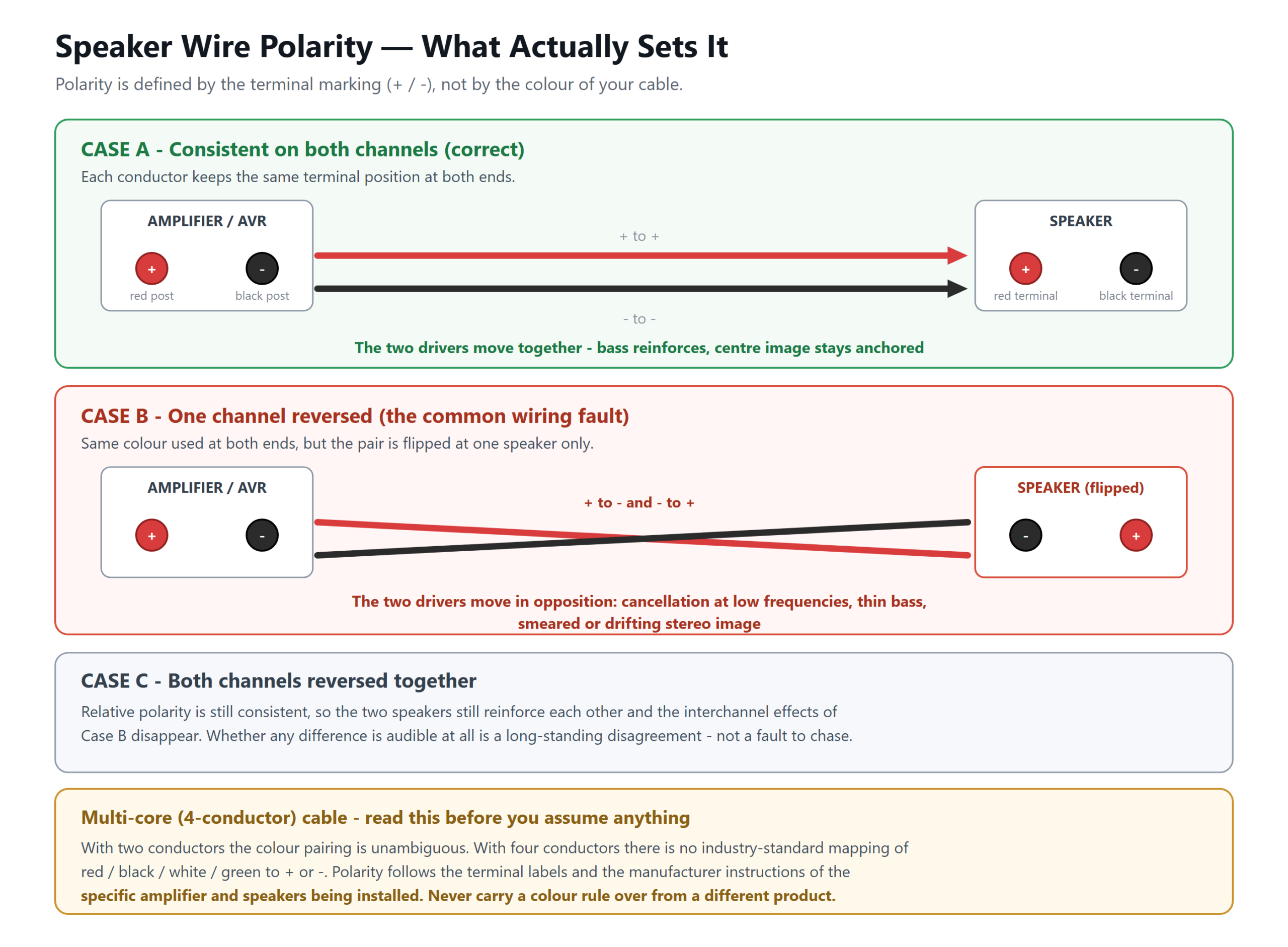
Label both ends before you pull anything, keep positive and negative consistent at every terminal, and confirm which pair feeds which section. If low frequencies sound thin after the change, suspect a polarity error at one end rather than a fault in the cable.
Practical scenarios
- Used floorstanders: four terminals and no manual, so test with a meter to find which pair reaches which driver section.
- Single run already installed: keep the plates and skip the second pair unless the run is long and the load low.
- Two amplifiers on hand: bi amping is the real upgrade, but only with a crossover that splits the bands before the amps.
- Wall plate in the way: a four conductor cable suits one plate with four posts, while two separate runs need two plates.
FAQ
Do I have to remove the jumpers to bi wire?
Yes, if you want the two sections fed separately. With the plates fitted, both cable pairs meet at the terminals and behave as one larger conductor.
Does bi wiring need a special amplifier?
No. It uses the same single channel. Bi amping is the arrangement that needs two channels and a proper crossover split.
Will four conductors fit my terminals?
Check the post diameter and the cable outer diameter. Many cabinets accept one 14/4 jacket, but a thick jacket plus spade lugs can crowd a small recessed panel.
Next step
Match the set to your terminals with the four conductor 12 gauge option, compare the lighter 16/4 wiring for short runs, and check the single pair reference if your cabinet has only two posts.
See the matching cables and adapters