
Cat8 RJ45 Connectors: Field Termination
Quick answer / TL;DR: Short answer: terminate Cat8 with shielded RJ45 plugs rated for the category – not generic Cat5e bodies. Observe the AWG limit (typically 22-24 AWG solid), keep pair untwisting to a minimum, bond the cable's shield to the plug shell, and test the finished assembly: continuity, shield bond and a channel test at the category.
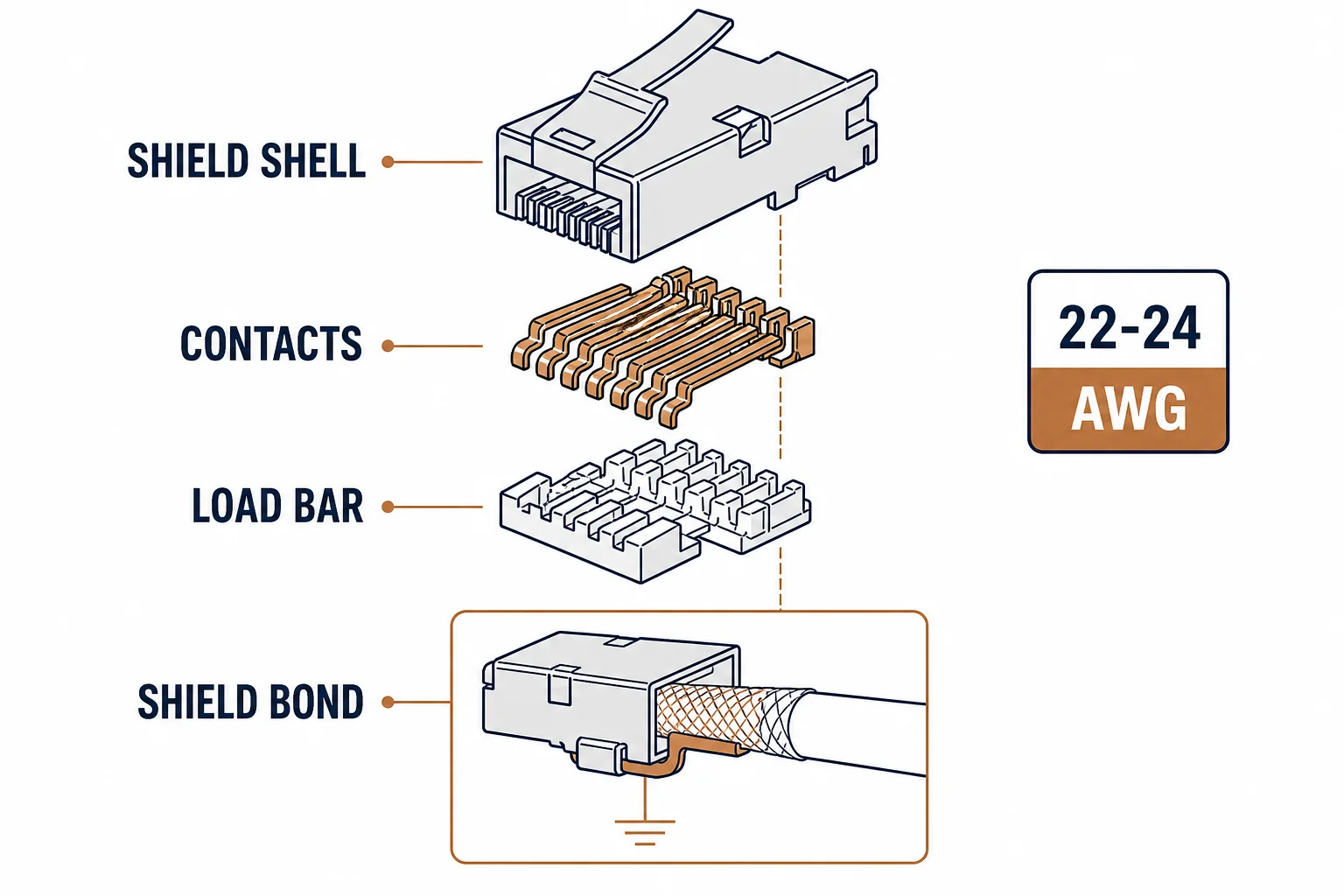
A Cat8 RJ45 connector is a shielded assembly: shell, contacts and load bar, designed to bond the cable's screen and hold pair geometry at 2 GHz. Terminating it with the habits learned on unshielded Cat5e is how a Cat8 channel tests at Cat6.
This is the termination guide: the parts, the conductor limits, the bond, and the tests that prove the assembly.
The Assembly
| The part | The function |
|---|---|
| Shield shell | Bonds the cable screen and shields the contacts |
| Contacts | Eight positions, rated for the band |
| Load bar | Holds pair geometry and reduces untwisting |
The load bar is the part generic plugs lack, and it is the reason field termination can hold a 2 GHz geometry at all.
The Conductor Limits
- AWG: most Cat8 plugs accept 22-24 AWG solid – thinner or stranded cable may not crimp reliably
- Solid only for permanent runs; Cat8 patch cords are factory-made
- Untwist: keep the pair twist to the minimum the load bar allows
- Bend radius: the plug's strain relief has a limit, and Cat8 cable is stiff
The limits are physical: the plug is machined for a narrow cable range, and the geometry depends on the pairs arriving in the right order.
The Shield Bond
| The bond | The method |
|---|---|
| Foil to shell | The plug's shield contact must touch the foil or drain |
| Continuity | Test from shell to shell after crimping |
| Grounding | The bonded shield continues to the panel at the far end |
Standards and Verification
| The reference | The relevance |
|---|---|
| TIA-568.2-D | Cat8 channel and component requirements |
| IEC 60603-7 | The RJ45 interface |
| Field test | Channel test at the installed category |
Per-SKU plug dimensions are not provided in the knowledge base. The rules are standard; follow the specific connector's termination instructions and test the result.
Real-World Applications
The rack build
Cat8 patch runs terminated in-house: shielded plugs with load bars, every assembly continuity-tested – the channel passing at the category.
The Cat5e plug substitution
Cat8 cable fitted with generic plugs: the shield floating, the channel testing at Cat6. The plugs replaced – the category recovered.
The AWG mismatch
A plug rated for 23 AWG on 26 AWG cable: the crimp holding mechanically but failing the continuity test. The correct plug ordered – the batch re-terminated.
Related reading: The distance the category allows? Read the Cat8 deployment guide — blogs/news/cat8-deployment-limits
Related reading: The shielding system it joins? Read the shielded system supply guide — blogs/news/shielded-system-supply
Frequently Asked Questions
Can I terminate Cat8 with standard RJ45 plugs?
Only shielded plugs rated for the category. Generic Cat5e bodies leave the shield unbonded and limit the channel.
What cable size do Cat8 plugs accept?
Typically 22-24 AWG solid. Outside that range the crimp is unreliable – check the plug's specification.
Do Cat8 patch cords need to be factory-made?
In practice yes – field termination is used for permanent runs, while cords are assembled and tested by the supplier.
How do I test a Cat8 assembly?
Continuity and pinout, shield bond shell to shell, then a channel test at the installed category.
Sourcing cables for a project, a store, or a private-label line? Contact our B2B sales team for specifications, certification evidence, and volume terms – FOB and CIF options available. Request a quote or sample.