
Industrial Ethernet Cable: Four Decisions
Quick answer / TL;DR: Short answer: specify industrial ethernet cable on four lines – jacket resistance (oil, coolant, UV), flex class (static, occasional, continuous), shielding (foil or braid for drive-heavy cells), and connector (RJ45 with a rugged housing, or M12/M8 for machine mounting). Then test the assembly, not just the cable: continuity, shield bond and a channel test.
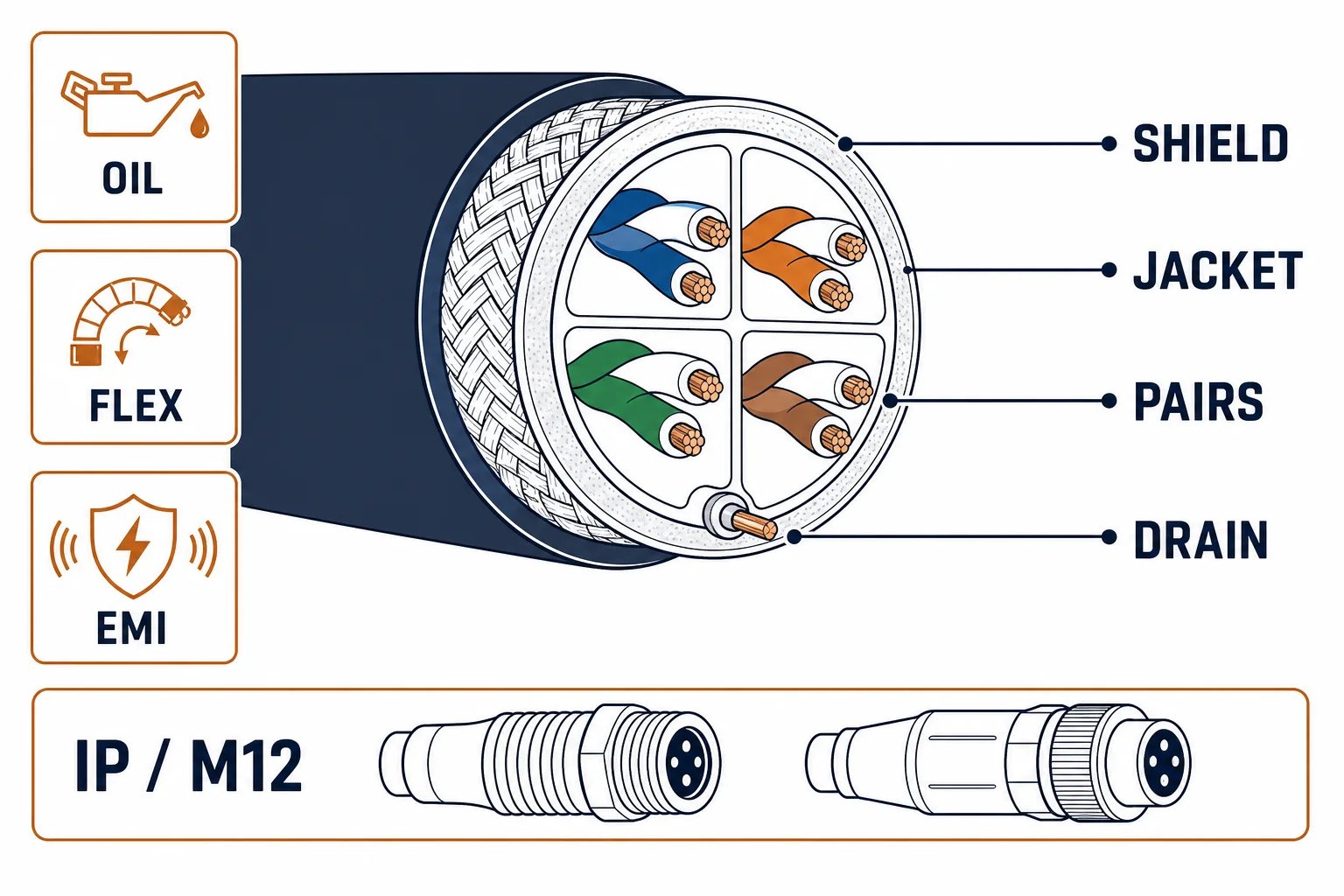
Industrial ethernet cable is not an office cable in a tougher jacket: the environment changes four specification decisions at once – what the jacket resists, whether the cable moves, what interference surrounds it, and which connector the machine expects. Buying by category alone leaves three of the four unaddressed.
This is the industrial guide: the four decisions, the failure each prevents, and the assembly tests that prove the result.
The Four Decisions
| The decision | The options | The failure it prevents |
|---|---|---|
| Jacket | PVC, PUR, TPE | Swelling or cracking in oil |
| Flex | Static, occasional, continuous | Conductor break in a moving axis |
| Shield | Foil, braid, both | Drive noise corrupting the link |
| Connector | Rugged RJ45, M12, M8 | Water and vibration at the plug |
The decisions map onto the failures rather than the datasheet, which is how an industrial cable is specified: start from what kills the link, then choose the construction.
Flex Is the One Buyers Miss
- Static: fixed tray runs – ordinary construction suffices
- Occasional: cable chain moves a few times a day – a flex-rated jacket and stranded conductor
- Continuous: constant travel – a drag-chain rated cable with a defined bend life
- The tell: a broken conductor inside an intact jacket, found only by a continuity test
Flex failure is invisible from outside, which is why the flex class belongs in the order line rather than in the installer's judgement.
The Assembly Tests
| The test | What it proves |
|---|---|
| Continuity and pinout | The assembly is wired as drawn |
| Shield bond | The screen reaches the connector shell |
| Channel test | The link meets its category |
| Flex test | Where continuous flex is claimed |
Standards and Verification
| The reference | The relevance |
|---|---|
| IEC 61156 | Cable construction and test |
| TIA-568.2-D | Channel requirements |
| IEC 61076 | M12 and circular connector standards |
| IP rating (IEC 60529) | Ingress protection at the connector |
Per-SKU flex life and oil resistance are not provided in the knowledge base. The decision structure is standard; request the specific resistance and flex data with the sample.
Real-World Applications
The packaging line
Cable in a moving axis beside servo drives: drag-chain rated, braided shield, M12 at the machine – three decisions made for three failure modes.
The wash-down area
A food-cell link washed daily: PUR jacket and IP67 M12 connectors – the assembly surviving what the office SKU would not.
Related reading: The shield that has to be bonded? Read the FTP primer — blogs/news/what-is-ftp-cat6
Related reading: The connector side of the assembly? Read the Cat8 RJ45 guide — blogs/news/cat8-rj45-connector
Frequently Asked Questions
What makes ethernet cable industrial?
Jacket resistance, flex rating, shielding and connector format – the four decisions the environment forces.
Do I need shielded industrial cable?
In drive-heavy cells, usually yes. The shield must be bonded at the connector to work.
RJ45 or M12 for machines?
M12 where vibration, wash-down or misalignment is a risk; ruggedized RJ45 where standard patching is preferred.
Why does industrial cable fail inside an intact jacket?
Flex fatigue – the conductor work-hardens and breaks. A drag-chain rated cable and a defined bend radius prevent it.
Sourcing cables for a project, a store, or a private-label line? Contact our B2B sales team for specifications, certification evidence, and volume terms – FOB and CIF options available. Request a quote or sample.