
Long Ethernet Cable: The 100-Metre Wall
Quick answer / TL;DR: Short answer: twisted-pair ethernet is limited to a 100 m channel (about 90 m permanent link plus cords), and no category changes that. Beyond it, use fiber, a copper extender, or an intermediate switch. Buying a longer cable does not extend the standard – it produces a link that may negotiate lower, drop packets, or fail outright.
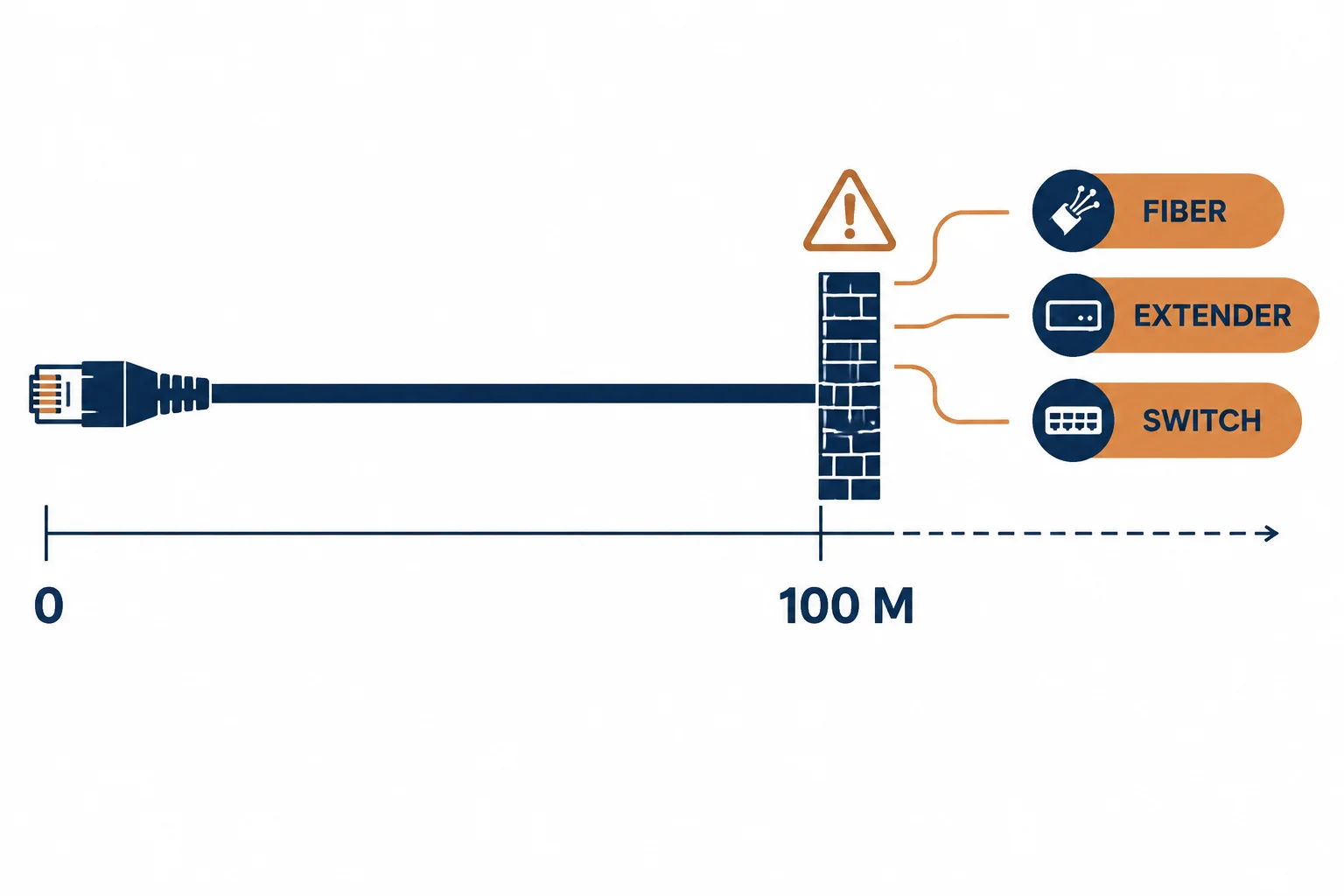
Long ethernet cable requests usually begin with a distance and end with a disappointment: 100 metres is the channel limit for twisted-pair ethernet, and no category removes it. The useful question is not which cable is longest but which method fits the distance.
This is the distance guide: what the limit is, why it exists, and the three ways installations legitimately pass it.
The Limit and Why It Exists
| The element | The figure | The note |
|---|---|---|
| Channel | 100 m | The standard's end-to-end limit |
| Permanent link | About 90 m | Leaving 10 m for cords |
| Beyond the limit | Not rated | Behaviour is undefined, not merely slower |
The limit exists because signal attenuation and delay spread accumulate with length; the standard fixes the point where a compliant channel still works for every supported rate.
The Three Ways Past It
- Fiber: immune to distance within reason, and the standard answer for inter-building runs
- Copper extender: a powered device that re-drives the signal over a long pair
- Intermediate switch: splitting the run into two compliant channels with power in the middle
Each option has a cost structure: fiber needs media conversion at both ends, extenders need power, intermediate switches need a location and power.
The Comparison
| The method | The distance | The trade-off |
|---|---|---|
| Fiber | Kilometers | Electronics at both ends |
| Extender | A few hundred metres | Powered midpoint, adds latency |
| Intermediate switch | As far as power allows | A cabinet or enclosure to maintain |
Standards and Verification
| The reference | The relevance |
|---|---|
| TIA-568.2-D | The 100 m channel definition |
| IEEE 802.3 | The ethernet variants and their media |
| ITU-T G.652 | Single-mode fiber for long links |
Per-SKU extender ratings are not provided in the knowledge base. The 100 m limit is standard; size the method to the actual distance with margin.
Real-World Applications
The outbuilding
A workshop 140 metres from the house: fiber between the buildings – the distance beyond copper, the link at full rate.
The camera at the gate
A camera 160 metres away on copper: an extender at the midpoint – the powered device housed in a weatherproof box.
The long cable that failed
A 130-metre cable sold as 'long range': the link negotiating at 100 Mbps and dropping under load. Replaced by an intermediate switch – the standard respected.
Related reading: The upgrade tier that changes bandwidth? Read Cat5e versus Cat6a — blogs/news/cat5e-vs-cat6a
Related reading: The joints that cost margin? Read couplers and junction boxes — blogs/news/ethernet-coupler-junction-box
Frequently Asked Questions
What is the longest ethernet cable?
A 100 m channel for twisted pair – about 90 m permanent link plus cords. No category extends it.
Can I use a longer cable and accept lower speed?
Not reliably – beyond the limit the link behaviour is undefined, which includes dropping packets, not just running slower.
What is the best way to run ethernet 200 metres?
Fiber, or an intermediate switch; a copper extender works for shorter overruns. Each needs power or electronics at the far end.
Does Cat6a extend the distance?
No – it raises bandwidth, not distance. The 100 m channel limit applies to all twisted-pair categories.
Sourcing cables for a project, a store, or a private-label line? Contact our B2B sales team for specifications, certification evidence, and volume terms – FOB and CIF options available. Request a quote or sample.