
Cat6 Patch Panel: 24 or 48 Port
Quick answer / TL;DR: Short answer: choose 48-port panels for dense racks where rack units are scarce and a skilled installer does the termination; choose 24-port panels where access is tight, moves are frequent, or the rack is half-full. Both occupy 1U. Specify Cat6-rated jacks, a rear cable manager, and a labeling scheme before ordering.
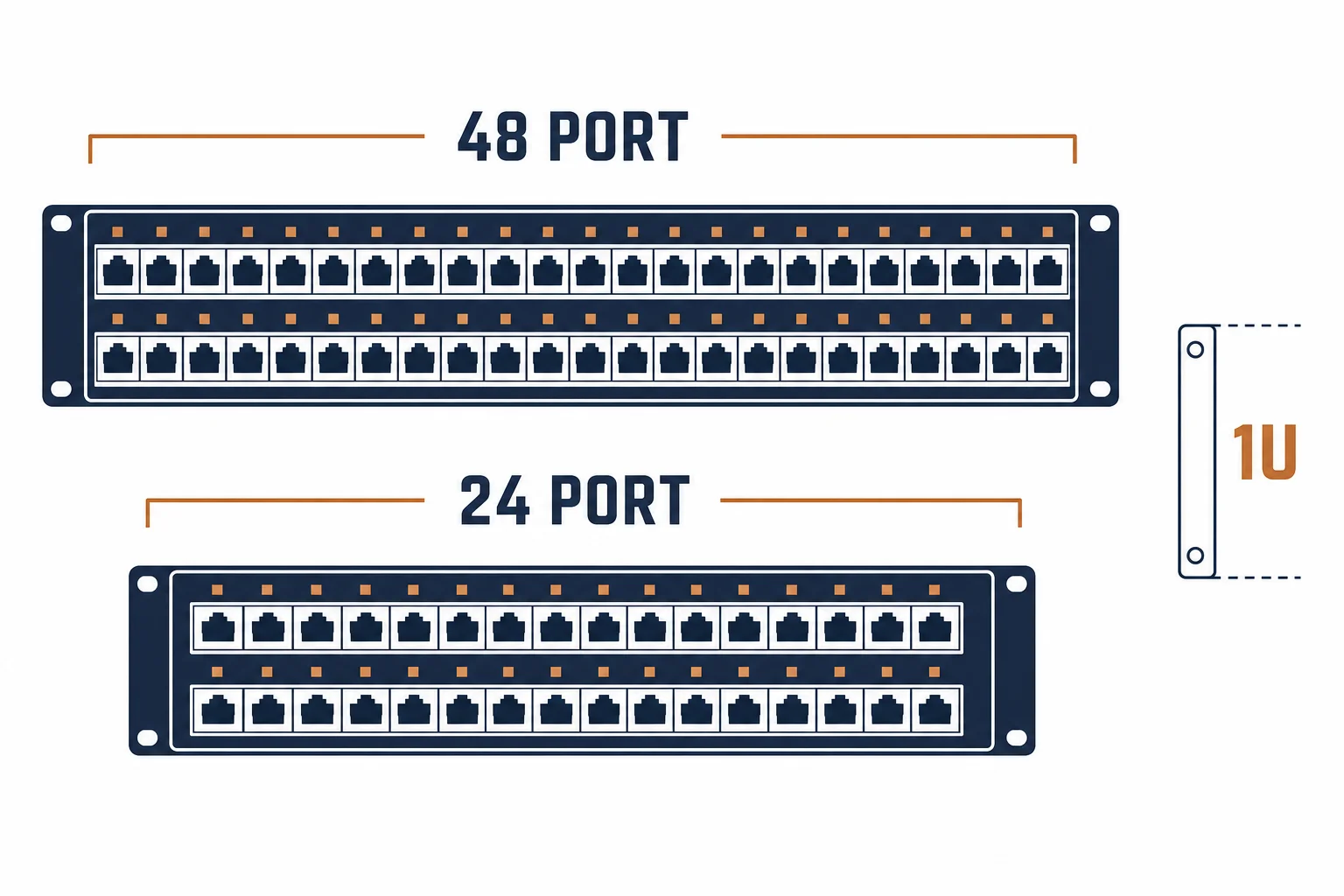
A 48-port Cat6 patch panel puts twice the ports in the same rack unit as a 24-port panel – and twice the terminations behind one faceplate. The density decision is really a decision about who terminates it, how it is labeled, and whether the rack has room to move.
This is the panel guide: the density math, the termination workload, and the specification lines that separate a good panel from a frustrating one.
The Density Math
| The panel | The ports per U | The best fit |
|---|---|---|
| 24-port | 24 in 1U | Shallow racks, frequent changes |
| 48-port | 48 in 1U | Dense racks, fixed patching |
The math is rack units against change frequency: density saves space and costs access.
The Hidden Cost: Termination
- 48 ports is 48 punch-downs, 48 label decisions, and 48 chances for a split pair
- Rear cable management matters more at 48 – the bundle behind the panel is twice the size
- Labeling: a scheme designed before termination, not after
- Testing: every port tested, not sampled
The density premium is paid in labor, not in the panel's price. A 48-port panel installed badly is worse than two 24-port panels installed well.
The Specification Lines
| The line | The check |
|---|---|
| Category | Cat6-rated jacks, matched to the cable |
| Termination | 110-style or tool-less – which does the installer prefer? |
| Cable manager | Included or separate? |
| Labeling | Numbered ports and a writable area |
| Grounding | Bonding point if the cable is shielded |
Standards and Verification
| The reference | The relevance |
|---|---|
| TIA-568.2-D | Administration and connecting hardware |
| IEC 60603-7 | The jack interface |
| Field test | Permanent link test after termination |
Per-SKU panel construction is not provided in the knowledge base. The density trade-off is standard; confirm jack category and cable management with the datasheet.
Real-World Applications
The dense cabinet
A 42U rack with 200 drops: six 48-port panels – the density fitting the rack, the rear managers ordered with them.
The branch office
An office with 60 drops and monthly moves: three 24-port panels – access over density, the patching simple.
The unlabeled panel
A 48-port panel terminated without a labeling scheme: a single port fault taking an hour to find. The next panel labeled before termination.
Related reading: The cable that lands on the panel? Read the Cat6 types guide — blogs/news/cat6-cable-types
Related reading: The conductor form for permanent runs? Read solid versus stranded — blogs/news/solid-vs-stranded-cat6
Frequently Asked Questions
Should I buy a 24 or 48 port patch panel?
48-port for density in fixed, professionally terminated racks; 24-port where access and frequent changes matter more than space.
Do both fit in 1U?
Yes – both are typically 1U; the difference is ports per unit and the termination workload behind them.
What category panel do I need?
One rated for the cable's category – a Cat6 panel with Cat6 cable, and shielded jacks if the cable is shielded.
Do I need a rear cable manager?
At 48 ports, effectively yes: the bundle behind the panel needs support and strain relief.
Sourcing cables for a project, a store, or a private-label line? Contact our B2B sales team for specifications, certification evidence, and volume terms – FOB and CIF options available. Request a quote or sample.