
Solid vs Stranded Cat6: The Purchase Decision
Quick answer / TL;DR: Short answer: buy solid Cat6 for permanent horizontal and backbone runs (lower loss, better for punch-down termination) and stranded Cat6 for patch cords (flexible, survives repeated plugging). Solid cable flexed repeatedly cracks at the connector; stranded cable terminated in punch-down blocks is unreliable. The order must state which.
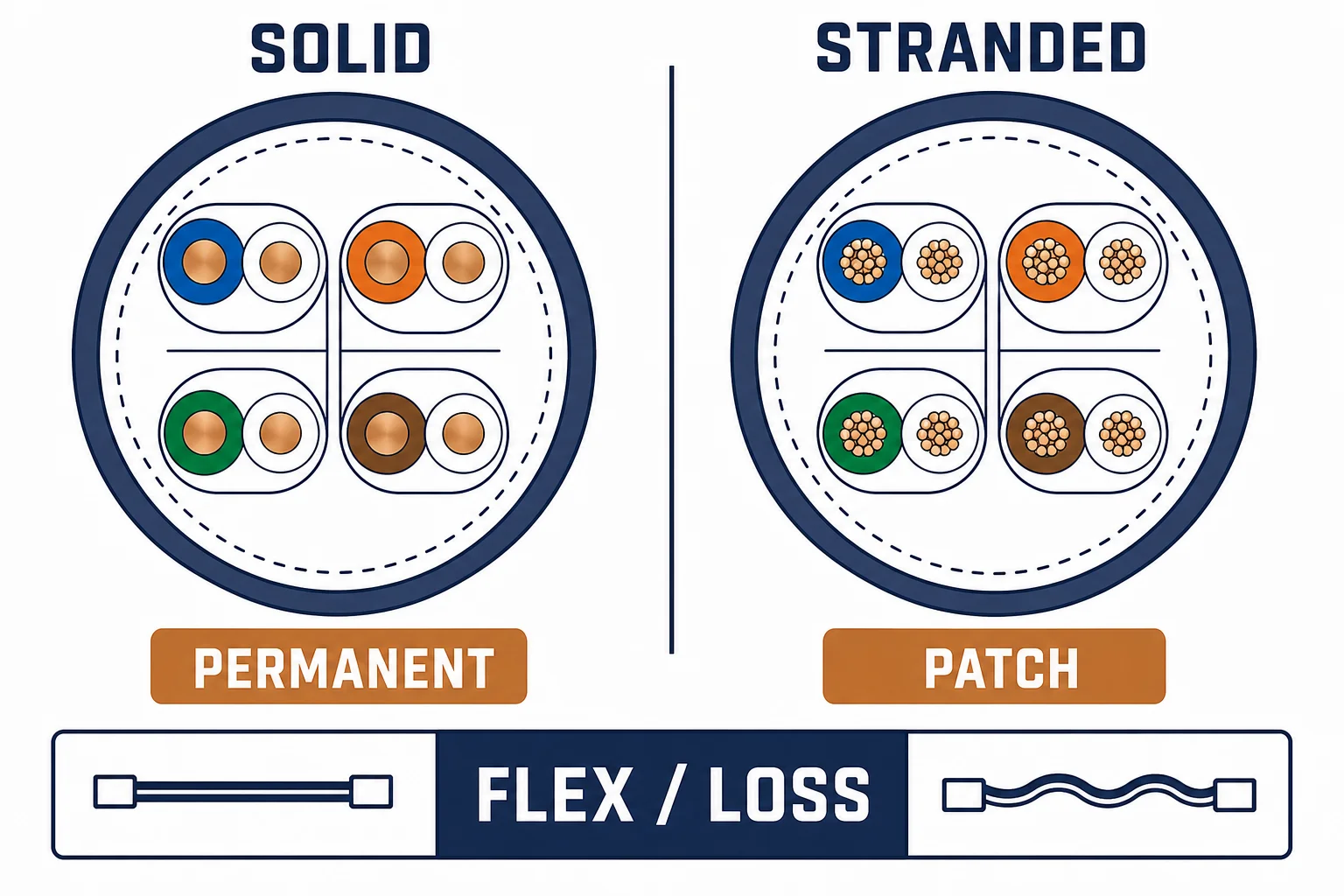
Solid and stranded Cat6 look identical on the shelf and behave differently in service: solid conductor for permanent runs, stranded for cords that flex. Buying the wrong form is not a performance failure at installation – it is a failure six months later, at the connector.
This is the conductor guide: what each form does, the termination rules, and the order line that prevents the mismatch.
The Two Forms
| The form | The construction | The best use |
|---|---|---|
| Solid | One copper core per conductor | Permanent runs, punch-down termination |
| Stranded | Many thin strands per conductor | Patch cords, cabinet jumpers |
The table is the whole decision in two rows: the form follows the termination type and the movement the cable will see.
The Failure Modes
- Solid in a patch cord: the core work-hardens and cracks at the plug after repeated flexing
- Stranded in a punch-down block: strands escape the slot, the contact degrades
- Wrong gauge with the wrong plug: the connector's strain relief does not grip
- Mixing forms in one channel: allowed, but each end must suit its termination
The failure modes appear late, which is why the mistake survives inspection and fails in service.
The Order Lines
| The need | The line |
|---|---|
| Horizontal cabling | Cat6 solid, 23 AWG, 305 m box |
| Patch cords | Cat6 stranded, 24-26 AWG, moulded plugs |
| Backbone | Cat6 solid, CMR/CMP as the route requires |
| Cabinet jumpers | Stranded, short lengths |
Standards and Verification
| The reference | The relevance |
|---|---|
| TIA-568.2-D | Cable and cord requirements |
| IEC 61156 | Conductor construction definitions |
| Field test | Channel test with the cords in place |
Per-SKU strand counts are not provided in the knowledge base. The form rules are standard; confirm the construction on the datasheet for both cable and cords.
Real-World Applications
The structured cabling job
Solid Cat6 to every outlet, punch-down panels at the rack: the form matched to the termination at both ends.
The bench batch
Stranded Cat6 cords cut and crimped in bulk: the flexible conductor surviving the plug – the cords lasting through moves.
The cord that failed
A solid-conductor cord used at a laptop that moves daily: continuity failing within months. The cord replaced with stranded – the cause understood.
Related reading: The product line these forms belong to? Read the UTP cable guide — blogs/news/utp-cable-line
Related reading: The SKU taxonomy explained? Read the Cat6 types guide — blogs/news/cat6-cable-types
Frequently Asked Questions
Should I use solid or stranded Cat6?
Solid for permanent runs and punch-down termination; stranded for patch cords and anything that flexes.
Can I make patch cords from solid cable?
It works initially but the conductor cracks at the plug under repeated flexing. Use stranded for cords.
Is stranded cable lower performance?
Slightly higher loss for the same gauge, which is why it is used in short cords rather than long runs.
Does the category change the rule?
No – solid and stranded versions exist across categories; the rule follows the application, not the category.
Sourcing cables for a project, a store, or a private-label line? Contact our B2B sales team for specifications, certification evidence, and volume terms – FOB and CIF options available. Request a quote or sample.