
Optical Splitter: One Output, Two Receivers
Quick answer / TL;DR: Short answer: a passive optical splitter divides the light and loses about half the power at each output, which may work over short cables and fail over long ones. An active splitter regenerates the signal and is the safer choice for two destinations. If the two destinations are never used at once, a passive switch is cheaper and avoids attenuation.
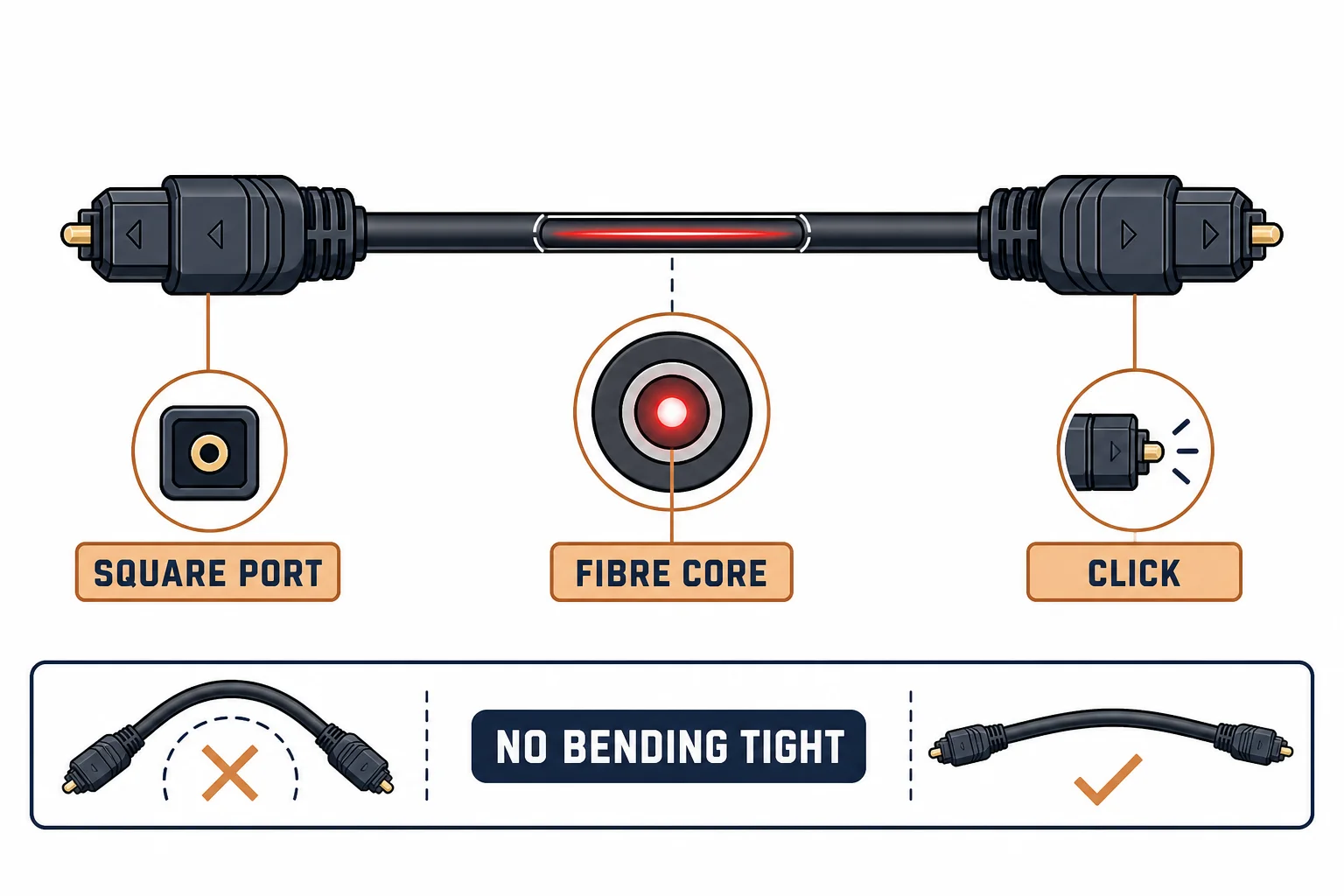
An optical splitter takes one TOSLINK output and feeds two destinations. Passive versions split the light, which halves the power at each output; active versions regenerate the signal, which costs a power supply and preserves level.
This is the splitter guide: what each type does, the attenuation that decides reliability, and the cases where a switch is better than a split.
Passive Against Active
| The type | The mechanism | The trade-off |
|---|---|---|
| Passive | Splits the light | About 3 dB loss per output |
| Active | Regenerates the signal | Needs power |
| Switch | Selects one output | No loss, one at a time |
The loss is the deciding factor: 3 dB is half the optical power, and it compounds with cable length.
Where Each Fits
- Passive: short cables, undemanding receivers
- Active: long runs or receivers with marginal sensitivity
- Switch: one destination at a time
- Never: chaining splitters
Chaining splitters is the mistake that produces a signal too weak to lock, with no obvious cause.
Standards and Verification
| The reference | The relevance |
|---|---|
| IEC 60958 | S/PDIF |
| TOSLINK | Connector conventions |
| Field test | Audio lock at both outputs |
Per-SKU loss figures are not provided in the knowledge base. The splitting principle is standard; test both outputs at the far end of the real cables.
Practical Notes
An optical switch is often the better purchase: most installations have one listener at a time, and a switch carries no loss. The splitter is for genuinely simultaneous use.
Real-World Applications
The two-room feed
One television output feeding an amplifier and a wireless headphone base: an active splitter used – both receivers locked, no dropouts.
The chained splitters
Two passive splitters chained to reach three destinations: the third would not lock. An active distributor used – the attenuation had compounded.
Related reading: Mini TOSLINK adapters — blogs/news/mini-toslink-cable
Related reading: Combined HDMI and optical splitting — blogs/news/hdmi-optical-splitter
Frequently Asked Questions
Do optical splitters reduce quality?
Passive ones reduce optical power; active ones regenerate the signal.
Can I chain splitters?
No – the loss compounds and the signal may not lock.
Splitter or switch?
A switch if only one destination is used at a time.
Does the splitter need power?
Active types do; passive types do not.
Sourcing cables for a project, a store, or a private-label line? Contact our B2B sales team for specifications, certification evidence, and volume terms – FOB and CIF options available. Request a quote or sample.