
Coaxial vs Optical: Same Signal, Two Media
Quick answer / TL;DR: Short answer: coaxial is more robust and easier to handle; optical is immune to electrical interference and ground loops. Choose optical where hum is a problem or the run is near power, coaxial where the cable must survive handling or the run is long. Both carry the same formats and neither is inherently better sounding.
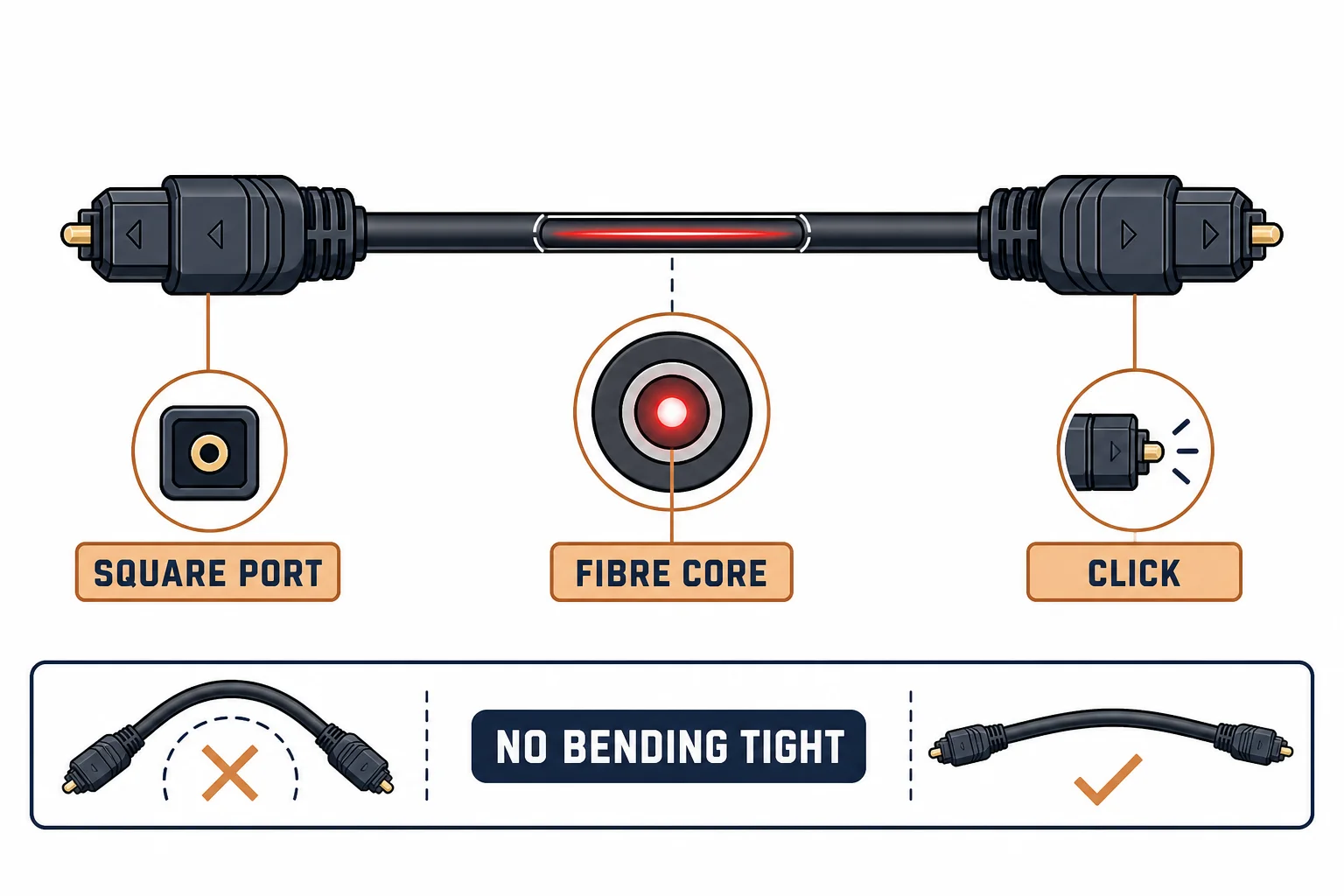
Coaxial and optical both carry S/PDIF digital audio, and in most domestic systems they sound identical. The choice comes down to four practical factors: interference immunity, cable handling, length, and what the equipment offers.
This is the comparison guide: the factors that matter, the ones that do not, and the cases where the answer is obvious.
The Four Factors
| The factor | Coaxial | Optical |
|---|---|---|
| Interference | Susceptible | Immune |
| Handling | Robust | Fragile |
| Length | Longer runs possible | Loss rises with length |
| Ground loops | Possible | Eliminated |
The table is the whole decision: each row favours one medium in a specific situation.
What Does Not Matter
- The formats carried: identical
- The jitter claims: implementation-dependent, not medium-dependent
- The cost: broadly similar
- The connector quality: matters for both
The differences that sell cables are mostly not the differences that affect sound.
Standards and Verification
| The reference | The relevance |
|---|---|
| IEC 60958 | S/PDIF over both media |
| IEC 61169 | Coaxial connectors |
| Field test | Audio lock and absence of dropouts |
Per-device output options are not provided in the knowledge base. The standards are identical for both media; choose by environment rather than by specification.
Practical Notes
If a system hums on coaxial and stops humming on optical, the problem was a ground loop – the optical cable did not improve the audio, it removed an electrical path. That is a diagnosis, not an upgrade.
Real-World Applications
The noisy installation
A television, an amplifier and a dimmer on the same circuit: optical used, hum eliminated – the isolation doing the work.
The long run
A 10 m digital run along a wall: coaxial used for its greater tolerance of length and handling – optical would have needed a gentler route.
Related reading: TOSLINK in practice — blogs/news/toslink-audio-cable
Related reading: The S/PDIF interface — blogs/news/spdif-cable
Frequently Asked Questions
Is optical better than coaxial?
Neither is inherently better; optical is immune to interference, coaxial is more robust.
Do they carry the same formats?
Yes – both carry S/PDIF.
Which for a long run?
Coaxial generally tolerates length better; optical prefers shorter, gentler routes.
Why does optical remove hum?
It breaks the electrical connection, eliminating ground loops.
Sourcing cables for a project, a store, or a private-label line? Contact our B2B sales team for specifications, certification evidence, and volume terms – FOB and CIF options available. Request a quote or sample.