
14 Gauge Speaker Wire: The Middle Ground
Quick answer / TL;DR: Short answer: 14 AWG suits runs of roughly 8-15 m at 8 ohms, and 4-ohm speakers at shorter distances. Oxygen-free copper is a purity claim that matters little at audio frequencies – conductor gauge matters more. It terminates in most banana plugs and binding posts, but not in small spring clips.
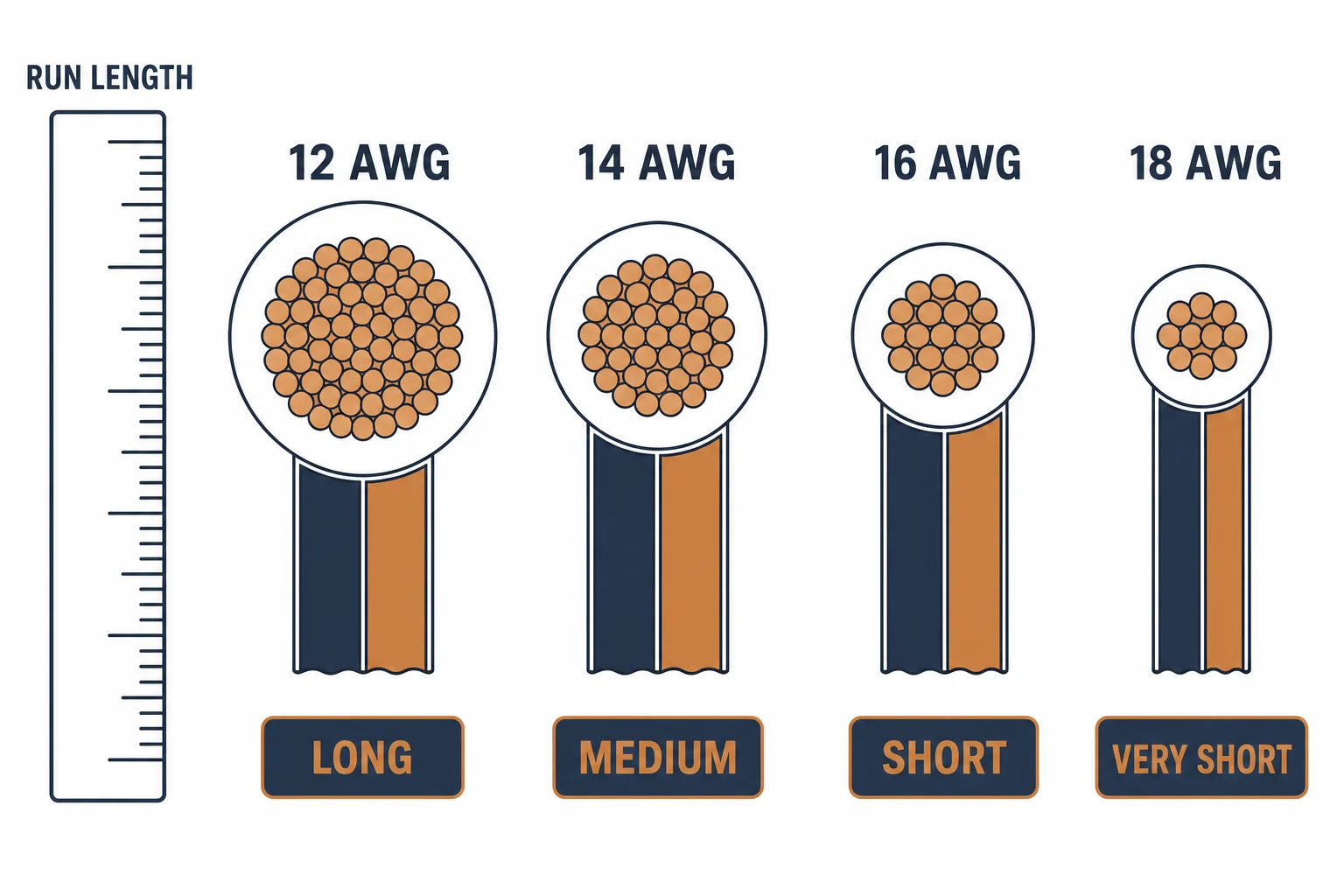
Fourteen gauge speaker wire sits between the domestic default and the long-run conductor: thicker than 16, lighter than 12, and adequate for most rooms. It is the sensible compromise when the run is longer than a few metres but the speakers are conventional.
This is the 14 AWG guide: the run lengths, what oxygen-free copper does and does not change, and the termination it accepts.
The Run Lengths
| The run | The load | The verdict |
|---|---|---|
| Up to 8 m | 8 ohm | 16 AWG suffices |
| 8-15 m | 8 ohm | 14 AWG |
| Any length | 4 ohm | 14 or 12 AWG |
| Over 15 m | 8 ohm | 12 AWG |
The table is the practical version of the resistance arithmetic: gauge follows length and load together.
The Oxygen-Free Question
- OFC reduces oxidation over decades, not over a season
- It does not change resistance meaningfully at audio frequencies
- Gauge and termination matter far more
- Copper-clad aluminium is the material to avoid
The claim is real but minor; the marketing around it is not proportional to the effect.
Standards and Verification
| The reference | The relevance |
|---|---|
| IEC 60268 | Audio interconnection |
| Local code | In-wall cable requirements |
| Continuity test | Per conductor |
Per-SKU stranding is not provided in the knowledge base. The gauge arithmetic is standard; for in-wall routes confirm a rated jacket separately.
Practical Notes
Fourteen gauge is the largest that fits comfortably in most spring clips and compact binding posts. If the terminals are small, the wire is not the upgrade – the terminals are the constraint.
Real-World Applications
The living room
Speakers 10 m from the amplifier: 14 AWG run behind the skirting, terminated in banana plugs – adequate for the load and easy to route.
The small terminal
14 AWG attempted in a compact spring clip: strands trimmed and contact lost. The run re-terminated with a spade lug on a different amplifier input – the terminal had been the limit.
Related reading: The 12 AWG long-run case — blogs/news/12-gauge-speaker-wire
Related reading: Terminal compatibility — blogs/news/speaker-terminals
Frequently Asked Questions
What length is 14 gauge good for?
About 8-15 m at 8 ohms; shorter for 4-ohm speakers.
Does oxygen-free copper matter?
Marginally for longevity; gauge matters more.
Will it fit spring clips?
Often not – spring clips usually accept up to 16 AWG.
Can I use it in a wall?
Only with a rated in-wall jacket.
Sourcing cables for a project, a store, or a private-label line? Contact our B2B sales team for specifications, certification evidence, and volume terms – FOB and CIF options available. Request a quote or sample.