
Optical to RCA Converter: The DAC Box
Quick answer / TL;DR: Short answer: the converter contains a DAC and outputs line-level analogue on RCA. It accepts PCM stereo reliably; compressed surround formats may pass only as noise or silence unless the source is set to PCM. Match the source's output setting to PCM stereo, power the box, and expect modest audio quality – the chip is inexpensive by design.
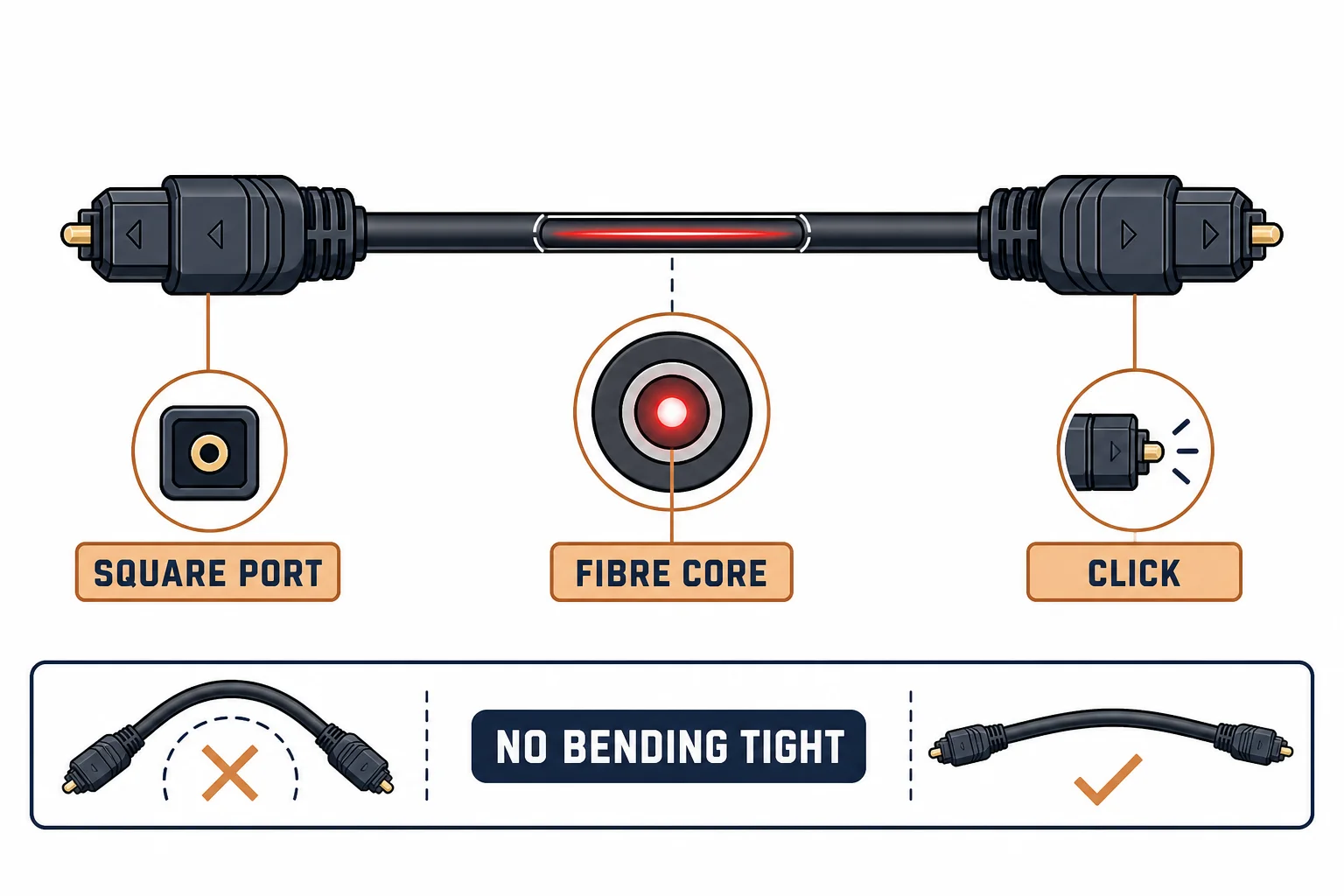
An optical to RCA converter takes a TOSLINK digital signal and produces analogue stereo on RCA sockets: a small box with a DAC inside. It solves the problem of a digital-only source feeding an analogue-only amplifier, and it is limited by the cheapest component in it – the converter chip.
This is the converter guide: what is inside, the formats it accepts, and the settings that cause silence.
What Is Inside
| The stage | The function | The limit |
|---|---|---|
| Optical receiver | Converts light to S/PDIF | Cable quality |
| DAC | Converts to analogue | Chip quality |
| Output | Line level on RCA | Fixed level |
The box is a complete signal chain in miniature, and the DAC defines what it can deliver.
The Format Trap
- PCM stereo: works on every converter
- Dolby Digital or DTS: often silence or noise
- The source must be set to PCM
- Some televisions default to the broadcast format
The trap explains most 'converter not working' reports: the box is fine, the input is a format it cannot decode.
Standards and Verification
| The reference | The relevance |
|---|---|
| IEC 60958 | S/PDIF |
| S/PDIF over TOSLINK | The optical interface |
| Field test | Audio at the analogue output |
Per-SKU DAC performance is not provided in the knowledge base. The format rules are standard; check the source's audio setting first when there is no sound.
Practical Notes
These converters are powered by a small supply, and a failing supply produces dropouts that look like a signal problem. Keep the original adapter labelled with the box.
Real-World Applications
The old amplifier
A modern television with optical output and a 1990s amplifier with RCA inputs: the converter in between, the TV set to PCM – sound restored for the cost of a small box.
The silent converter
The same setup with the television outputting Dolby Digital: silence. The setting changed to PCM – the converter had been waiting for a format it could read.
Related reading: TOSLINK cable basics — blogs/news/toslink-audio-cable
Related reading: The inline-DAC cable — blogs/news/toslink-to-rca-cable
Frequently Asked Questions
What does an optical to RCA converter do?
It converts a TOSLINK digital signal to analogue stereo on RCA.
Why is there no sound?
The source is outputting a surround format instead of PCM.
Does it support surround?
No – it outputs stereo only.
Does it need power?
Yes, from a small supply.
Sourcing cables for a project, a store, or a private-label line? Contact our B2B sales team for specifications, certification evidence, and volume terms – FOB and CIF options available. Request a quote or sample.