
TOSLINK Audio Cable: Light in a Plastic Core
Quick answer / TL;DR: Short answer: TOSLINK carries S/PDIF digital audio over a plastic fibre core with a square connector. It is immune to electrical interference and ground loops, and intolerant of tight bends and crushing. Keep runs moderate, avoid sharp corners, and push the plug until it clicks – an unseated plug is the most common failure.
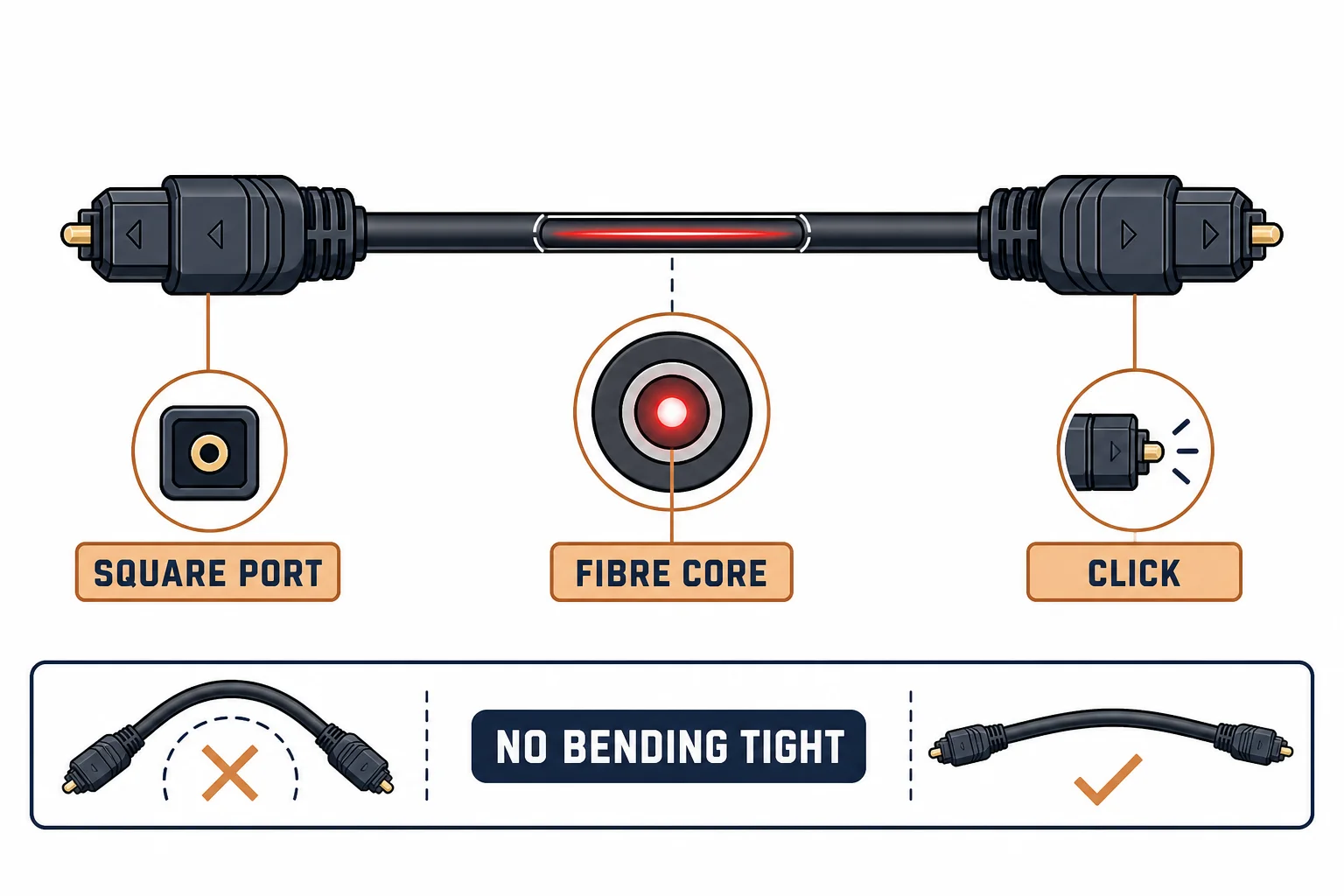
TOSLINK is the optical audio standard: a plastic fibre core, a square connector, and an S/PDIF signal carried as red light. Its advantage is complete electrical isolation; its weakness is mechanical – the fibre tolerates almost no abuse.
This is the TOSLINK guide: the construction, the practical length limits, and the handling rules that keep the light flowing.
The Construction
| The element | The material | The limit |
|---|---|---|
| Core | Plastic fibre | Bend radius |
| Jacket | PVC | Crush resistance |
| Connector | Square TOSLINK | Must seat and click |
There is no copper in the signal path, which is the entire reason the format exists.
Length and Handling
- Practical runs are modest – loss rises with length
- Sharp bends crack the core invisibly
- Cable ties crush the fibre
- A damaged cable can still show red light at the end
The last point matters: a visible light is not proof that the cable carries a signal.
Standards and Verification
| The reference | The relevance |
|---|---|
| IEC 60958 | S/PDIF over optical |
| TOSLINK | The connector convention |
| Field test | Audio lock at the receiver |
Per-SKU fibre type is not provided in the knowledge base. The interface is standard; test with a source rather than relying on the visible glow.
Practical Notes
Keep a spare TOSLINK cable: they are cheap, they fail silently, and diagnosing one without a spare means testing the source, the receiver and the settings before the cable.
Real-World Applications
The ground-loop fix
A television and amplifier humming on copper: TOSLINK removed the electrical path – the hum disappeared with no other change.
The crushed run
A cable tie-wrapped to a shelf upright: the core cracked and audio dropped out intermittently. Re-routed loosely – the tie had been the cause.
Related reading: The mini TOSLINK variant — blogs/news/mini-toslink-cable
Related reading: Coaxial against optical — blogs/news/coax-vs-optical-audio
Frequently Asked Questions
What is a TOSLINK cable?
An optical cable with square connectors carrying S/PDIF digital audio.
Why use optical instead of coaxial?
It removes electrical interference and ground loops.
Can I bend it sharply?
No – a tight bend can crack the core.
Why does it work only sometimes?
Usually an unseated plug or a damaged core.
Sourcing cables for a project, a store, or a private-label line? Contact our B2B sales team for specifications, certification evidence, and volume terms – FOB and CIF options available. Request a quote or sample.