
Composite RCA: One Wire for Video
Quick answer / TL;DR: Short answer: composite RCA uses the yellow plug for video and carries standard-definition signals – typically 480i or 576i – over a 75-ohm cable. The format limits sharpness and produces dot crawl and colour bleed that no cable can remove. Use it where the source only offers it; for anything better, use component, SCART, HDMI or a converter.
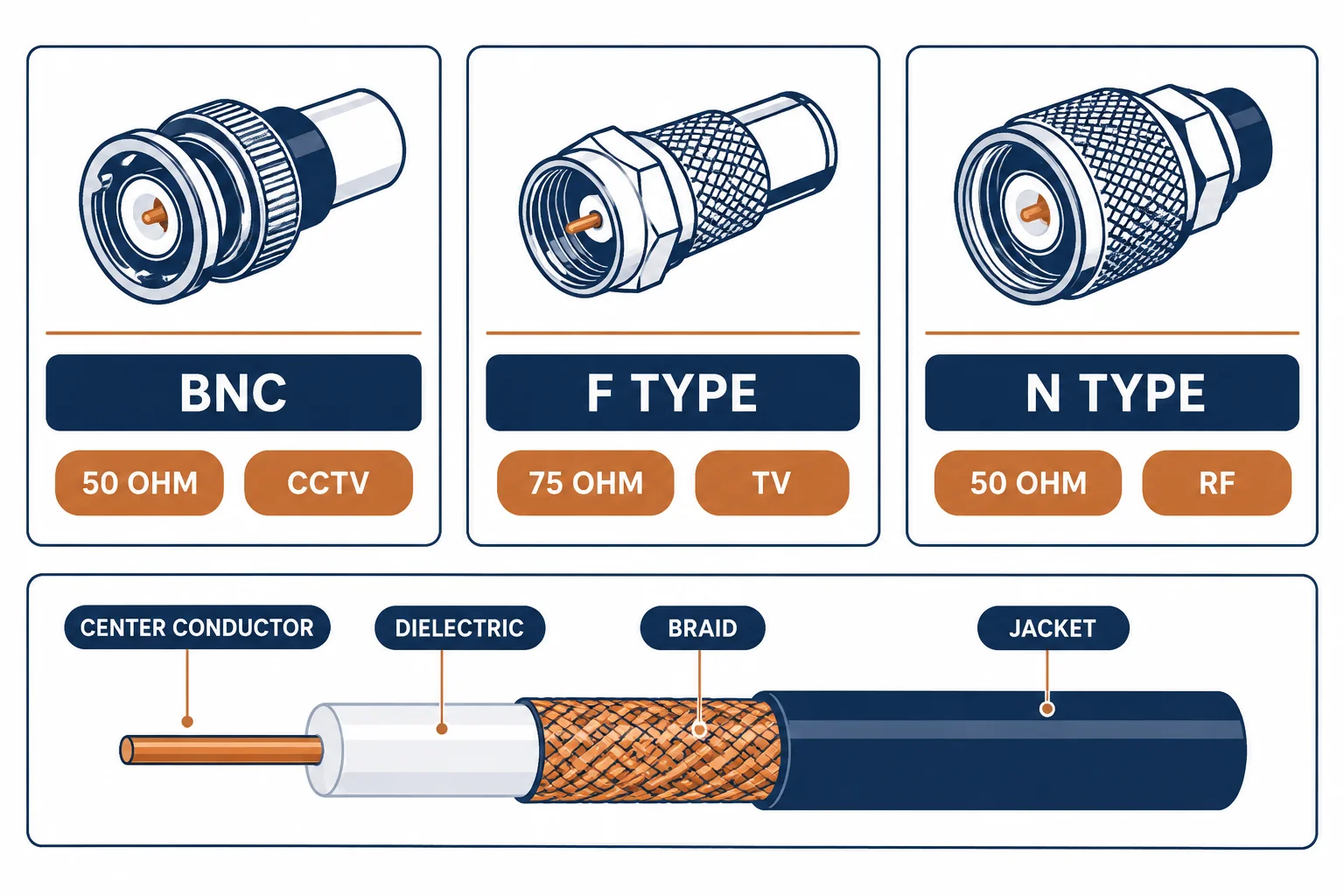
Composite video carries all the picture information on one conductor, with the colour and brightness signals multiplexed together. That is why it is simple, universally supported and fundamentally limited: the separation cannot be undone at the display.
This is the composite guide: what the yellow plug carries, the artefacts inherent to the format, and the devices that still rely on it.
What the Yellow Plug Carries
| The plug | The signal | The limit |
|---|---|---|
| Yellow | Composite video | Standard definition |
| White and red | Audio left and right | Unbalanced |
| Cable | 75-ohm coaxial | Required for video |
The three plugs are usually a set; the video one needs the 75-ohm construction that the audio pair does not.
The Artefacts
- Dot crawl at colour edges
- Colour bleed between adjacent areas
- Reduced horizontal resolution
- Cross-colour on fine patterns
The artefacts are inherent to combining luminance and chrominance, which is why component video separated them.
Standards and Verification
| The reference | The relevance |
|---|---|
| NTSC / PAL | The standard-definition formats |
| IEC 61169 | Coaxial connectors |
| Field test | Picture stability at the display |
Per-device output options are not provided in the knowledge base. The format limits are standard; check whether the source offers component or HDMI before using composite.
Practical Notes
Composite survives on legacy consoles, camcorders and industrial equipment. A converter to HDMI is often the practical answer, but it cannot restore detail the format never carried.
Real-World Applications
The legacy console
A retro console on composite: the artefacts accepted as part of the experience – the cable doing exactly what the format allows.
The converter
An old camcorder on a modern television: a composite-to-HDMI converter used, with the standard-definition softness understood rather than blamed on the adapter.
Related reading: RCA cable construction — blogs/news/rca-cable-guide
Related reading: Coaxial connector families — blogs/news/coaxial-cable-wholesalers
Frequently Asked Questions
What does the yellow RCA carry?
Composite video – standard definition on one conductor.
Can a better cable remove dot crawl?
No – it is inherent to the format.
Is composite the same as component?
No – component separates the signals and supports higher resolution.
What resolution does composite support?
Standard definition, typically 480i or 576i.
Sourcing cables for a project, a store, or a private-label line? Contact our B2B sales team for specifications, certification evidence, and volume terms – FOB and CIF options available. Request a quote or sample.