
Single Mode vs Multimode: The Choice
Quick answer / TL;DR: Short answer: multimode (OM3/OM4/OM5) suits in-building and data-centre links up to a few hundred metres because its optics are cheap. Single mode (OS2) suits long runs, between buildings and anywhere the distance is uncertain, because its optics cost more but its reach is effectively unlimited by comparison.
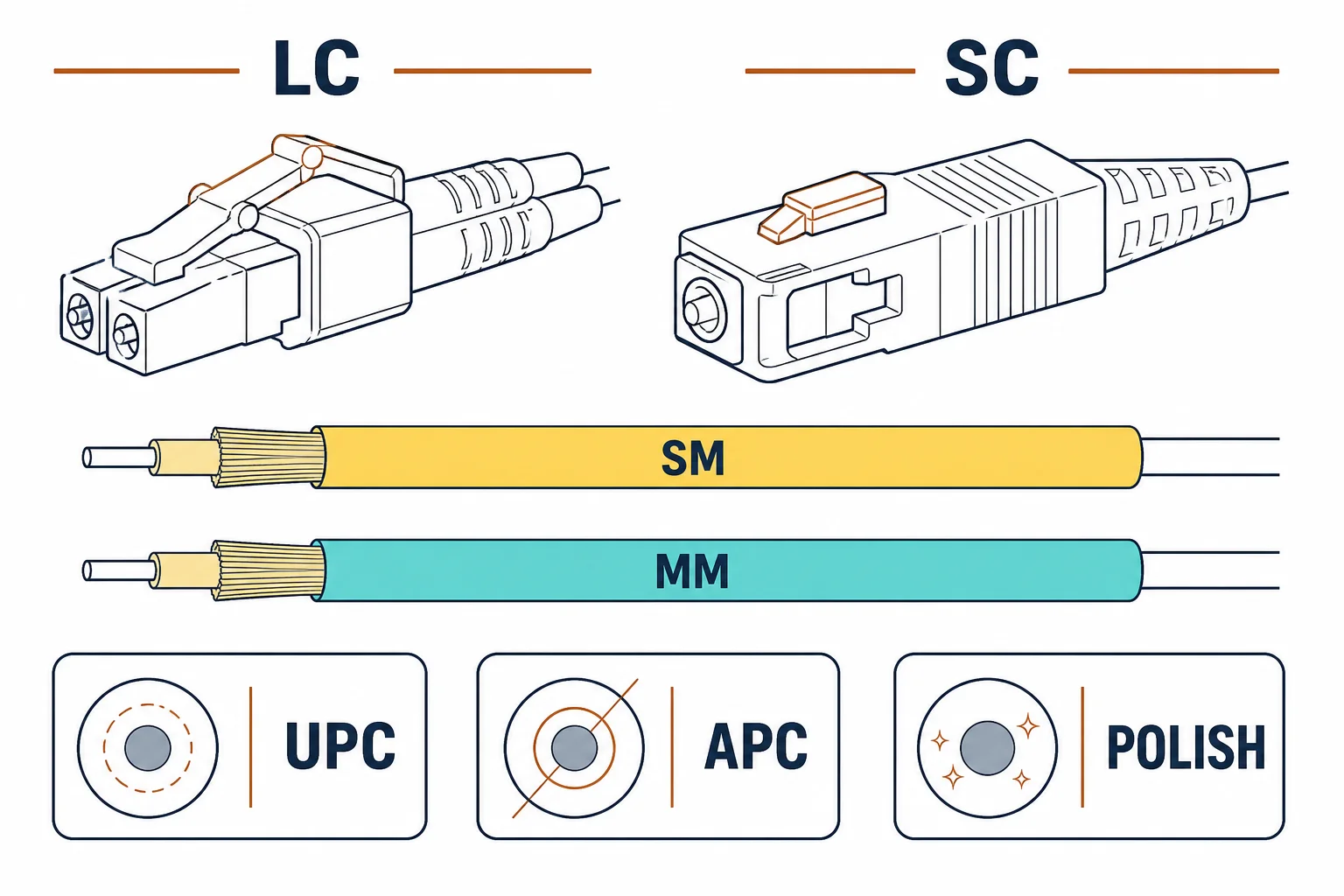
Single mode and multimode fiber differ in core diameter, in the optics they need, and therefore in the distance they serve economically: multimode is cheaper to light and shorter in reach, single mode is the opposite on both counts. The decision is arithmetic, not preference.
This is the comparison: the core and optics difference, the distance where the economics flip, and the installations each suits.
The Core Difference
| The fiber | The core | The light path |
|---|---|---|
| Multimode OM3/OM4 | 50 micron | Several modes |
| Single mode OS2 | 9 micron | One mode |
| Effect | Modal dispersion limits distance | No such limit in practice |
The larger core accepts more light and more paths; the paths arrive at slightly different times, which is what limits multimode distance.
The Optics and the Cost
- Multimode optics: short-wavelength, inexpensive
- Single mode optics: longer-wavelength, more costly
- Cable cost: similar per metre for both
- Termination: similar, but single mode tolerates less contamination
The cost difference lives in the transceivers, which is why the decision depends on how many links and how far.
Where the Economics Flip
| The distance | The usual choice |
|---|---|
| Within a rack | Multimode or copper |
| Within a building | Multimode |
| Between buildings | Single mode |
| Over a kilometre | Single mode |
The flip point is around the few hundred metres typical of multimode at the required rate.
Standards and Verification
| The reference | The relevance |
|---|---|
| ISO/IEC 11801-1 | OM3-OM5 and OS2 |
| ITU-T G.652 | Single-mode characteristics |
| TIA-568.3 | Fiber cabling practice |
| Field test | Loss measurement per link |
Per-SKU reach figures are not provided in the knowledge base. The class definitions are standard; confirm the reach at the actual rate before specifying.
Practical Notes
Choose single mode when the distance might grow, even if multimode would work today: the cable is the cheap part and the transceivers can be changed, while re-pulling fiber between buildings is not.
Real-World Applications
The data hall
Rack-to-rack links under 100 m: multimode OM4 with short-reach optics – the cheapest way to reach 100G across a row.
The campus link
Two buildings 700 m apart: single mode between them – multimode would not reach at the required rate, and the transceiver cost was a fraction of the trench.
The mixed plant
A site with both types: colour-coded cords and labelled panels – a multimode cord in a single-mode link was caught before installation by the labelling.
Related reading: The single-mode cord specification — blogs/news/single-mode-fiber-patch-cable
Related reading: OM3 multimode in practice — blogs/news/om3-lc-fiber-patch
Frequently Asked Questions
Which is faster?
Both carry the same rates; multimode's limit is distance, not speed.
Which is cheaper?
Multimode optics are cheaper; the cable cost is similar.
How far does multimode reach?
A few hundred metres depending on rate and grade.
Can I mix them?
No – the core sizes and optics are incompatible.
Sourcing cables for a project, a store, or a private-label line? Contact our B2B sales team for specifications, certification evidence, and volume terms – FOB and CIF options available. Request a quote or sample.