
12 Gauge Speaker Wire: Long Runs
Quick answer / TL;DR: Short answer: choose 12 AWG for runs over about 15 m, for 4-ohm speakers, or where the amplifier is powerful; 14 or 16 AWG is sufficient for short runs at 8 ohms. The benefit is reduced resistance – measurable, not mystical. Thick wire needs connectors rated for it: many banana plugs and spring terminals will not accept 12 AWG.
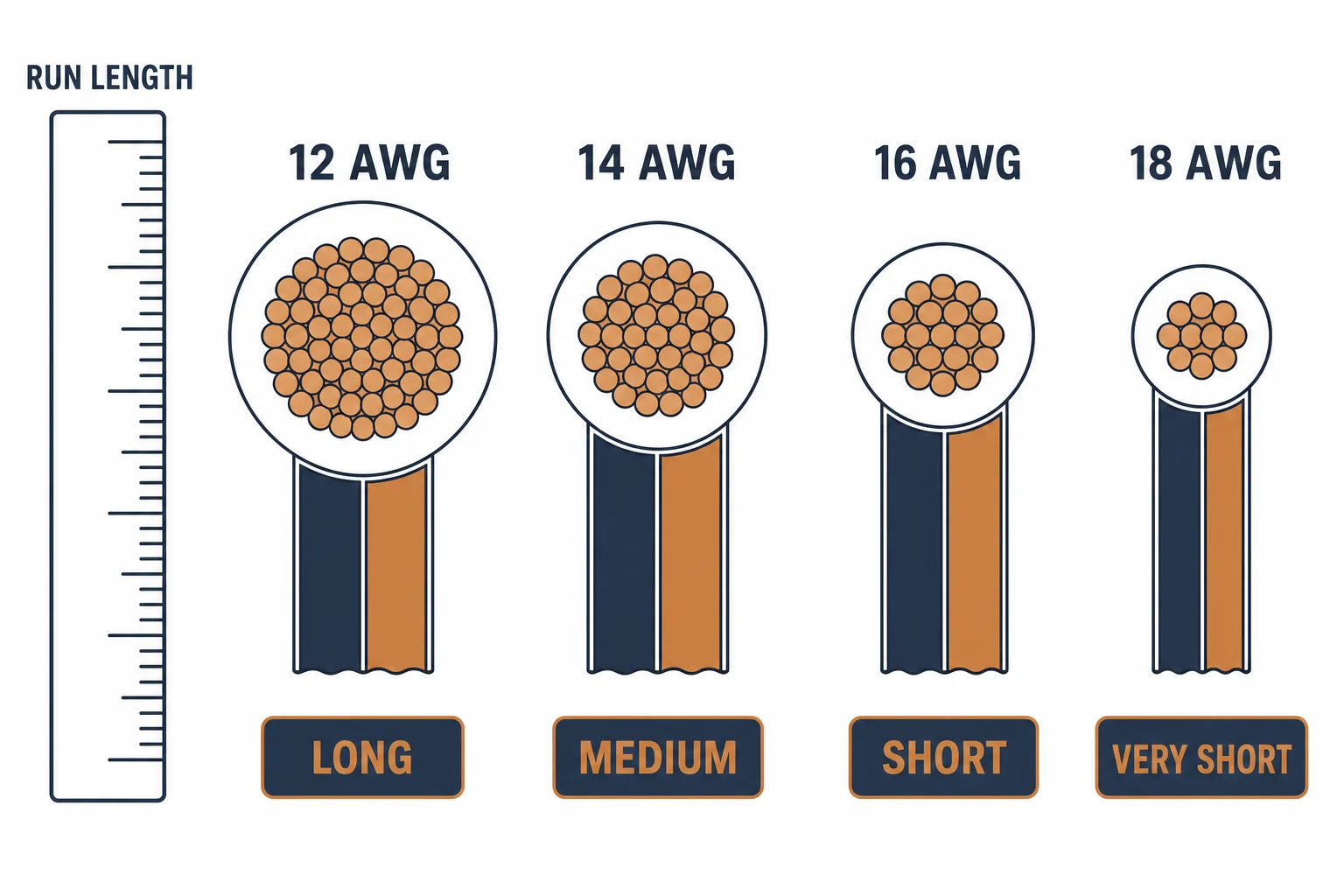
Twelve gauge speaker wire is the heaviest conductor most domestic systems will ever need: lower resistance per metre, less power lost in the cable, and a physical size that makes termination harder. It is bought for long runs and low-impedance speakers, and wasted on short runs.
This is the gauge guide: the resistance arithmetic, the cases where 12 AWG is necessary, and the termination details that make it work.
The Resistance Arithmetic
| The gauge | The resistance | The practical run |
|---|---|---|
| 12 AWG | Lowest | Over 15 m |
| 14 AWG | Low | Up to 15 m |
| 16 AWG | Moderate | Up to 8 m |
| 18 AWG | Highest | Short runs only |
The numbers translate into damping factor and power loss: a thin cable in a long run makes an amplifier work against the cable rather than the speaker.
When 12 AWG Is Necessary
- Runs longer than about 15 m
- 4-ohm speakers, where current is higher
- High-power amplifiers at sustained levels
- In-wall runs where the cable cannot be changed later
The in-wall case is the strongest argument: the cost difference is trivial against opening a wall again.
Termination
| The detail | The practice |
|---|---|
| Plugs | Rated for 12 AWG |
| Binding posts | Check the hole size |
| Bare wire | Twist tightly, no stray strands |
| In-wall | Use a rated jacket, not a flexible cord |
The termination is where heavy wire fails: a plug that accepts 12 AWG mechanically may not clamp it electrically.
Standards and Verification
| The reference | The relevance |
|---|---|
| IEC 60268 | Audio system interconnection |
| Local code | In-wall cable requirements |
| Continuity test | Per conductor, both ends |
Per-SKU conductor counts are not provided in the knowledge base. The gauge arithmetic is standard; confirm the plug's rated range before terminating.
Practical Notes
Two runs of 16 AWG are not equivalent to one of 12: the resistance is per conductor, and parallel conductors are not a substitute for the right gauge. Buy the gauge the run needs rather than combining what is on the shelf.
Real-World Applications
The long living room
Speakers 18 m from the amplifier: 12 AWG in the wall, terminated on rated plugs – the bass control that thin cable had blurred returned.
The 4-ohm load
A pair of 4-ohm speakers on a powerful amplifier: 14 AWG upgraded to 12 for the longer side – the channel imbalance between the two runs disappeared.
The plug that would not fit
12 AWG wire into spring terminals rated for 16: the strands bunched and one channel dropped out. Plugs rated for the gauge used – the termination corrected.
Related reading: The 16 gauge comparison — blogs/news/16-gauge-speaker-wire
Related reading: Splicing and extending runs — blogs/news/splicing-speaker-wire
Frequently Asked Questions
Do I need 12 gauge speaker wire?
For runs over about 15 m, 4-ohm speakers or high power; otherwise 14 or 16 AWG is sufficient.
Does thicker wire sound better?
It reduces loss; whether that is audible depends on the run and the load.
Can I use 12 AWG in banana plugs?
Only plugs rated for it – many accept 16-14 AWG.
Can I parallel two thinner cables?
Not as a substitute for the correct gauge.
Sourcing cables for a project, a store, or a private-label line? Contact our B2B sales team for specifications, certification evidence, and volume terms – FOB and CIF options available. Request a quote or sample.