
Digital Audio to Optical: TOSLINK
Quick answer / TL;DR: Short answer: an optical audio cable uses a plastic fibre core and a square TOSLINK connector, carrying S/PDIF. It is immune to electrical noise but intolerant of tight bends and of being crushed. Keep the run gentle, avoid 90-degree folds, and choose optical over coax where hum or ground loops are a problem.
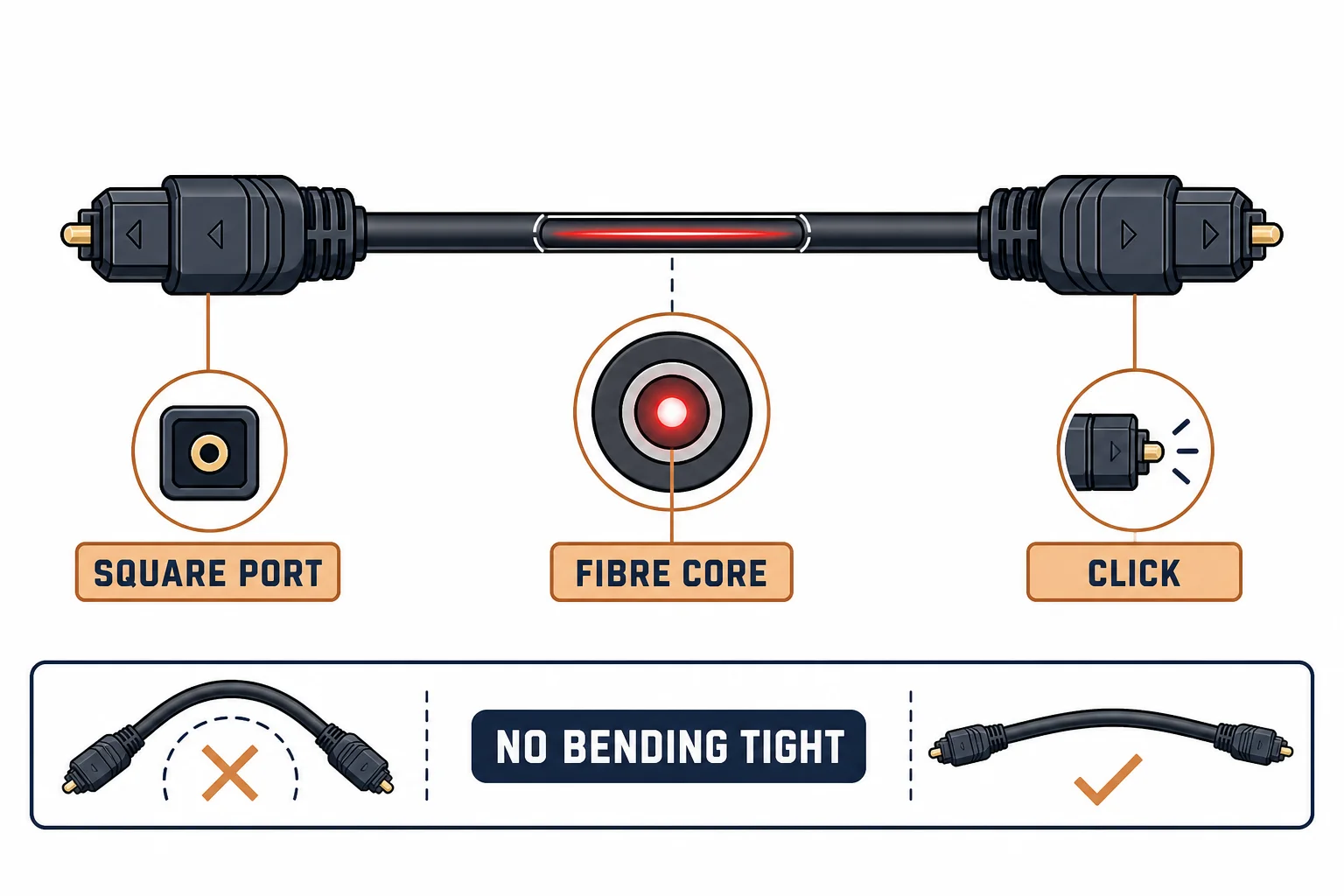
An optical audio cable carries digital audio as light through a plastic fibre core, using the TOSLINK connector – a square plug that clicks into a matching port. It exists because light is immune to electrical interference, which is why it survives runs that hum on copper.
This is the TOSLINK guide: what the cable contains, the bending rules that break it, and the comparison with coaxial digital audio.
What the Cable Contains
| The element | The material | The limit |
|---|---|---|
| Core | Plastic optical fibre | Bend radius |
| Jacket | PVC or similar | Crush resistance |
| Connector | Square TOSLINK | Seat fully, click |
| Signal | Red light, S/PDIF | No electrical contact |
There is no copper in the signal path, which is the entire point: no ground loop, no hum, no antenna effect.
The Bending Rules
- Minimum bend radius is larger than copper equivalents
- A sharp fold can crack the core invisibly
- Cable ties pulled tight crush the fibre
- Coiling for storage should be generous
A damaged optical cable often still shows a red light at the end, which is why a visual check is not a test.
Optical Against Coaxial
| The factor | Optical | Coaxial |
|---|---|---|
| Interference | Immune | Susceptible |
| Ground loops | Eliminated | Possible |
| Bend tolerance | Poor | Good |
| Cost | Similar | Similar |
The choice is environmental: noisy or ground-loop-prone installations favour optical.
Standards and Verification
| The reference | The relevance |
|---|---|
| IEC 60958 | S/PDIF over optical and coaxial |
| TOSLINK | The connector convention |
| Field test | Audio lock at the receiver |
Per-SKU fibre type is not provided in the knowledge base. The interface is standard; test with a known source rather than relying on the visible light.
Practical Notes
Cheap optical cables often fail at the connector rather than the fibre: the plug does not seat fully and the light leaks. Push until it clicks, and if it does not click, the plug or the port is out of tolerance.
Real-World Applications
The ground-loop fix
A TV and an amplifier humming on copper: an optical cable removed the electrical path entirely – the hum disappeared with no other change.
The crushed cable
An optical cable tie-wrapped to a shelf upright: the core cracked and the audio dropped out intermittently. Replaced and routed loosely – the tie had been the fault.
The unclicked plug
A cable that worked only when held: the plug not seated. Pushed until it clicked – the connection had never been made properly.
Related reading: The AV port behind the cable — blogs/news/audio-output-cable
Related reading: HDMI ARC as the alternative — blogs/news/hdmi-arc-cable-buying
Frequently Asked Questions
What is an optical audio cable?
A fibre cable with TOSLINK connectors carrying S/PDIF digital audio as light.
Optical or coaxial digital?
Optical where hum or ground loops are a risk; coaxial is fine otherwise.
Can I bend an optical cable sharply?
No – a tight bend can crack the core and the cable will fail intermittently.
Why does my optical cable work only sometimes?
Usually an unseated plug or a damaged core from bending or crushing.
Sourcing cables for a project, a store, or a private-label line? Contact our B2B sales team for specifications, certification evidence, and volume terms – FOB and CIF options available. Request a quote or sample.