
RCA Cable: One Plug, Several Jobs
Quick answer / TL;DR: Short answer: for line-level audio, a standard RCA cable works up to a few metres. For composite video or digital S/PDIF, specify a 75-ohm coaxial RCA cable – an audio lead may work short and fail long. Match the colour convention (white left, red right, yellow video) and keep unbalanced runs short.
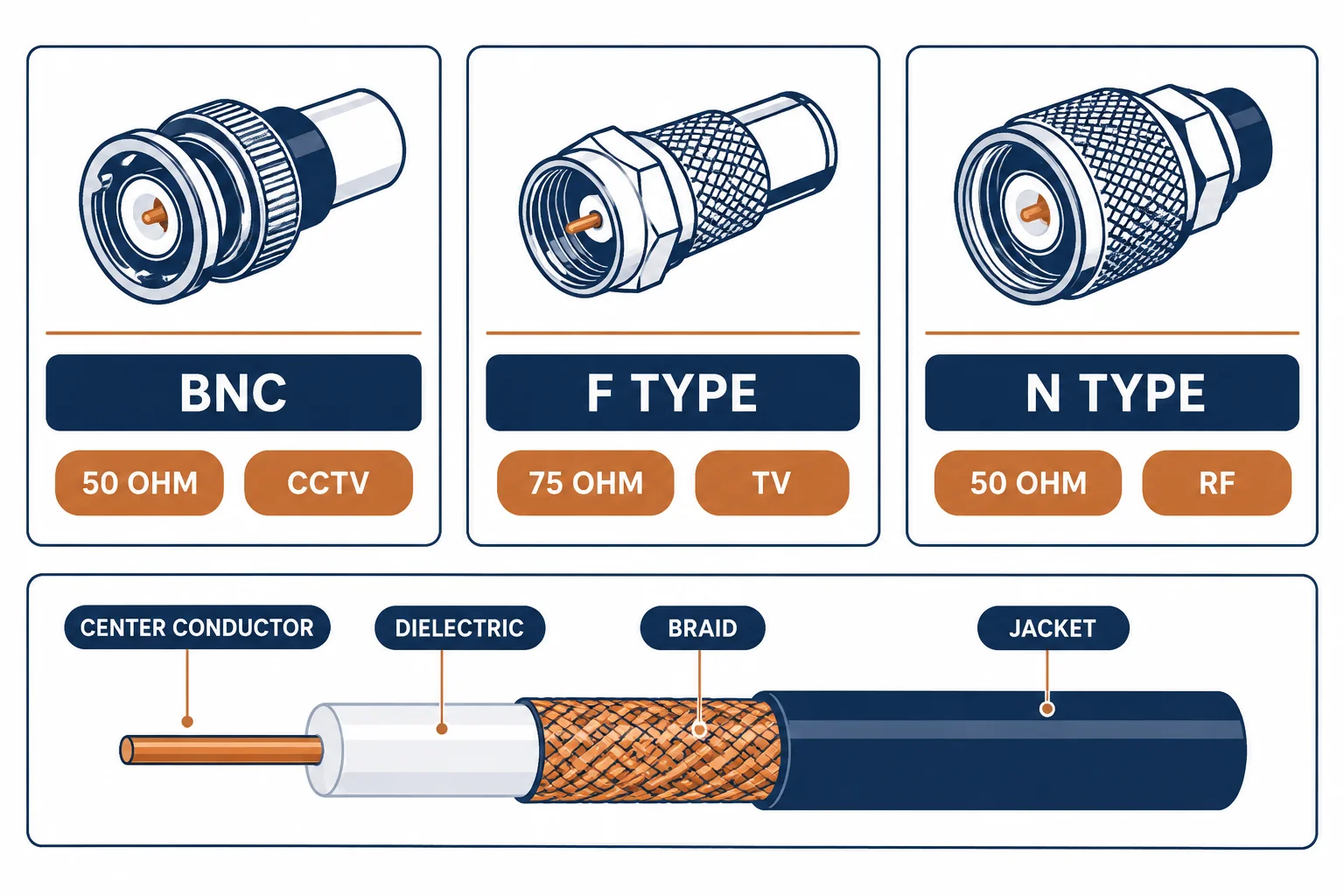
An RCA cable is a single-conductor coaxial lead with a centre pin and an outer ring, used for line-level audio, composite video and digital S/PDIF. The plug is identical across those jobs; the cable behind it is not, and buying the wrong construction is the most common RCA mistake.
This is the category guide: what the plug does, how audio and 75-ohm versions differ, and the length limits that decide performance.
The Plug and Its Jobs
| The use | The signal | The cable |
|---|---|---|
| Line-level audio | Unbalanced analogue | Standard RCA |
| Composite video | Analogue video | 75-ohm RCA |
| S/PDIF | Digital audio | 75-ohm RCA |
| Subwoofer | Low-frequency analogue | RCA, often longer |
The plug is a connector; the cable construction decides whether the signal survives the distance.
Audio Against 75-Ohm
- Audio leads: flexible coaxial, impedance unspecified
- 75-ohm cable: controlled impedance for video and digital
- Substitution at short length hides the difference
- The failure appears as sparkle, dropouts or lost lock
The two constructions are visually similar, which is why substitution is common and usually undetected until a longer run is installed.
Colour Conventions
| The colour | The signal | The note |
|---|---|---|
| White | Left audio | Convention |
| Red | Right audio | Convention |
| Yellow | Composite video | Requires 75-ohm |
| Orange or black | Digital coax | Often used for S/PDIF |
The conventions are inherited from consumer equipment and are not a standard, but they prevent most wiring errors.
Standards and Verification
| The reference | The relevance |
|---|---|
| IEC 60958 | S/PDIF digital audio |
| IEC 60268 | Audio interconnection practice |
| Continuity test | Centre to centre, ring to ring, no short |
Per-SKU impedance is not provided in the knowledge base. The 75-ohm requirement for video and digital is standard; confirm the cable type before a long run.
Practical Notes
RCA cables fail at the plug more often than in the cable: the outer ring loses contact after repeated plugging. A plug with a split ring or a compression body lasts longer than a moulded basic type.
Real-World Applications
The stereo system
A CD player to an amplifier: a 1 m RCA pair, white and red to matching inputs – the shortest run and the least noise.
The digital substitution
An audio RCA lead used for S/PDIF over 4 m: the receiver losing lock intermittently. Replaced with 75-ohm coax – the impedance mismatch had been the fault.
The worn ring
A cable working only when wiggled: the outer ring contact worn. Replaced with a compression-style plug – the mechanical failure, not the signal, was the problem.
Related reading: The patch-cord side of RCA — blogs/news/rca-patch-cables
Related reading: Digital coax in detail — blogs/news/digital-coaxial-rca-buying
Frequently Asked Questions
Are all RCA cables the same?
No – audio leads and 75-ohm video/digital cables share a plug but differ in construction.
Can I use an audio RCA cable for video?
At short lengths it may work; for reliable video use 75-ohm cable.
What do the colours mean?
White left, red right, yellow composite video – conventions, not standards.
How long can an RCA run be?
Keep unbalanced audio to a few metres; video and digital need 75-ohm cable for longer runs.
Sourcing cables for a project, a store, or a private-label line? Contact our B2B sales team for specifications, certification evidence, and volume terms – FOB and CIF options available. Request a quote or sample.