
Ethernet HDMI Cable: The Combined Claim
Quick answer / TL;DR: Short answer: an HDMI cable with the Ethernet channel works as an ordinary HDMI cable whether or not either device implements HEC. Do not buy it expecting network connectivity: both ends need HEC support and software, which is rare. To network a TV, use its LAN port with a Cat6 cord; to extend HDMI over distance, use an extender pair over Cat6.
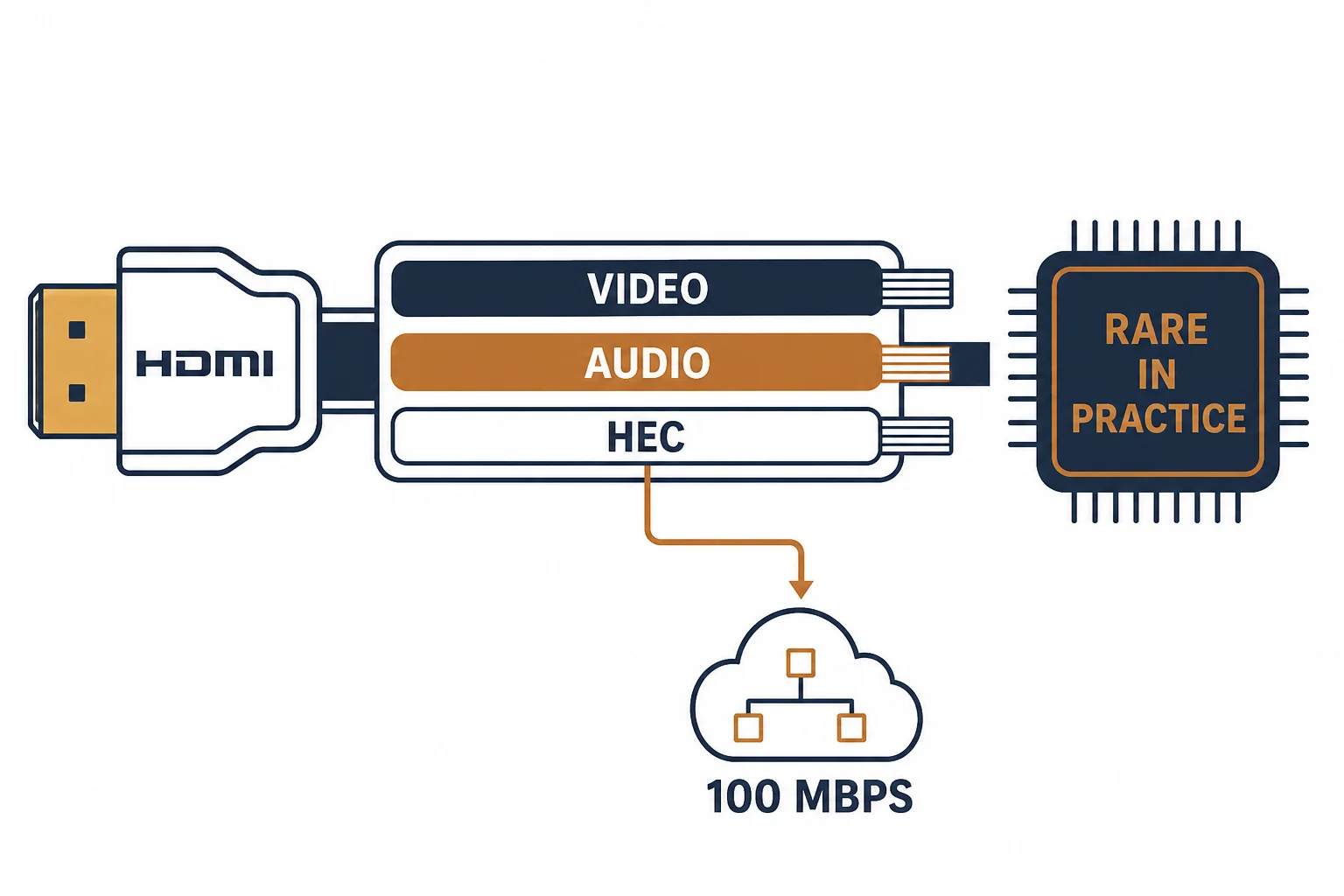
An 'ethernet HDMI cable' is an HDMI cable that also carries the HDMI Ethernet Channel – a data lane defined in HDMI 1.4 that would let connected devices share a network link. The cable exists; the ecosystem that would use it largely does not.
This is the combined-cable guide: what the cable actually contains, why the feature is rarely active, and the products that solve the underlying problem.
What the Cable Contains
| The element | The function | The reality |
|---|---|---|
| Video lanes | The HDMI signal | Universal |
| Audio lanes | Embedded audio | Universal |
| HEC lane | A data pair for networking | Rarely implemented |
| CEC | Device control | Common |
The cable is an ordinary HDMI cable with one extra pair; the feature depends on devices, not on the copper.
Why HEC Rarely Works
- Both devices must implement the channel
- Software support was rarely built
- Wi-Fi and LAN ports solved the same problem
- Cable certification does not imply device support
The failure is at the ecosystem level, which is why a capable cable in a capable-looking system still does nothing.
What to Buy Instead
| The goal | The product |
|---|---|
| Network a smart TV | Cat6 cord to its LAN port |
| Extend HDMI over distance | Extender pair over Cat6 |
| Guarantee HDMI features | A certified High Speed or Ultra High Speed cable |
| Control devices | HDMI CEC, already common |
The alternatives are cheaper and more reliable than a feature that depends on both ends.
Standards and Verification
| The reference | The relevance |
|---|---|
| HDMI 1.4 and later | Defines the HEC lane |
| HDMI certification | Cable performance categories |
| TIA-568.2-D | The Cat6 cord used instead |
Per-device HEC support is not provided in the knowledge base. The feature is defined in the standard; check the device manual before relying on it.
Real-World Applications
The hopeful purchase
An ethernet HDMI cable bought to network a TV: no change, because the TV has no HEC implementation. Its LAN port used instead – the cable kept for video.
The rare pair
A TV and receiver both supporting HEC: the channel enabled and the receiver reached the network through the HDMI cable – the exception that proves the rule.
The extender solution
A display 15 m away needing both picture and network: HDMI extender over Cat6 plus a separate Cat6 drop – two cables, both doing a job they were designed for.
Related reading: The HDMI Ethernet Channel in detail — blogs/news/hdmi-ethernet-channel
Related reading: Networking a TV the reliable way — blogs/news/tv-ethernet-cable
Frequently Asked Questions
What is an ethernet HDMI cable?
An HDMI cable that also carries the HDMI Ethernet Channel data pair.
Will it give my TV internet?
Only if both devices implement HEC, which is rare.
Is it worse than a normal HDMI cable?
No – it works as a normal cable; the extra pair is simply unused.
What should I use instead?
The TV's LAN port with a Cat6 cord, or an extender pair for distance.
Sourcing cables for a project, a store, or a private-label line? Contact our B2B sales team for specifications, certification evidence, and volume terms – FOB and CIF options available. Request a quote or sample.