
RJ45 to RJ11 Tester: Two Services
Quick answer / TL;DR: Short answer: an RJ45/RJ11 tester confirms pin continuity and, on better models, pin order – enough for voice and simple data faults. It will not measure performance or reliably detect a split pair unless it displays a pin map. Use it for continuity, use a channel tester for certification, and keep a known-good reference cord to prove the tester itself.
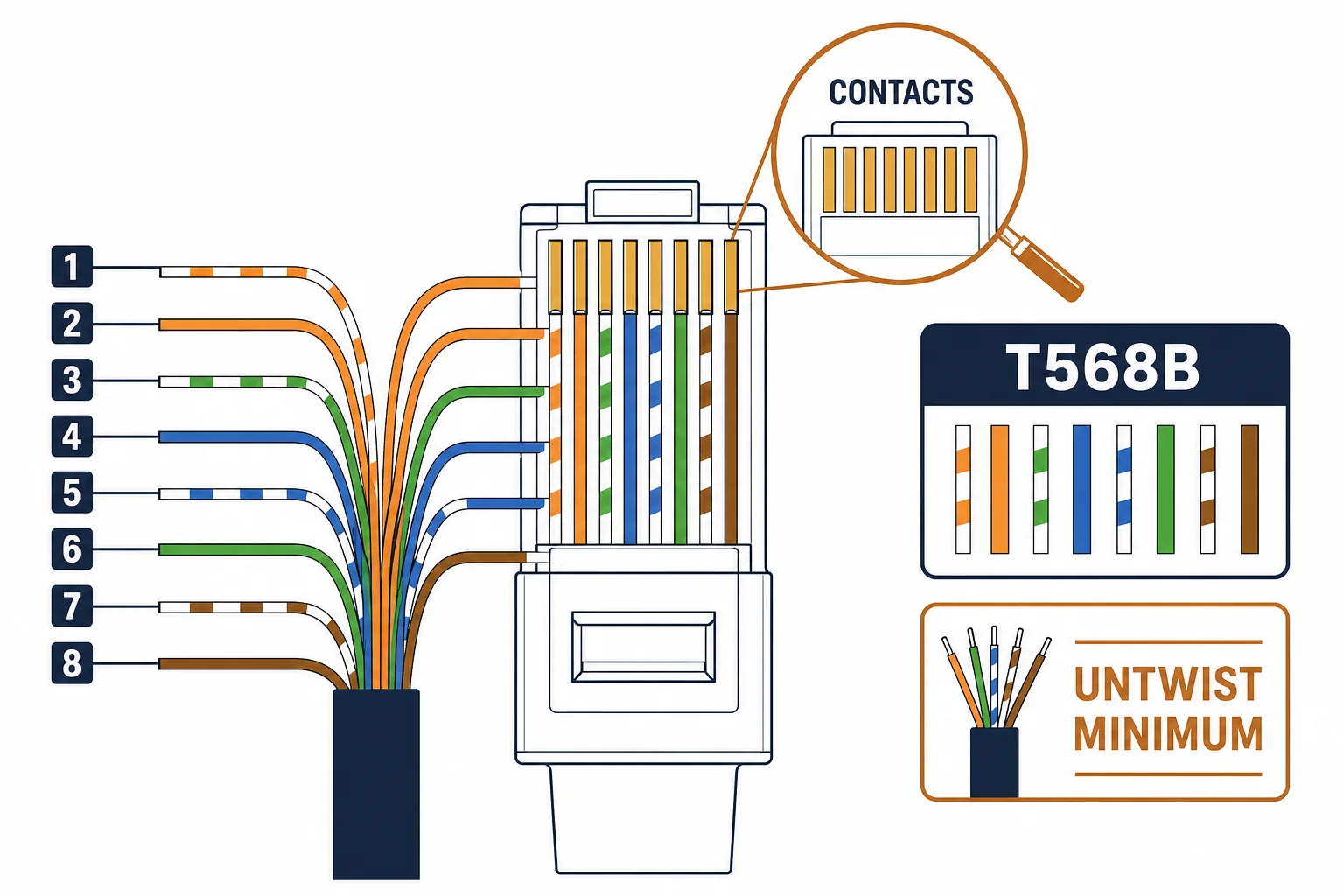
A tester with both RJ45 and RJ11 sockets covers the two cabling services in a small building: eight-pin data and six-pin voice. The combined instrument is convenient, and its data mode is often simpler than a data-only unit – which is where its limits begin.
This is the dual-service tester guide: what each mode actually verifies, the adapters that bridge the two, and the faults a basic tester will not reveal.
What Each Mode Checks
| The mode | The socket | The check |
|---|---|---|
| RJ11 | 6P | Pair continuity for voice |
| RJ45 | 8P | Eight-pin continuity and order |
| Tone | Either | Cable identification |
| Loopback | Either | End-to-end path |
Both modes are continuity instruments; the difference is the socket and the pin count they display.
The Limits
- No insertion loss or crosstalk measurement
- Split pairs only visible if a pin map is displayed
- No length measurement on basic models
- No certification – a pass is not a category claim
The limits matter at gigabit: a cable can pass continuity and fail the rate because of a split pair.
Using It Well
| The practice | The reason |
|---|---|
| Known-good reference | Proves the tester, not just the cable |
| Both ends labelled | Avoids mapping the wrong pair |
| Test before and after a repair | Confirms the change |
| Record results | A baseline for next time |
The reference cord is the step most people skip, and it is the one that tells you whether a failure is real.
Standards and Verification
| The reference | The relevance |
|---|---|
| TIA-568.2-D | Cable and test practice |
| IEC 60603-7 | The RJ45 interface |
| Registered jack designations | The 6-position family |
| Channel test | Certification beyond continuity |
Per-SKU tester features are not provided in the knowledge base. The continuity function is standard; check whether the model displays pin order before relying on it for data faults.
Real-World Applications
The office move
Twenty data ports and six voice lines checked in a morning: one tester with both sockets, results written per port – the move signed off without a return visit.
The split pair
A cable passing continuity but failing at gigabit: the tester showed only a green light. A pin-map tester found a split pair – the basic unit had been honest about its limits.
The faulty tester
A tester reporting every cable as faulty: the reference cord's plug was damaged. Replaced – eleven cables had been condemned wrongly.
Related reading: The voice panel these lines land on — blogs/news/phone-patch-panel
Related reading: The termination the tester verifies — blogs/news/toolless-keystone-jack
Frequently Asked Questions
Can an RJ45 tester test RJ11?
Only with an RJ11 socket or an adapter; a combined unit has both.
Will it find a split pair?
Only if it displays the pin map. A continuity light will not.
Can it certify a cable?
No – certification needs a channel tester with performance measurement.
Why keep a reference cord?
To prove the tester is working before condemning a cable.
Sourcing cables for a project, a store, or a private-label line? Contact our B2B sales team for specifications, certification evidence, and volume terms – FOB and CIF options available. Request a quote or sample.