
Splicing Cat6: The Last Resort
Quick answer / TL;DR: Short answer: avoid splicing Cat6. Where a repair is unavoidable, use a rated inline coupler or a proper junction enclosure, keep the total channel under 100 m, and test afterwards. Twisting and taping conductors is never acceptable. If the cable is accessible, a new run costs less than the labour of a reliable splice.
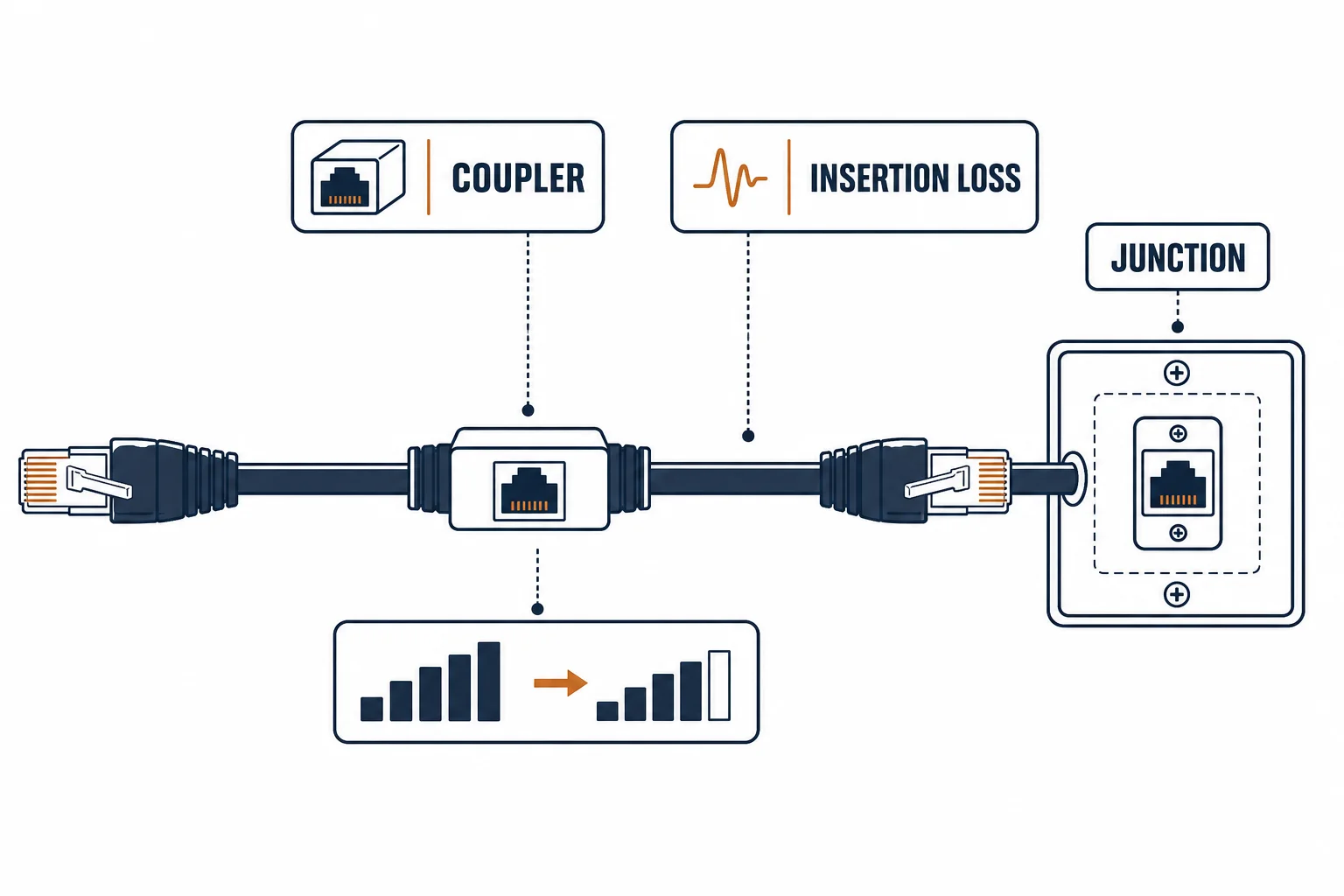
Splicing Cat6 is technically possible and almost always the wrong answer: a splice introduces an impedance discontinuity in a cable that was manufactured to have none, and the channel's margin is not there to absorb it. The legitimate methods exist for repair, not for design.
This is the splicing guide: what a joint does electrically, the methods that are acceptable in a repair, and the arithmetic that usually favours a new run.
What a Joint Does
| The effect | The cause | The consequence |
|---|---|---|
| Impedance discontinuity | A break in the geometry | Reflections at high rates |
| Insertion loss | Two extra connections | Less margin |
| Mechanical weakness | A joint in a cable | A future failure point |
| Crosstalk | Untwisted conductors | Pair separation lost |
The splice undoes the manufacturing precision that the category depends on.
Acceptable Methods for Repair
- Rated inline coupler with plugs at both ends
- Junction box with proper terminations inside
- Re-termination at both ends if length allows
- A new run wherever the route permits
Every acceptable method is a termination, not a splice: the conductors meet in a connector designed for the purpose.
The Arithmetic
| The option | The cost | The risk |
|---|---|---|
| New run | Cable plus labour | Low |
| Coupler | Low | A joint in the channel |
| Twist and tape | Very low | Unpredictable failure |
| Junction box | Moderate | A serviceable joint |
The arithmetic usually favours the new run once the labour of a reliable joint is counted.
Standards and Verification
| The reference | The relevance |
|---|---|
| TIA-568.2-D | Channel and connecting hardware |
| IEC 60603-7 | The RJ45 interface |
| Field test | Channel test after any repair |
Per-SKU coupler loss is not provided in the knowledge base. The principle is standard; test the channel rather than assuming the joint is transparent.
Practical Notes
The one case where a joint is clearly right is a cable damaged inside a finished wall with no route for a new one: a junction box with an access plate is then the professional answer, not a hidden twist.
Real-World Applications
The chewed cable
A cable damaged by a chair castor under a desk: re-terminated at both ends with new plugs, the damaged section removed – a repair without a joint.
The wall repair
A cable cut inside a plastered wall: a junction box with an access plate fitted at the damage point, the channel tested – serviceable, compliant and honest.
The taped twist
A twist-and-tape repair behind a skirting: the link worked for a month and then failed at 1 GbE. Replaced with a proper run – the joint had cost more than the cable.
Related reading: The couplers that replace a splice — blogs/news/ethernet-coupler-junction-box
Related reading: The distance budget a joint consumes — blogs/news/long-ethernet-cable
Frequently Asked Questions
Can you splice Cat6 cable?
Only as a repair, using a rated coupler or junction box – never by twisting conductors.
Does a splice reduce speed?
It reduces margin and can cause reflections; a marginal run may drop its rate.
What is the best splice method?
A rated inline coupler or a junction enclosure, followed by a channel test.
New run or splice?
A new run wherever the route allows – it is usually cheaper than a reliable joint.
Sourcing cables for a project, a store, or a private-label line? Contact our B2B sales team for specifications, certification evidence, and volume terms – FOB and CIF options available. Request a quote or sample.