
Low Profile Patch Cables: Clearance
Quick answer / TL;DR: Short answer: choose low profile patch cables where the plug body, not the cable, is the constraint – shallow cabinets, flush floor boxes, behind wall-mounted screens. Expect less strain relief and less latch protection; support the cable within a few centimetres of the plug, and prefer factory-moulded assemblies over field termination.
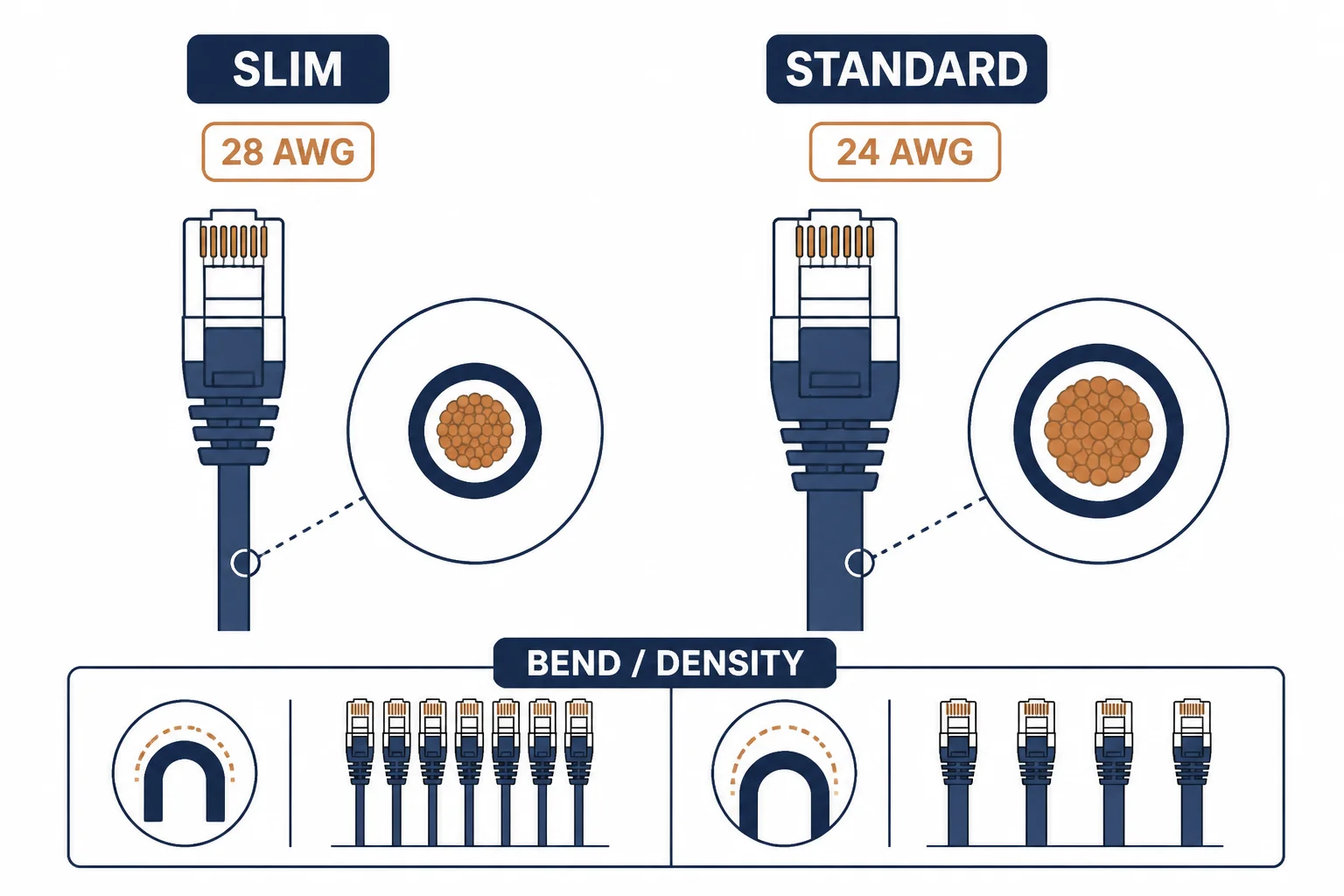
A low profile patch cable reduces the height of the plug body rather than the diameter of the cable. That distinction matters: clearance problems in a cabinet are usually vertical, and a slim cable with a standard plug does not solve them.
This is the clearance guide: the plug profiles available, the installations they fit, and the strain relief they give up in exchange.
The Profiles
| The profile | What is reduced | The use |
|---|---|---|
| Pancake | Plug depth | Tight racks, shallow boxes |
| Low profile moulded | Body height | Behind screens and furniture |
| Slim cable only | Diameter, not plug | Density without clearance gain |
| Right angle | Direction | Wall-mounted equipment |
Only the first two address height; the last two solve different problems, which is why the terms are often confused.
What Is Given Up
- Strain relief: less material to spread the load
- Latch protection: the clip is often exposed
- Field termination: harder at this size
- Durability: thinner shells crack under repeated handling
The trade is mechanical: clearance is bought with the material that would have protected the joint.
Standards and Verification
| The reference | The relevance |
|---|---|
| TIA-568.2-D | Cord requirements |
| IEC 60603-7 | The plug interface |
| Field test | Channel test with the cords installed |
Per-SKU plug dimensions are not provided in the knowledge base. Measure the clearance before ordering; the difference between profiles is millimetres.
Practical Notes
Where clearance is tight, the cable's bend is the next problem: a low profile plug leaves the cable turning almost immediately. A right-angle version of the same profile often solves both at once.
Real-World Applications
The floor box
A shallow floor box with a flush lid: pancake cords on both ports, the lid closing without pressure – the alternative was replacing the box.
The wall screen
A display mounted 20 mm off the wall: right-angle low profile cords, the cables turning inside the bracket recess – no visible cable and no crushed jacket.
The cracked shell
Low profile plugs pulled out by the cable rather than the body: two shells cracked in a year. The cords replaced and a pull loop added – the handling corrected rather than the product.
Related reading: The slim variant and its limits — blogs/news/slimline-ethernet-cable
Related reading: The right-angle plug profile — blogs/news/right-angle-rj45
Frequently Asked Questions
What is a low profile patch cable?
A cord whose plug body is shallower than standard, for tight clearances.
Does it improve airflow?
Marginally – airflow is mostly about cable volume and routing, not plug height.
Are they as durable?
Less so: thinner shells and less strain relief.
What is the alternative?
A right-angle plug, which changes direction instead of reducing height.
Sourcing cables for a project, a store, or a private-label line? Contact our B2B sales team for specifications, certification evidence, and volume terms – FOB and CIF options available. Request a quote or sample.