
Voice and Data Patch Cords: Two Kinds
Quick answer / TL;DR: Short answer: keep voice and data cords separate by specification and by colour – data cords rated to the site category, voice cords matched to the telephone system's pair count. Label both ends and the panel, and never use a voice cord to patch a data port: it may carry one or two pairs and will not support the link.
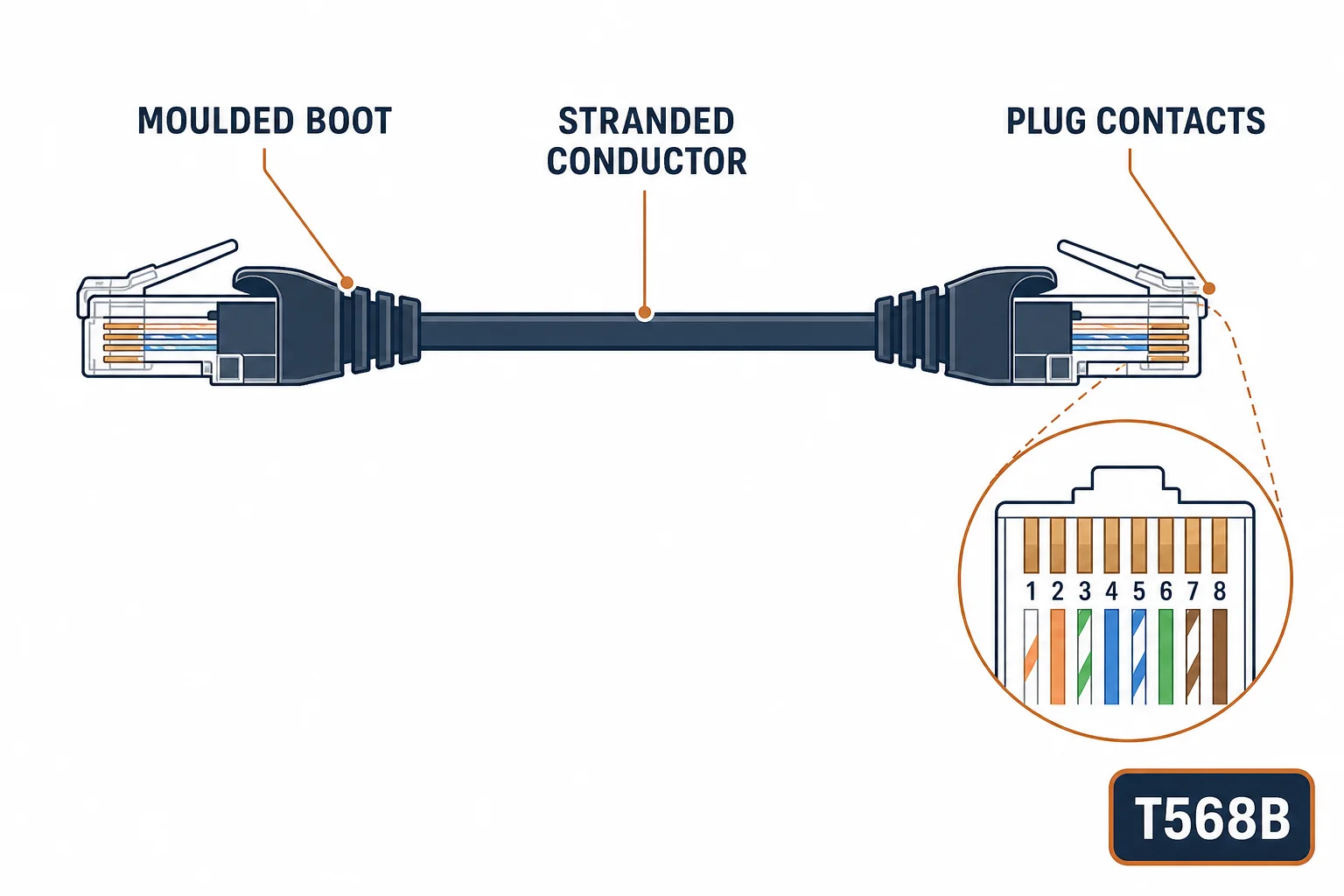
A cabinet serving both voice and data holds two kinds of cord that look alike and are not interchangeable: data cords carry four pairs to a category, voice cords often carry one or two pairs to a telephone system. Mixing them produces a line that works for voice and a port that fails for data.
This is the dual-service guide: the physical differences, the colour and labelling discipline, and the checks that keep one service from borrowing the other's patching.
The Physical Differences
| The cord | The pairs | The use |
|---|---|---|
| Data | Four, category-rated | Ethernet links |
| Voice | One or two, often untwisted | Telephone and intercom |
| Adapted | RJ45 plug on voice pairs | A data port with voice performance |
The plug may be the same; the pair count and the twist are not.
The Colour and Labelling Discipline
- One colour for data, another for voice
- Label both ends with the service and the port
- Mark the panels themselves, not just the cords
- Keep a port map in the cabinet
The discipline exists because the two services are patched by different people at different times, usually in a hurry.
Standards and Verification
| The reference | The relevance |
|---|---|
| TIA-568.2-D | Data cabling and administration |
| Local telecom practice | Voice interface |
| Field test | Link test for data; continuity for voice |
The test differs too: a data link needs a channel test, while voice needs pair continuity and a dial tone.
Per-market telecom interface rules are not provided in the knowledge base. The separation principle is standard; confirm the carrier interface before terminating lines.
Practical Notes
The most common failure is a voice cord used to restore a data link in an emergency and never replaced. A colour rule makes that substitution visible, and a labelled panel makes it reversible in seconds.
Real-World Applications
The mixed cabinet
A cabinet with 48 data ports and 24 voice pairs: blue data cords, grey voice cords, both panels labelled by service – a fault traced without opening a single drawing.
The substituted cord
A data port patched with a voice cord during an outage: the link negotiated at 100 Mbps and then failed. The correct cord fitted – the pair count had been the whole problem.
The unlabelled block
A 25-pair voice block with no labels: two lines crossed during a move. Labelled pair by pair afterwards – the next change took minutes instead of an afternoon.
Related reading: The voice panel behind the cords — blogs/news/phone-patch-panel
Related reading: The cord assembly in general — blogs/news/patch-cord-buying
Frequently Asked Questions
Can I use a voice cord for data?
No – it usually carries one or two pairs and is not category-rated.
Do voice and data need different panels?
They can share a cabinet but should use separate panels and colours.
How is voice tested?
Pair continuity and a dial tone, not a channel test.
Why does colour matter?
It makes a substitution visible before it becomes a fault.
Sourcing cables for a project, a store, or a private-label line? Contact our B2B sales team for specifications, certification evidence, and volume terms – FOB and CIF options available. Request a quote or sample.