
Cat6a LSZH Cable: Low Smoke, No Halogen
Quick answer / TL;DR: Short answer: specify LSZH Cat6a where smoke toxicity and visibility matter – public buildings, tunnels, transport. It is a separate property from the plenum (CMP) and riser (CMR) ratings, and some projects require both. LSZH compounds are often stiffer and more sensitive to UV, so check the routing and the bend radius before installation.
Cat6a LSZH cable uses a jacket compound that releases little smoke and no halogen acids when it burns. It is specified where people evacuate through the space – tunnels, stations, hospitals, airports – and it is not the same requirement as a plenum rating, although the two are often confused.
This is the LSZH guide: what the compound does, how it differs from CMP and CMR, and the handling differences that affect installation.
What the Compound Does
| The property | LSZH | PVC |
|---|---|---|
| Smoke | Low | Higher |
| Halogen acids | None | Produced |
| Flame spread | Limited by construction | Requires additives |
| Cost | Higher | Lower |
The benefit is measured in evacuation conditions: less smoke and no corrosive acids attacking equipment and lungs.
LSZH Against CMP and CMR
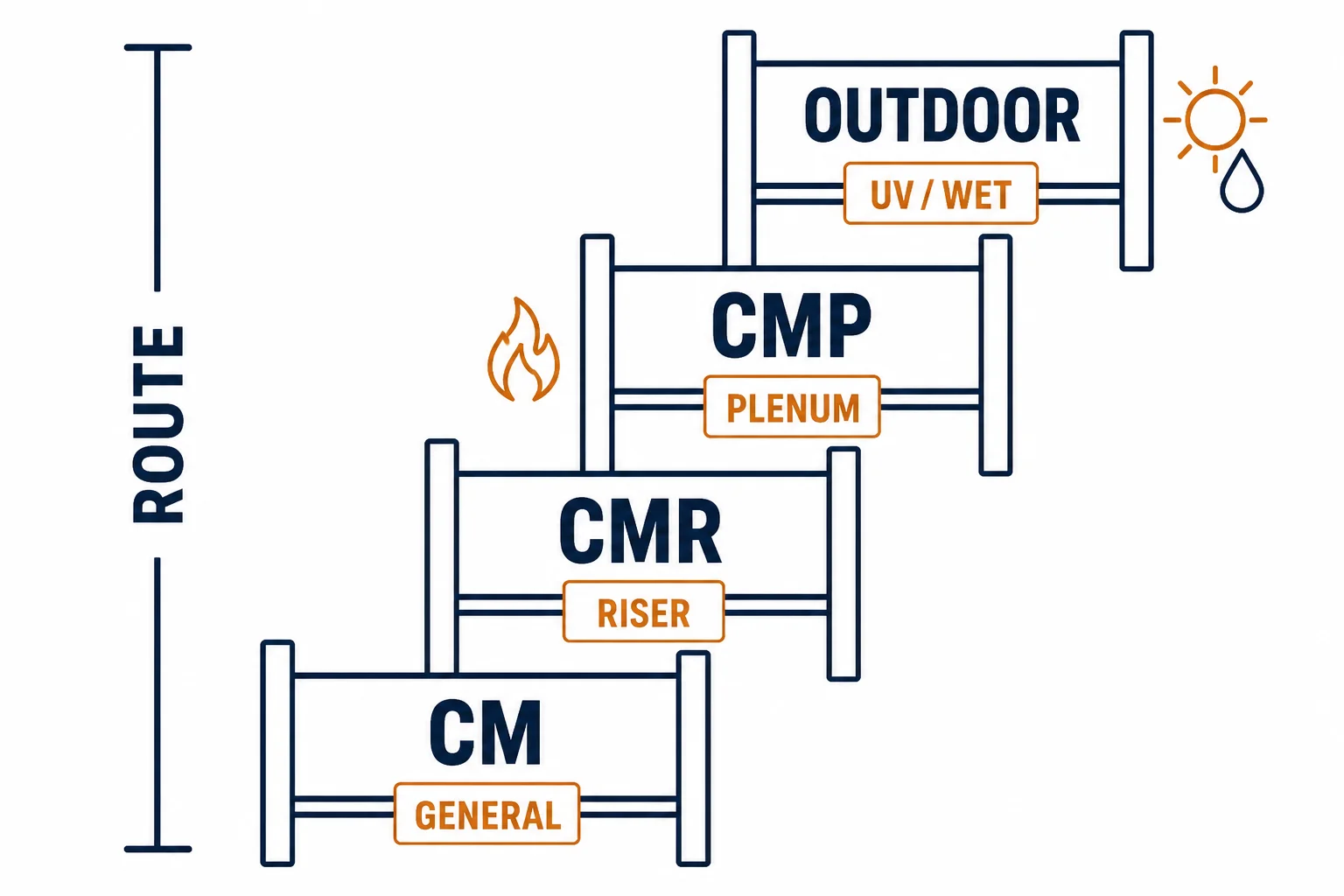
- CMP: plenum rating for air-handling spaces
- CMR: riser rating for vertical shafts
- LSZH: smoke and halogen performance, independent of the route
- Some projects require LSZH and a route rating together
The three answer different questions, which is why a specification can legitimately demand two of them at once.
Standards and Verification
| The reference | The relevance |
|---|---|
| IEC 60754 | Halogen acid gas test |
| IEC 61034 | Smoke density test |
| IEC 60332 | Flame propagation |
| UL 444 / NEC | Route ratings where applicable |
The test numbers are what a specification should cite: 'LSZH' alone is a description, not a result.
Per-market requirements are not provided in the knowledge base. The test standards are international; confirm which the local authority accepts before ordering bulk.
Practical Notes
LSZH jackets are often less flexible and more prone to scuffing than PVC, and some compounds are not UV-stable. On a long pull through containment, plan more support and a larger bend radius than the same cable in PVC.
Real-World Applications
The station concourse
A transport project requiring low smoke: Cat6a LSZH throughout, the test certificates filed per reel – the specification evidenced rather than asserted.
The dual requirement
A hospital riser needing both a route rating and low smoke: a cable meeting both specified, with the documentation to prove each – the two questions answered by one product.
The UV mistake
LSZH cable used for an exposed roof run: the jacket chalking within a year. Replaced with a UV-stable outdoor construction – the compound had been right for smoke, wrong for sunlight.
Related reading: The jacket ratings compared — blogs/news/cable-jacket-ratings
Related reading: The fire performance question — blogs/news/fire-resistant-ethernet-cable
Frequently Asked Questions
What is LSZH cable?
A jacket compound that produces little smoke and no halogen acids when burned.
Is LSZH the same as plenum?
No – plenum (CMP) is a route rating for air-handling spaces; LSZH is a smoke and halogen property.
Where is LSZH required?
Public buildings, tunnels, transport and healthcare projects where evacuation and equipment protection matter.
Is LSZH harder to install?
Often stiffer and less abrasion-resistant, and some grades are not UV-stable.
Sourcing cables for a project, a store, or a private-label line? Contact our B2B sales team for specifications, certification evidence, and volume terms – FOB and CIF options available. Request a quote or sample.