
24 AWG Cat6: The Thinner Conductor
Quick answer / TL;DR: Short answer: 24 AWG Cat6 meets the category on paper but has less margin than 23 AWG – higher attenuation over distance and more voltage drop under PoE. Use it for short horizontal runs and patch-heavy environments; specify 23 AWG for runs near the 100 m limit, for high-power PoE, and for dense bundles where heat builds.
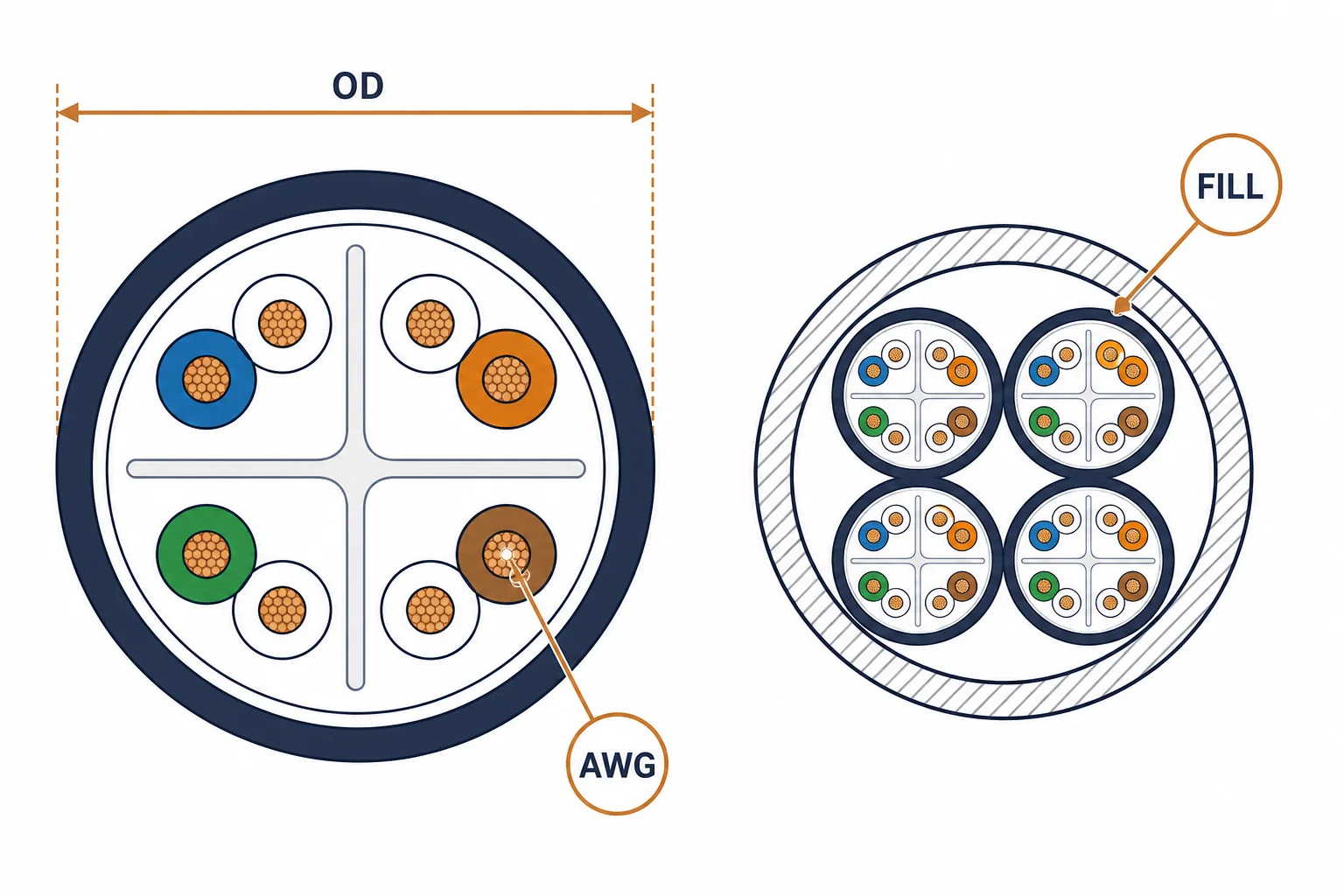
Cat6 is normally built on 23 AWG conductors, but 24 AWG versions exist and sell well: thinner, easier to route, and cheaper per metre. The trade is measurable – higher attenuation and more voltage drop – and whether it matters depends on the run length and the PoE load.
This is the gauge guide: the arithmetic behind the difference, the installations where 24 AWG is fine, and the ones where the saving is spent later.
What Changes With the Gauge
| The property | 23 AWG | 24 AWG |
|---|---|---|
| Copper per metre | More | Less |
| Attenuation | Lower | Higher |
| PoE voltage drop | Lower | Higher |
| Diameter | Larger | Smaller, easier to route |
The differences are small individually and compound on long runs with powered devices at the far end.
Where 24 AWG Is Acceptable
- Short horizontal runs well under 100 m
- Office drops at gigabit with no PoE
- Patch-heavy environments where flexibility helps
- Retrofits through tight existing conduit
The pattern is margin: where the run is short and the load is light, the thinner conductor's penalty never shows.
Standards and Verification
| The reference | The relevance |
|---|---|
| TIA-568.2-D | Category 6 requirements |
| IEC 61156 | Conductor construction |
| IEEE 802.3af/at | PoE current and heating |
| Field test | Channel test at the installed category |
Both gauges can pass the category test on a short link; the difference appears at the edges of the specification.
Per-SKU attenuation tables are not provided in the knowledge base. The gauge difference is standard; request the datasheet figures if the run is near the limit.
Practical Notes
The gauge is often not printed prominently, and a supplier may substitute 24 AWG for 23 without saying so. Write the gauge on the purchase order and check the jacket print – the substitution is invisible in service until a link is marginal.
Real-World Applications
The tight retrofit
A 1970s office with narrow conduit: 24 AWG Cat6 pulled through existing containment where 23 AWG would not pass – gigabit links at 40 m, tested and stable.
The PoE failure
Cameras on 24 AWG at 90 m: reboots at night when the illuminator drew current. Re-run on 23 AWG – the gauge, not the length, was the limit.
The silent substitution
A delivery of 'Cat6' with 24 AWG conductors where 23 was ordered: two long links testing marginal. The order restated with the gauge and the print checked at goods-in.
Related reading: The dimensions behind the gauge choice — blogs/news/cat6-cable-size
Related reading: The heavier 22 AWG option — blogs/news/22-awg-ethernet-cable
Frequently Asked Questions
Is 24 AWG Cat6 as good as 23 AWG?
It meets the category, with less margin – higher loss and more PoE voltage drop.
When should I avoid 24 AWG?
Near the 100 m limit, for high-power PoE, and in dense bundles.
Does gauge affect speed?
It affects margin rather than the rated speed. Marginal runs may negotiate lower or drop packets.
How do I confirm the gauge?
Read the jacket print and the datasheet; write the gauge on the order.
Sourcing cables for a project, a store, or a private-label line? Contact our B2B sales team for specifications, certification evidence, and volume terms – FOB and CIF options available. Request a quote or sample.