
Copper Patch Cables: Material in Short Runs
Quick answer / TL;DR: Short answer: specify bare copper stranded conductors in patch cords. Copper-clad aluminium raises resistance, worsens PoE voltage drop and is more brittle under repeated flexing – all in a component that is handled daily. Check the cord's specification or cut one open: a silver core means CCA. For PoE devices, the difference shows up as reboots under load.
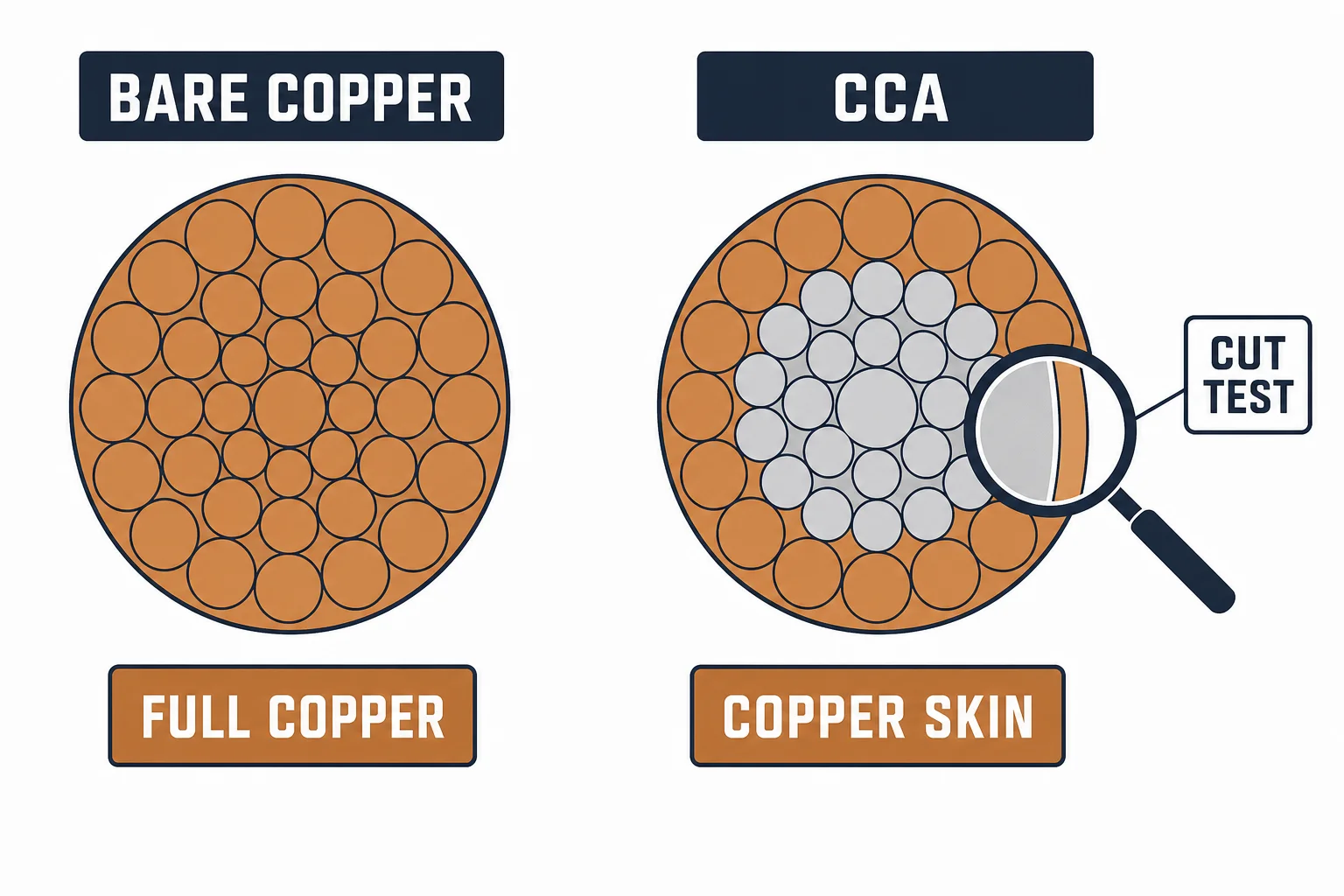
Copper patch cables are bought on the assumption that a short cord cannot matter much. The assumption fails in two places: PoE devices that draw real current through thin stranded conductors, and cords that flex at the plug until the conductor gives up – both of which get worse if the copper is only a plating.
This is the cord-material guide: what CCA does in a patch cord, the symptoms it produces, and the checks that catch it before a cabinet is built.
What CCA Does in a Cord
| The property | Bare copper | CCA |
|---|---|---|
| Resistance | Baseline | Higher |
| PoE voltage drop | Lower | Higher |
| Flex life | Good | Brittle at the plug |
| Cost | Higher | Lower |
In a long cable the resistance difference is spread over distance; in a cord it concentrates at the plug and the crimp.
The Symptoms
- Devices that reboot under PoE load
- Intermittent links after the cord is moved
- Cords that fail at the strain relief rather than the contacts
- Channels that test marginal with no visible damage
The symptoms are all delayed and intermittent, which is why a cheap cord can pass acceptance and fail in service.
The Checks
| The check | The method |
|---|---|
| Specification | Conductor material stated |
| Cut test | A silver core indicates CCA |
| Flex test | Repeated bending at the plug |
| PoE test | Voltage at the device under load |
The first two checks take minutes at goods-in and settle the question for the whole batch.
Standards and Verification
| The reference | The relevance |
|---|---|
| TIA-568.2-D | Cord requirements |
| IEC 61156 | Conductor requirements |
| IEEE 802.3af/at | PoE classes and cable heating |
| Continuity test | Per cord |
Per-SKU conductor material is not provided in the knowledge base. The cut test is definitive; make it part of goods-in for any low-price cord order.
Practical Notes
A patch cord is the cheapest component in a link and the one most often replaced. That argues for buying a known specification in bulk rather than whatever is available at the moment of need – the difference in failure rate is large.
Real-World Applications
The rebooting access point
An access point rebooting under load: the cord supplying it had CCA conductors and the voltage fell below threshold. A copper cord fitted – the reboots stopped, and the cause was a component worth a few dollars.
The brittle cord
Cords failing at the strain relief after a year of desk use: the conductors cracked inside intact jackets. Copper stranded cords specified – the failure rate dropped to near zero.
The batch check
A hundred-cord delivery sampled with a cut test: three of ten showing silver cores. The batch returned and the specification written into the purchase order – the check becoming routine.
Related reading: The cut test for conductor material — blogs/news/pure-copper-ethernet
Related reading: The PoE load behind the symptom — blogs/news/cat6-poe-cable
Frequently Asked Questions
Does conductor material matter in a patch cord?
Yes – resistance and flex life both suffer with CCA, especially on PoE and daily handling.
How do I identify CCA in a cord?
Cut a conductor: copper is the same colour throughout, CCA shows a silver core.
Why do PoE devices reboot on cheap cords?
Higher resistance causes voltage drop at the device, which can fall below its threshold under load.
Are copper cords much more expensive?
The difference is small per cord and large against the cost of intermittent faults.
Sourcing cables for a project, a store, or a private-label line? Contact our B2B sales team for specifications, certification evidence, and volume terms – FOB and CIF options available. Request a quote or sample.