
One Foot Patch Cable: Short and Specific
Quick answer / TL;DR: Short answer: one foot cords suit adjacent ports in the same panel row and switch-to-panel patching where the two are close. They are less tolerant of tight bends than longer cords, so route them with a gentle curve rather than a fold. Stock them in the site category with snagless boots – they are consumed faster than any other length.
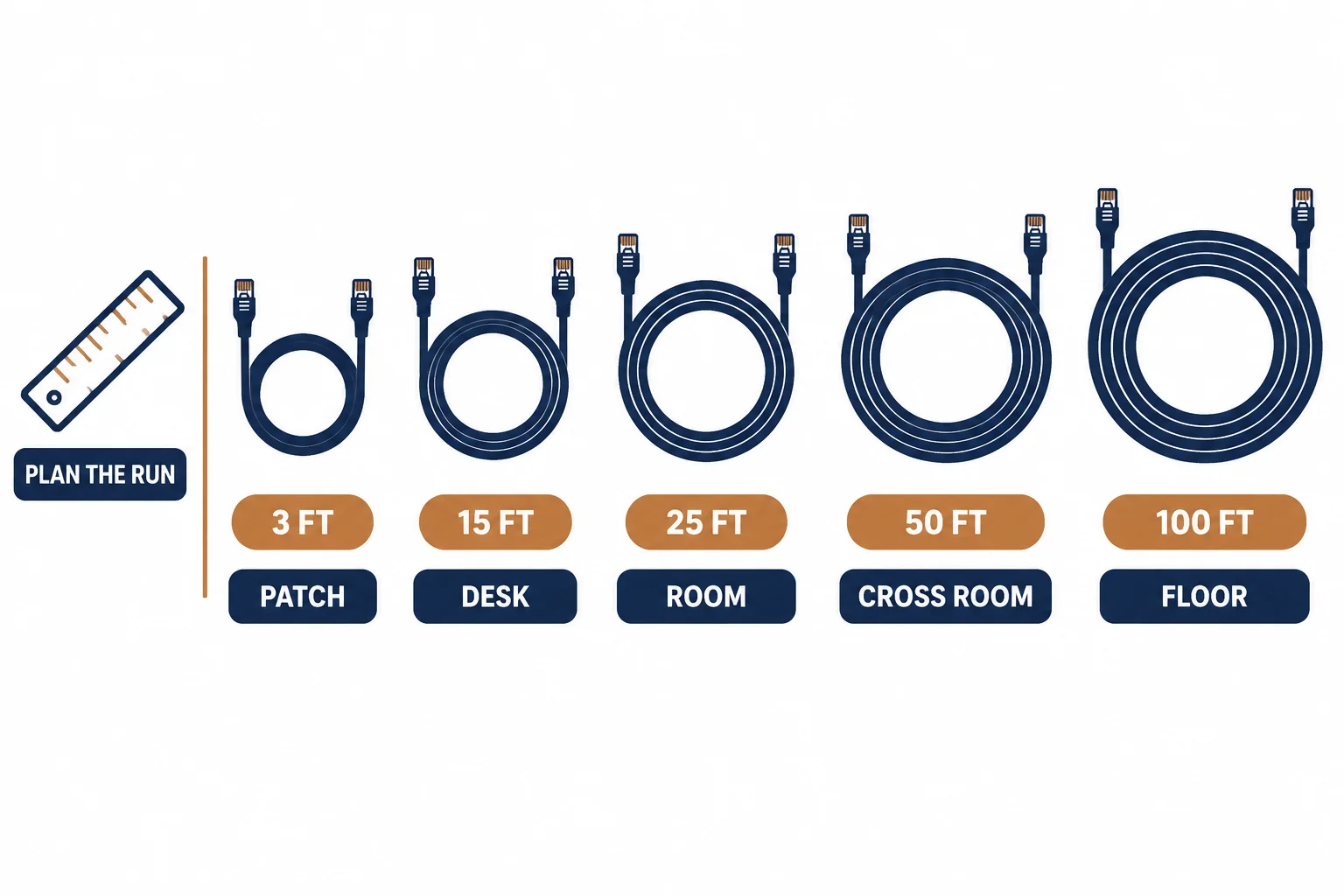
A one foot patch cable is the shortest length most cabinets can actually use: enough to cross between adjacent ports, short enough that the excess does not become a coil. It is also the length most often missing from a stock room, because it is ordered last and consumed first.
This is the one-foot guide: where 30 cm cords belong, the bend radius that short lengths demand, and the stock policy that keeps them on the shelf.
Where 30 cm Belongs
| The position | The fit | The note |
|---|---|---|
| Adjacent ports, same row | Ideal | No excess to manage |
| Panel to switch, same U | Ideal | Short and direct |
| Across a cabinet | Too short | Use 2-3 ft |
| Desk to outlet | Too short | Use 2-3 m |
The length is defined by adjacency: it works where the two ports are within a hand's width.
The Bend Radius Problem
- Short cords turn sharply at the plug if pulled tight
- The jacket and pair geometry suffer at the bend
- A gentle loop is better than a fold, even at 30 cm
- Snagless boots help but do not fix a bad route
The shorter the cord, the less cable there is to absorb a bad route – which is why short cords fail at the plug more often than long ones.
The Stock Policy
| The practice | The reason |
|---|---|
| Stock in the site category | Interchangeable with the patch field |
| Snagless boots | Density is the use case |
| Reorder at half stock | Consumed fastest |
| Two colours | Data and management |
The reorder point matters more than the quantity: a cabinet build can consume a hundred in an afternoon.
Standards and Verification
| The reference | The relevance |
|---|---|
| TIA-568.2-D | Cord requirements |
| IEC 60603-7 | The plug interface |
| Field test | Channel test with cords in place |
Per-SKU cord lengths are not provided in the knowledge base. The category and construction rules are standard; measure a sample if the length is critical.
Practical Notes
A one foot cord that measures 28 cm is not a problem; one that measures 35 cm will not fit the gap it was bought for. Length tolerance is worth asking about on a bulk order of short cords.
Real-World Applications
The panel rebuild
A 48-port panel rebuilt with one foot snagless cords: the patching legible, the airflow clear, and two boxes of spares left for the next change.
The tight row
Time-of-flight cameras are not needed here: a row of adjacent ports where two foot cords would not fit. One foot cords used – the excess problem solved by length rather than management.
The stockout
A cabinet build halfway through with no one foot cords left: two days waiting on a delivery. The reorder point was set at half stock afterwards – the delay never repeated.
Related reading: The full cord matrix by length — blogs/news/ethernet-patch-cable-line
Related reading: The short-cable stock policy — blogs/news/short-ethernet-cable
Frequently Asked Questions
What is a one foot patch cable used for?
Adjacent ports and short panel-to-switch runs where longer cords would create coils.
Are short cords less reliable?
They are less tolerant of sharp bends, so route them with a gentle curve.
Snagless or standard?
Snagless in dense panels, which is where one foot cords are used.
How many should I stock?
Treat them as the fastest-moving length and reorder at half stock.
Sourcing cables for a project, a store, or a private-label line? Contact our B2B sales team for specifications, certification evidence, and volume terms – FOB and CIF options available. Request a quote or sample.