
Cat8 Patch Cables: The Short-Reach Premium
Quick answer / TL;DR: Short answer: buy Cat8 patch cables only for 25G or 40G links within 30 m, with shielded connectors bonded at both ends and switch ports that actually support those rates. For 10G, Cat6a cords are cheaper and rated to 100 m. A Cat8 cord in a gigabit link changes nothing except the price.
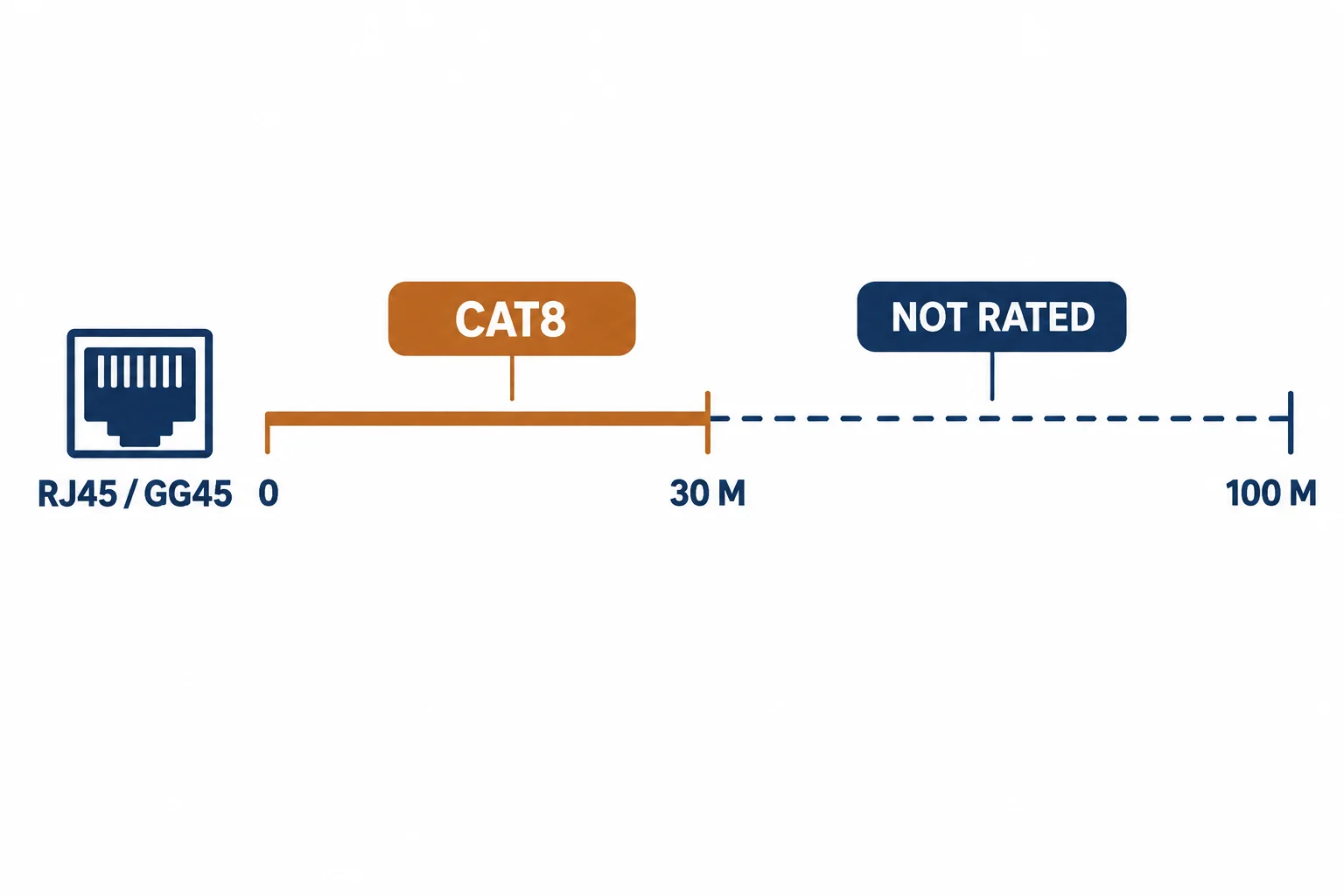
Cat8 patch cables are the shortest, heaviest and most expensive cords in the twisted-pair family: rated to 30 metres for 25G and 40GBASE-T, shielded throughout, and terminated in connectors that must be bonded. They exist for rack-to-rack links in data centres, and for almost nothing else.
This is the Cat8 cord guide: what the rating permits, what the connectors require, and the purchases that look advanced and buy nothing.
What the Rating Permits
| The class | The target | The distance |
|---|---|---|
| Cat8.1 (Class I) | 25GBASE-T | 30 m |
| Cat8.2 (Class II) | 40GBASE-T | 30 m |
| Cat6a | 10GBASE-T | 100 m |
The distance column is the whole story: Cat8's advantage exists only inside a rack row, and only at rates above 10G.
What the Connectors Require
- Shielded plugs, bonded to the cable's screen
- Shielded jacks and panels at both ends
- Same-category cords throughout the channel
- Switch ports rated for the target rate
One unshielded element ends the claim: Cat8 is a channel specification, and the weakest component sets the result.
The Purchases That Buy Nothing
| The situation | The verdict |
|---|---|
| Gigabit link | No benefit |
| 10G within 30 m | Cat6a is cheaper and equal |
| Desktop or home | Overspecified |
| Longer than 30 m | Outside the rating |
The table covers most Cat8 retail sales, which is why the premium is usually spent on appearance rather than performance.
Standards and Verification
| The reference | The relevance |
|---|---|
| TIA-568.2-D | Cat8 requirements |
| ISO/IEC 11801-1 | Class I and II |
| IEEE 802.3bq | 25G and 40GBASE-T |
| Field test | Channel test at the installed class |
Per-SKU cord ratings are not provided in the knowledge base. The class definitions are standard; confirm both the cord and the far-end hardware support the target rate.
Real-World Applications
The rack upgrade
A server row moving to 25G: Cat8 cords within the rack, shielded panels bonded, ports rated – the only configuration where the category delivers what it promises.
The gigabit substitution
Cat8 cords bought for a gigabit office: no measurable change and a cost several times the Cat6 equivalent. Returned where possible – the specification was above the requirement in every dimension.
The mixed channel
Cat8 cord into a Cat6a panel: the channel tested below the cord's class. The panel replaced – the weak link was at the far end, not in the cable that was bought.
Practical Notes
Cat8 cable is stiff enough that short cords in a dense rack need careful routing: the bend radius is larger than the space often allows, and a forced bend can damage the shield bond that the rating depends on.
Per-SKU bend radius is not provided in the knowledge base. Plan the routing before the cords arrive; the mechanical limits of Cat8 are stricter than its electrical ones suggest.
The tight rack
Cat8 cords forced behind a close-mounted panel: one shield bond failed and the link dropped to a lower rate. The panel moved forward – the bend radius respected, the class restored.
The honest downgrade
A project specifying Cat8 for every link, reviewed against actual port rates: only four links needed 25G. Cat6a used elsewhere – the budget redirected to the switch ports that mattered.
The documentation gap
A Cat8 installation with no test records: the customer could not prove the class. Every link re-tested and the certificates filed – the rating became evidence rather than a claim.
Related reading: The distance the class allows — blogs/news/cat8-deployment-limits
Related reading: The connector rules for Cat8 — blogs/news/cat8-rj45-connector
Frequently Asked Questions
What are Cat8 patch cables for?
25G and 40GBASE-T links within 30 m, typically inside a rack row.
Do I need Cat8 for 10G?
No – Cat6a carries 10G to 100 m at lower cost.
Can Cat8 cords be longer than 30 m?
Not within the rating. Beyond 30 m the standard does not apply.
Do Cat8 cords need shielded panels?
Yes – the channel must be shielded and bonded end to end.
Sourcing cables for a project, a store, or a private-label line? Contact our B2B sales team for specifications, certification evidence, and volume terms – FOB and CIF options available. Request a quote or sample.