
Quarter Inch Patch Cord: TS and TRS
Quick answer / TL;DR: Short answer: use TRS (three-conductor) for balanced line-level patching between studio gear, and TS (two-conductor) for unbalanced instrument connections. A TS plug in a balanced socket unbalances the link; the cable still works, which is why the mistake survives. Keep patch cords short, and label both ends in a bay.
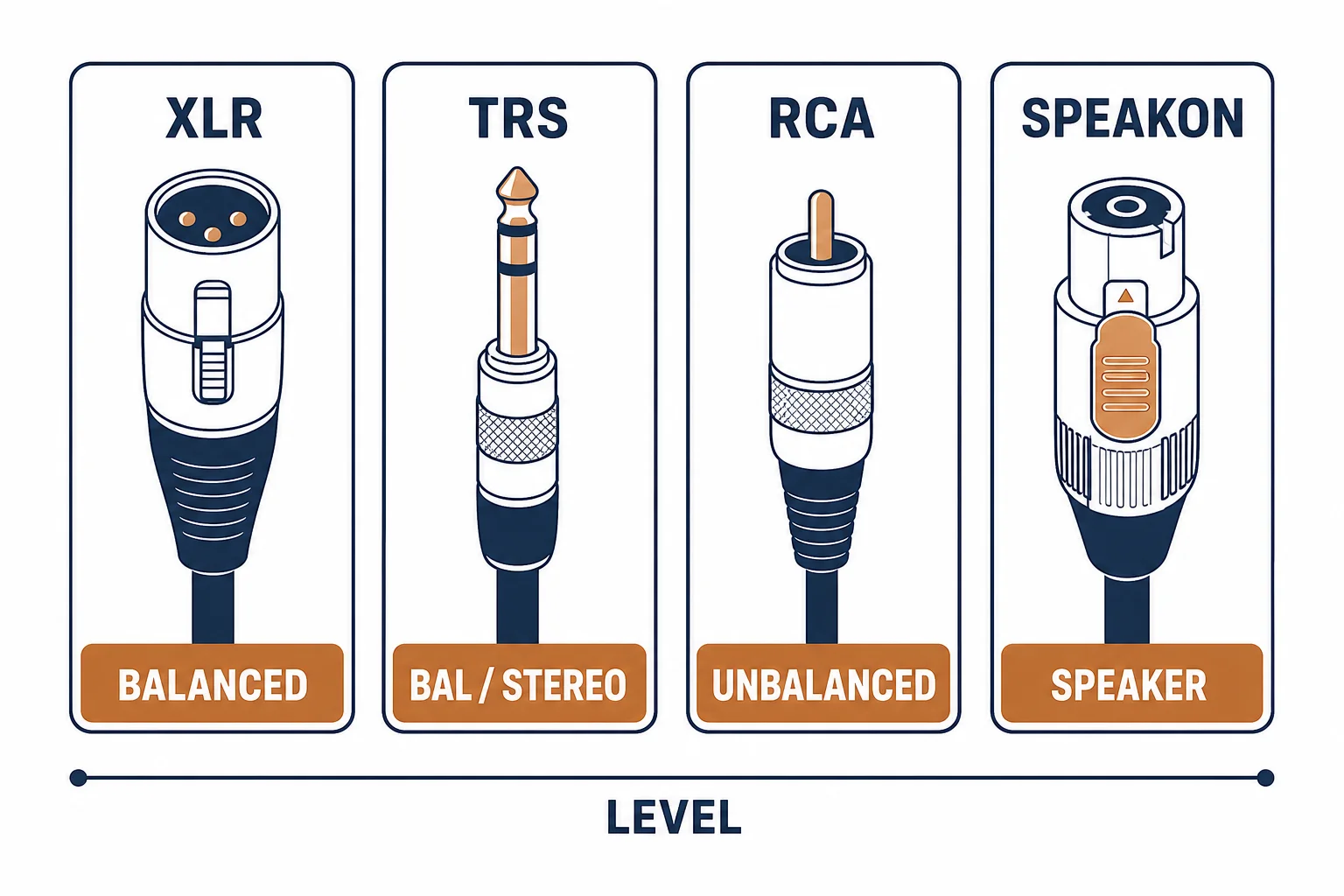
A quarter inch patch cord is a 6.35 mm lead used between equipment: patchbays, outboard gear, instruments and amplifiers. Two versions exist – TS with two conductors and TRS with three – and choosing the wrong one turns a balanced connection into an unbalanced one without any visible difference.
This is the 6.35 mm guide: the plug types, where each belongs, and the patching conventions that keep a studio quiet.
The Two Plugs
| The plug | The conductors | The use |
|---|---|---|
| TS | Tip and sleeve | Instruments, unbalanced lines |
| TRS | Tip, ring and sleeve | Balanced line level, stereo |
| TS in a TRS socket | Unbalanced link | Often works – and misleads |
The physical difference is small and the electrical difference is the whole point of a balanced patch.
Where Each Belongs
- Instrument to amp or pedalboard: TS
- Outboard gear to patchbay: TRS, balanced
- Synth or drum machine outputs: often TS
- Insert points on a console: TRS, wired for send and return
- Headphone outputs: TRS, stereo
The pattern is level and distance: balanced TRS for line-level patching, TS for instrument-level connections.
Patchbay Practice
| The practice | The benefit |
|---|---|
| Label both ends | Faster patching |
| Consistent length | Tidy bay |
| TRS throughout a balanced bay | No accidental unbalancing |
| Spares of each length | Recovery during a session |
Standards and Verification
| The reference | The relevance |
|---|---|
| IEC 60268 | Audio interconnection practice |
| AES14 | Grounding practice |
| Continuity test | Tip, ring and sleeve discrete |
Per-SKU wiring is not provided in the knowledge base. The plug conventions are standard; verify TS versus TRS on the product rather than the picture.
Real-World Applications
The outboard rack
An outboard rack patched with TRS quarter-inch cords in three lengths: balanced throughout and labelled at both ends – the accidental unbalancing a TS cord had caused disappeared.
Related reading: The audio cable families — blogs/news/audio-cable-manufacturers
Related reading: The balanced XLR alternative — blogs/news/xlr-patch-cable-buying
Frequently Asked Questions
What is a quarter inch patch cord?
A 6.35 mm lead used to patch audio equipment, in TS (unbalanced) or TRS (balanced) versions.
TS or TRS for a patchbay?
TRS for balanced line-level patching; TS only for unbalanced instrument connections.
Does a TS plug damage a TRS socket?
Not usually, but it unbalances the link and can lose level.
How long should patch cords be?
Short – typically under a metre for a bay, to limit capacitance and tidiness problems.
Sourcing cables for a project, a store, or a private-label line? Contact our B2B sales team for specifications, certification evidence, and volume terms – FOB and CIF options available. Request a quote or sample.