
Power and Ethernet Outlet: Two Services
Quick answer / TL;DR: Short answer: use a combined plate where the layout needs one position, but keep mains and data separated as the local code requires – separate compartments, dividers or spacing. Check the back box depth: two services need more room than one. Install and test the data side before the plate goes on, and have the mains side done by a qualified electrician.
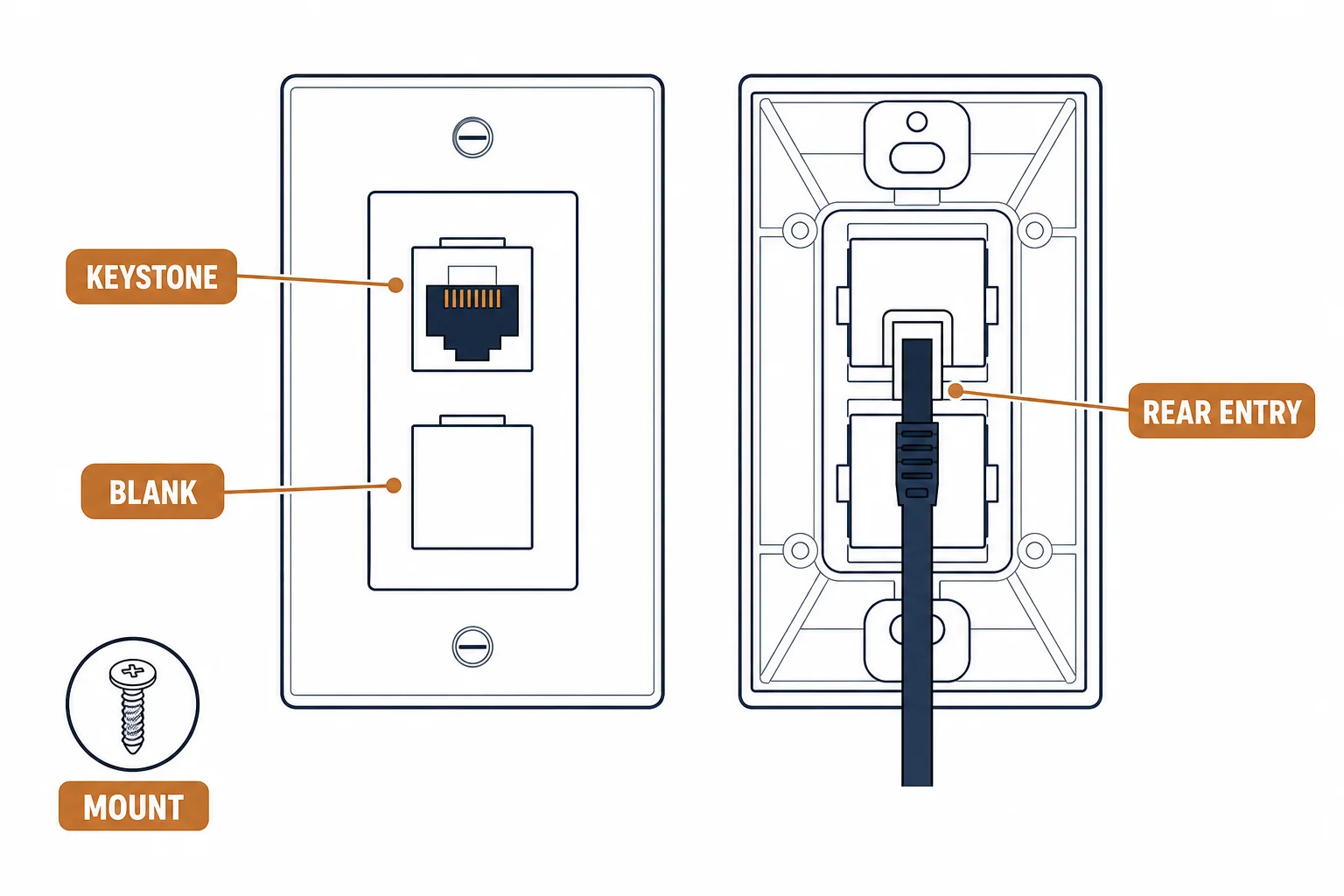
A combined power and ethernet outlet puts a mains socket and a data jack on one plate – convenient at a desk, and the point where two trades meet: electrical installation rules on one side, structured cabling on the other. The separation between them is not optional.
This is the combined-outlet guide: the separation requirement, the box depth problem, and the installation order that keeps the data side testable and the power side compliant.
The Separation Requirement
| The element | The rule | The reason |
|---|---|---|
| Compartment | Divided plate or separate boxes | Keeps mains and data apart |
| Spacing | Per local code | Reduces coupling |
| Barrier | Metal or insulated divider | Physical separation |
| Cable route | Separate paths, cross at right angles | Limits induced noise |
The separation rules exist for both safety and signal: mains cables induce noise, and mixing services in one enclosure needs care.
The Box Depth Problem
- Two services need more depth than a single-gang box provides
- Data cable needs bending room behind the jack
- Mains terminations need their own space
- A shallow box forces tight bends, which damages data cable
The depth is the most common installation failure: the plate fits, the cables do not bend.
The Installation Order
| The step | The order |
|---|---|
| First fix | Boxes and conduit, separate routes |
| Data termination | Jack terminated and tested |
| Mains | By a qualified electrician |
| Plate on | After both sides are complete |
| Test | Data link test with the plate fitted |
Standards and Verification
| The reference | The relevance |
|---|---|
| Local electrical code | Separation and enclosure rules |
| TIA-568.2-D | Data outlet practice |
| IEC 60603-7 | The jack interface |
| Field test | Permanent link test at the outlet |
Per-market electrical rules are not provided in the knowledge base. Confirm the separation requirement locally and use a qualified electrician for the mains side.
Real-World Applications
The desk position
A desk position needing power and data in one place: a divided plate on a deep box, data terminated and tested before the plate went on, mains completed by an electrician – both services separated and compliant.
Related reading: The wall plate that holds the jack — blogs/news/ethernet-wall-plate-buying
Related reading: Flush, surface and modular outlets — blogs/news/ethernet-wall-outlet-types
Frequently Asked Questions
Can power and ethernet share one outlet plate?
Yes, with the separation the local code requires – divided compartments or separate boxes.
Does mains cable interfere with ethernet?
It can, which is why separation and right-angle crossings are required.
What box depth do I need?
Enough for the data cable's bend radius plus the mains terminations – usually deeper than a single-service box.
Who should install the power side?
A qualified electrician; the data side can be terminated and tested separately.
Sourcing cables for a project, a store, or a private-label line? Contact our B2B sales team for specifications, certification evidence, and volume terms – FOB and CIF options available. Request a quote or sample.