
Cat5e Direct Bury: Cheaper, With Conditions
Quick answer / TL;DR: Short answer: use cable explicitly rated for direct burial – gel-filled or water-blocked with a tough jacket – at the depth local code requires, on a sand bed, with warning tape above. Cat5e is adequate for gigabit at these distances; the cable's burial construction matters far more than its category. Test before backfilling.
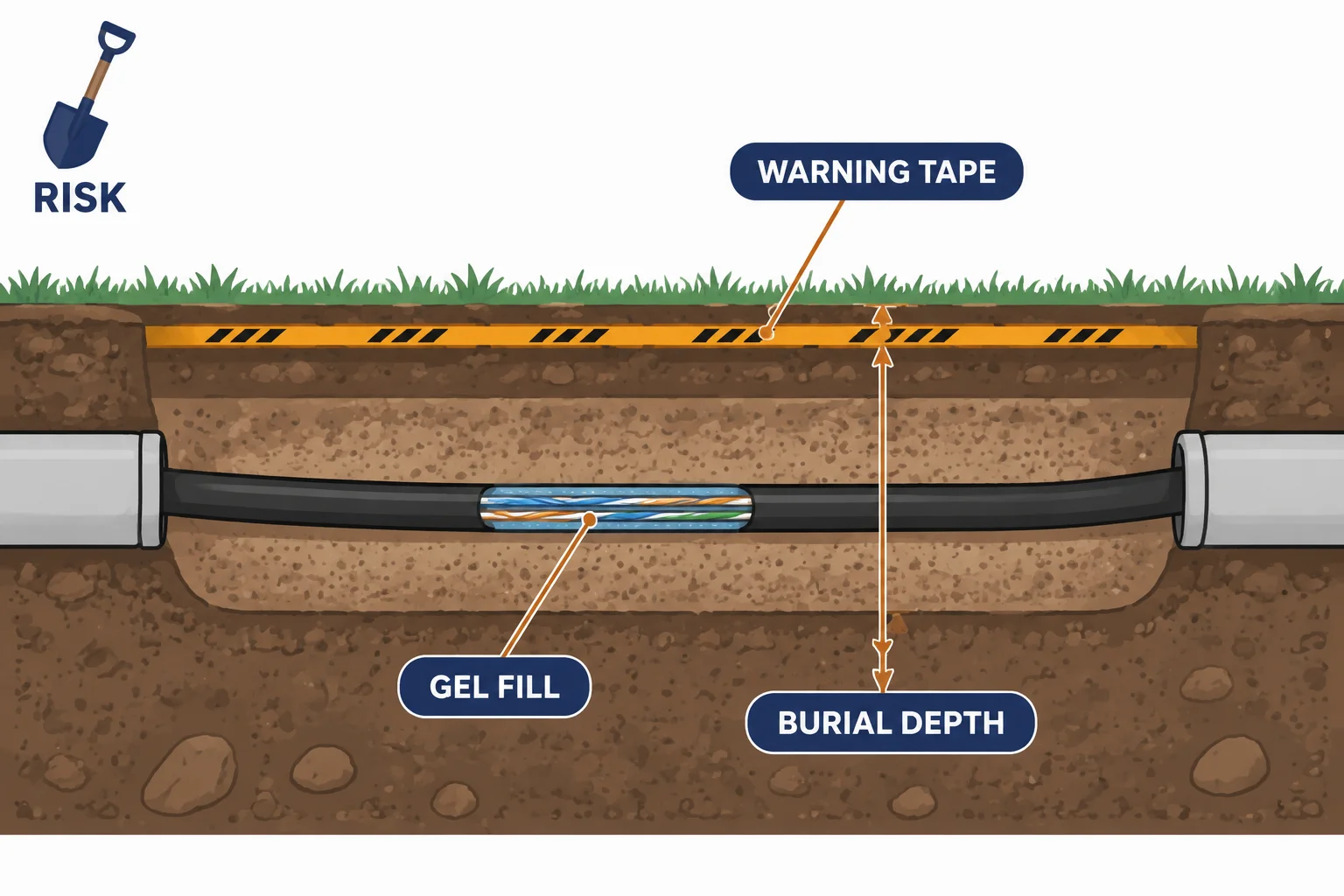
Cat5e direct bury cable is the budget route to an outbuilding: lower cost than Cat6a and adequate for a gigabit link. The saving is real, and so are the conditions – water, depth and protection decide whether the run lasts a decade or a season.
This is the Cat5e burial guide: the construction that matters, the procedure that protects it, and the failures that appear when either is skipped.
What the Construction Must Have
| The feature | The purpose | The failure it prevents |
|---|---|---|
| Gel fill or water blocking | Stops water travelling inside | Corrosion at the far end |
| Tough jacket | Abrasion and soil chemicals | Jacket breach |
| UV-stable compound | Exposed ends | Cracking |
| Rated burial construction | Stated by the maker | Warranty and performance |
Category is secondary here: a Cat5e burial cable that keeps water out outperforms a Cat6a cable that does not.
The Procedure
- Depth per local code, deeper under vehicle traffic
- Sand or fine soil bedding, no sharp stones
- Conduit at crossings and where future access is likely
- Warning tape above the cable
- Test the link before backfilling
The sequence exists so that the irreversible step comes after the test.
Where It Fails
| The symptom | The cause |
|---|---|
| Link works, then drops in wet weather | Water in the jacket |
| One pair failing at the far end | Corrosion at the termination |
| Jacket split after a season | Abrasion against stone |
Standards and Verification
| The reference | The relevance |
|---|---|
| TIA-568.2-D | Exterior cabling practice |
| Local electrical code | Depth and protection |
| Field test | Channel test before and after backfill |
Per-market depth requirements are not provided in the knowledge base. Confirm locally; the construction and testing principles are standard.
Real-World Applications
The garden office
A garden studio 30 m from the house: Cat5e burial cable at code depth, sand bedding and warning tape, tested before the trench closed – gigabit to the studio through two winters.
Related reading: The Cat6 burial equivalent — blogs/news/direct-burial-cat6-cable
Related reading: Whether Cat6 is outdoor rated at all — blogs/news/cat6-outdoor-rated
Frequently Asked Questions
Can Cat5e be buried?
Only a cable rated for direct burial, with the right construction and depth.
Is Cat5e enough for an outbuilding?
For a gigabit link at typical garden distances, yes.
Do I need conduit?
Not for the whole run if the cable is burial rated, but use it at crossings and where access may be needed.
Why does a buried link fail after rain?
Water travelled inside the jacket – the failure a gel fill or water block prevents.
Sourcing cables for a project, a store, or a private-label line? Contact our B2B sales team for specifications, certification evidence, and volume terms – FOB and CIF options available. Request a quote or sample.