
Slimline Ethernet Cable: Thin and Limited
Quick answer / TL;DR: Short answer: use slimline cable for short patch runs in dense racks where standard cords will not fit or will block airflow. Expect higher attenuation and more voltage drop: keep runs short (a couple of metres), avoid high-power PoE, and confirm the category on the packaging – a slim cord can still be Cat6 rated, or not.
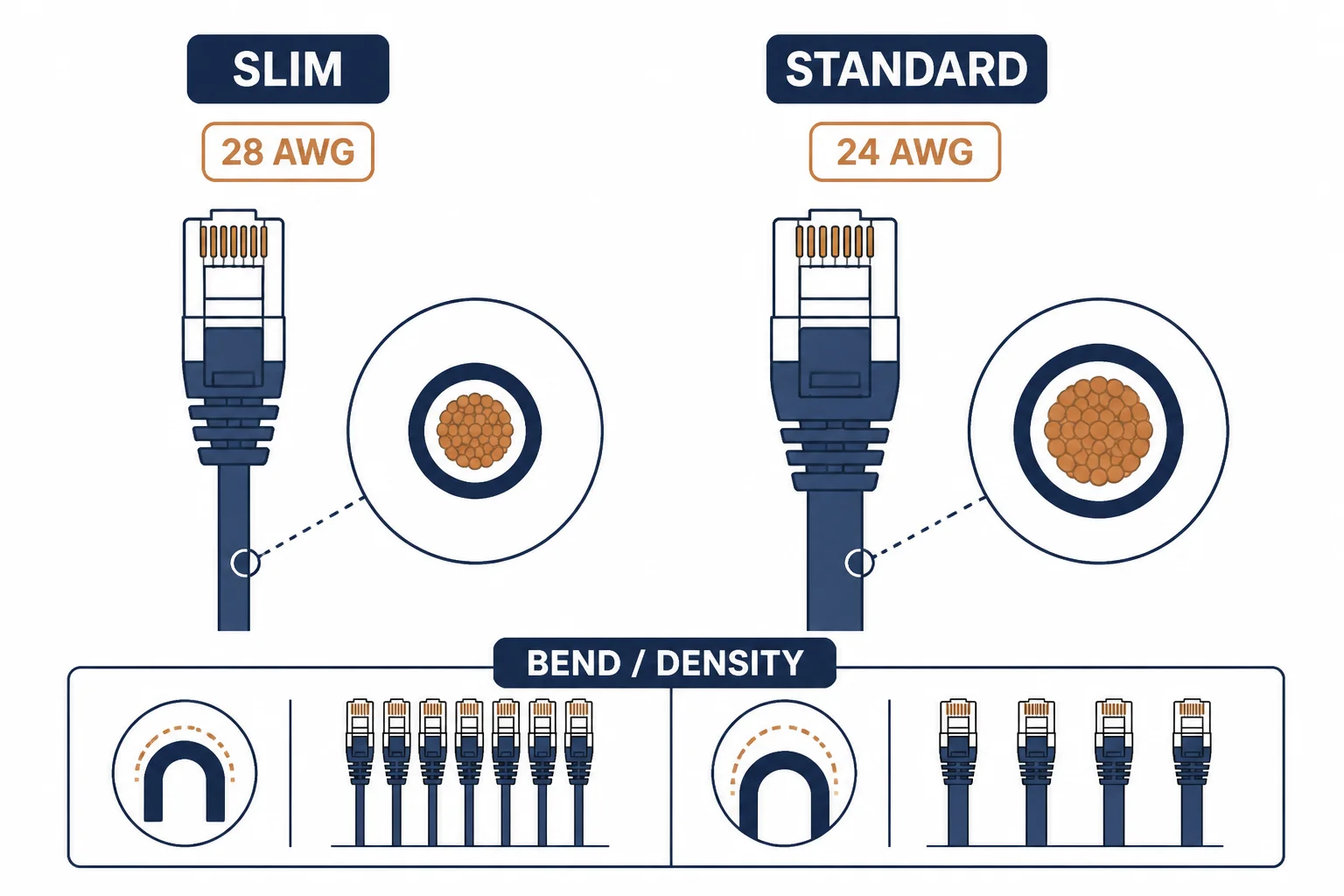
Slimline ethernet cable trades conductor size for diameter: a visibly thinner cord that fits where a standard one will not. The trade is electrical – thinner copper means more attenuation and more voltage drop – so slim line has a shorter useful life than the cable it imitates.
This is the slimline guide: what the thin construction costs, the length and power limits that follow, and the installations where it is the right answer rather than a compromise.
What the Thin Construction Costs
| The property | Standard cord | Slimline |
|---|---|---|
| Conductor | 24-26 AWG | 28 AWG typical |
| Attenuation | Lower | Higher per metre |
| Voltage drop under PoE | Lower | Higher |
| Bend tolerance | Better | Thinner jacket, less margin |
Every line follows from the conductor: less copper, more resistance, less thermal mass.
Where Slim Line Belongs
- Dense patch fields where plug bodies collide
- Cabinets with tight cable management
- Short runs, typically under 2 m
- Displays and devices where the cable is visible
- Not for long horizontal runs
- Not for high-power PoE devices
The rule is length and power: slim line is a density tool, not a substitute for structured cabling.
The Cosmetic Case
| The situation | The verdict |
|---|---|
| Cable visible behind a wall-mounted TV | Slim helps |
| Under-carpet run | Flat cable, not slim |
| Permanent in-wall | Standard solid cable |
| Rack patching | Slim, short lengths |
Standards and Verification
| The reference | The relevance |
|---|---|
| TIA-568.2-D | Cord requirements |
| ISO/IEC 11801-1 | Category definitions |
| IEEE 802.3af/at | PoE classes and cable heating |
| Continuity test | Per cord on receipt |
Per-SKU conductor data is not provided in the knowledge base. Confirm the AWG and the category marking rather than assuming a slim cord matches its standard equivalent.
Real-World Applications
The media wall
A wall-mounted TV with a 12 mm gap behind it: a slimline cord dressed into the bracket recess – visually clean, and short enough that the thinner conductor costs nothing.
Related reading: The Cat6a slim cord in dense racks — blogs/news/cat6a-slim-patch-cable
Related reading: The patch cord stock policy — blogs/news/patch-cord-buying
Frequently Asked Questions
Is slimline ethernet cable as good as standard?
For short runs and light loads it performs the same in practice; for long runs and PoE it costs margin.
What gauge is slimline cable?
Typically 28 AWG versus 24-26 AWG on standard cords.
Can slimline cable carry PoE?
At low power and short length, generally yes. Avoid it for high-power devices.
Does slimline cable meet Cat6?
Some products do and some do not. Read the category marking.
Sourcing cables for a project, a store, or a private-label line? Contact our B2B sales team for specifications, certification evidence, and volume terms – FOB and CIF options available. Request a quote or sample.