
Pure Copper Ethernet: The Cut Test
Quick answer / TL;DR: Short answer: specify bare copper conductors and verify by cutting a sample – copper is copper-coloured through its section, CCA shows a silver aluminium core under a thin copper skin. CCA has higher resistance (worse PoE drop) and is more brittle at terminations. It is not permitted by many category standards, so a 'Cat6 CCA' claim is already a contradiction.
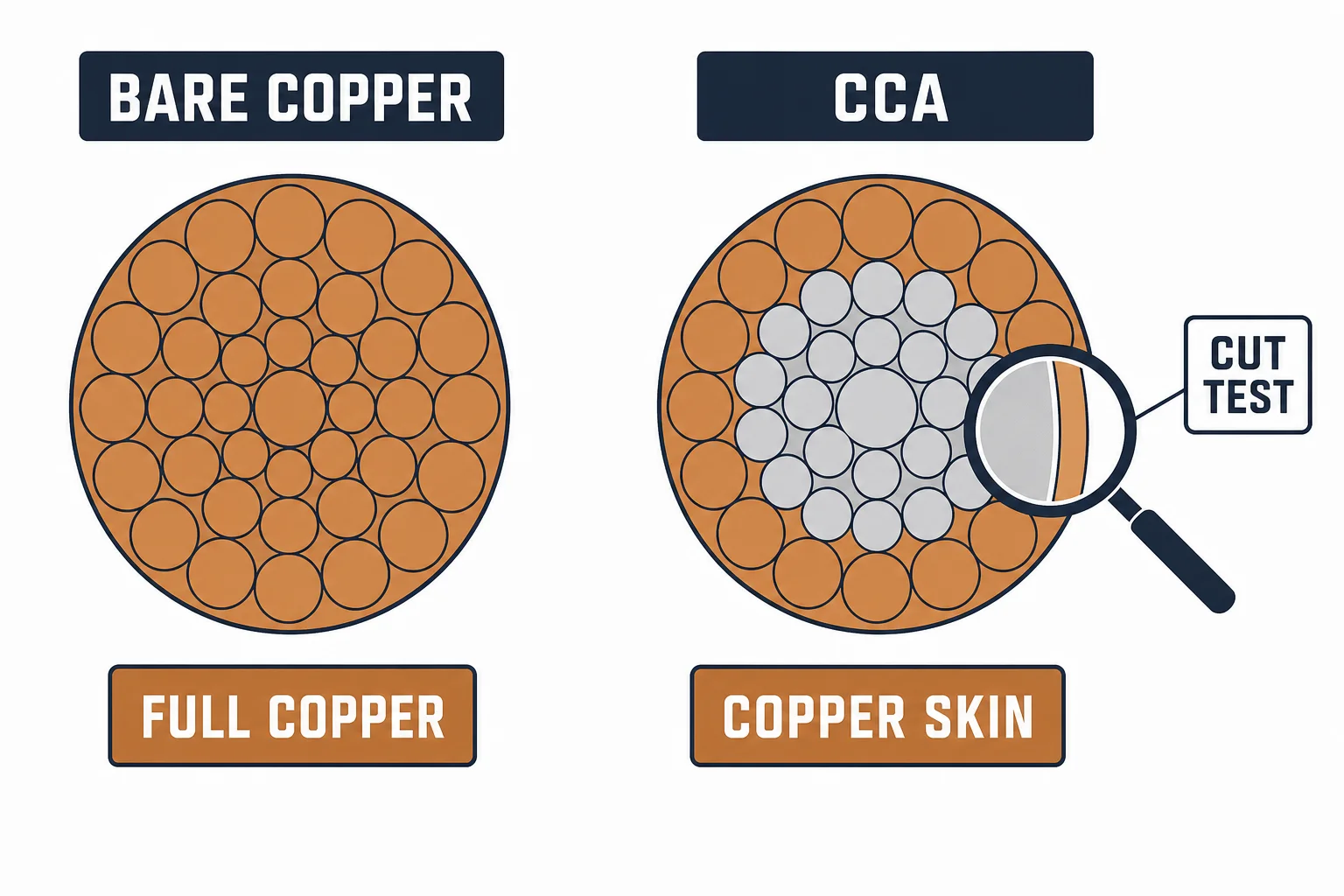
Pure copper ethernet cable is specified because the alternative – copper-clad aluminium – looks identical on the outside and behaves differently in service: higher resistance, more voltage drop on PoE, and a brittleness that shows up at terminations. The difference is invisible until you cut a conductor.
This is the conductor guide: what CCA is, why it fails in ways copper does not, and the three checks that keep it out of an installation.
What CCA Is
| The conductor | The construction | The consequence |
|---|---|---|
| Bare copper | Copper throughout | Baseline resistance and ductility |
| CCA | Aluminium core, copper plating | Higher resistance, more brittle |
| CCS | Steel core, copper plating | Higher resistance still |
The plating is thin and cosmetic in function; the current flows mostly in the aluminium.
Why It Fails
- Resistance: aluminium is less conductive, so PoE voltage drop rises
- Brittleness: the conductor cracks at punch-down and crimp points
- Corrosion: aluminium oxides form at exposed ends
- Standards: category specifications assume copper conductors
The failure pattern is delayed and distributed: many terminations, each slightly worse, and a channel that tests marginal.
The Three Checks
| The check | The method |
|---|---|
| Cut test | Cut a conductor: silver core means CCA |
| Jacket print | Should state copper, not just the category |
| Datasheet | Conductor material and AWG |
| Price | Copper below copper's market cost is not copper |
Standards and Verification
| The reference | The relevance |
|---|---|
| TIA-568.2-D | Category requirements assume copper |
| IEC 61156 | Conductor requirements |
| UL 444 | Cable construction |
Per-SKU conductor material is not provided in the knowledge base. The cut test is definitive; make it part of goods-in inspection for any bulk delivery.
Real-World Applications
The cheap pallet
A pallet bought at a price below copper market value: the cut test showing a silver core. Returned and the specification amended to state bare copper – the price had been the warning.
Related reading: The bulk order where conductor checks belong — blogs/news/bulk-ethernet-cable-box
Related reading: Why price below copper market is a warning — blogs/news/ethernet-cable-cost-structure
Frequently Asked Questions
How can I tell pure copper from CCA?
Cut a conductor: copper is the same colour through its section, CCA shows a silver core.
Does CCA affect performance?
It raises resistance, worsens PoE voltage drop and is more brittle at terminations.
Is CCA allowed in Cat6?
Category specifications assume copper conductors; a Cat6 CCA claim is inconsistent with the standard.
Why is CCA sold?
It is cheaper. For short, non-PoE runs it may function, but it is not equivalent to copper.
Sourcing cables for a project, a store, or a private-label line? Contact our B2B sales team for specifications, certification evidence, and volume terms – FOB and CIF options available. Request a quote or sample.