
Phone Patch Panel: Voice Administration
Quick answer / TL;DR: Short answer: use a phone patch panel for voice – 25-pair punch-down blocks for multi-line systems, or RJ12/RJ11 panels for small ones. Do not run ethernet through it: voice panels are not category-rated for data. In a retrofit, keep voice and data on separate panels and label both, even where they share a cabinet.
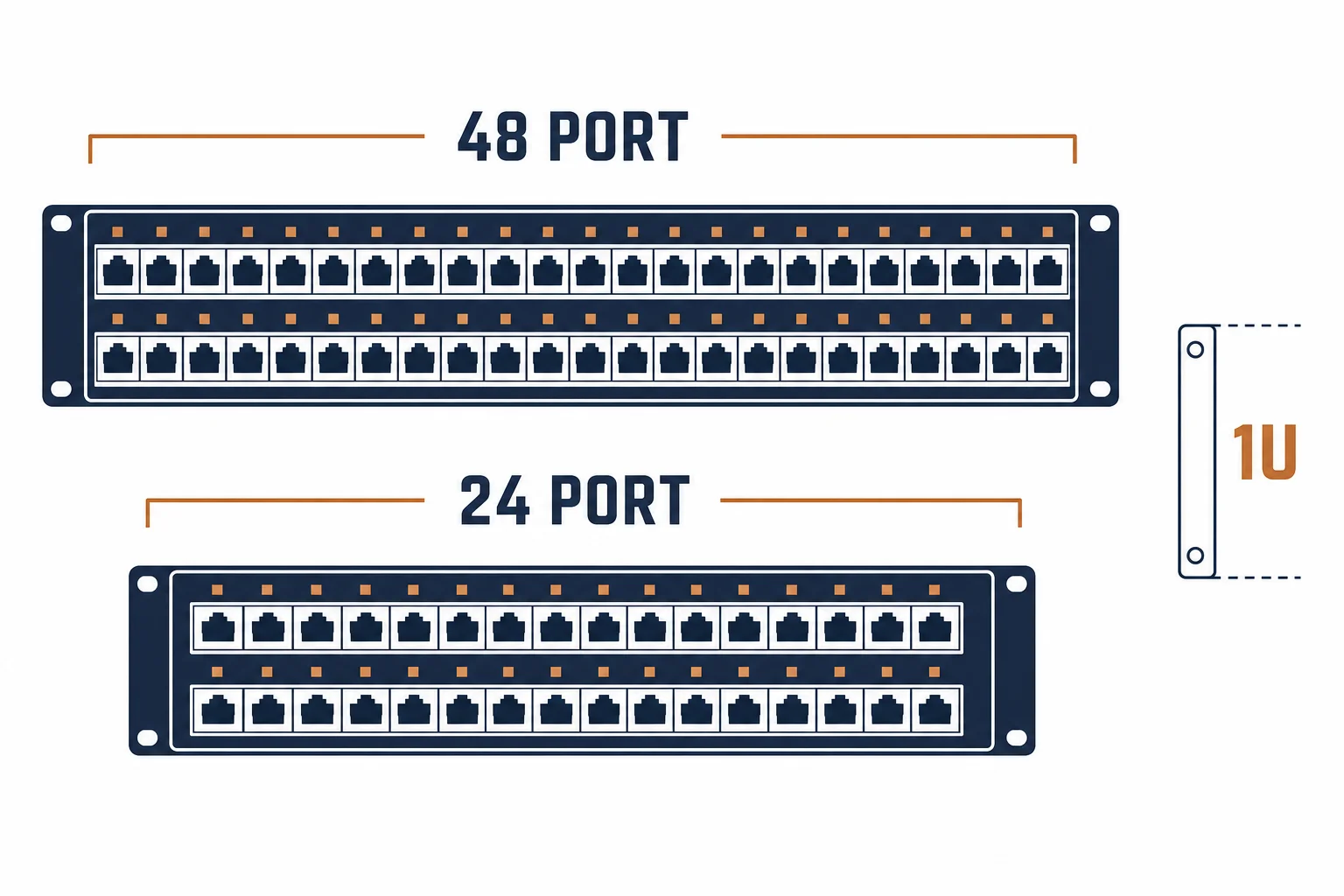
A phone patch panel administers voice circuits: 25-pair cable landing on punch-down blocks, or RJ12/RJ11 ports for smaller systems. It looks like a data panel and is not one – the pair count, the impedance and the acceptable loss are all different, and using a voice panel for data caps the link before it starts.
This is the voice-panel guide: the formats, the differences that matter, and the retrofit decision when a building has both.
The Formats
| The format | The capacity | The use |
|---|---|---|
| 25-pair block | 25 lines per block | Key systems and PBX |
| RJ12/RJ11 panel | 6 or 12 ports | Small office, analogue lines |
| 66-block | Cross-connect | Legacy telephone installations |
The block formats are voice-specific: they are designed for punch-down of many pairs, not for category-rated data.
How Voice Differs From Data
- Pair count: one or two pairs per line, not four
- Bandwidth: voice needs a few kilohertz
- Loss tolerance: generous compared with data
- Termination: punch-down blocks, not keystone jacks
The differences explain why a voice panel is cheaper and why it cannot substitute for a data panel.
The Hybrid Cabinet
| The practice | The reason |
|---|---|
| Separate panels | Different categories and pair counts |
| Labelled blocks | Voice faults are traced by pair |
| Colour discipline | Voice and data cables distinguishable |
| Documentation | The next technician needs the map |
Standards and Verification
| The reference | The relevance |
|---|---|
| TIA-568.2-D | Includes voice-grade cabling practice |
| Local telecom regulations | Line interface requirements |
| Continuity test | Pair-by-pair for voice |
Per-market telecom interface rules are not provided in the knowledge base. The panel formats are standard; confirm the carrier's interface requirement before terminating lines.
Real-World Applications
The small office
Six analogue lines and a door intercom: an RJ12 panel in the same cabinet as the data patch, labelled separately – a voice fault traced without touching the network.
The legacy PBX
A PBX replacement on an existing 25-pair block: the block reused, the pairs re-labelled, the carrier interface checked first – the migration completed without touching the data cabinet.
Related reading: Why voice cable cannot carry data — blogs/news/cat3-vs-cat5
Related reading: The connector difference at the outlet — blogs/news/rj12-vs-rj45
Frequently Asked Questions
What is a phone patch panel?
A termination panel for voice circuits – 25-pair blocks or RJ12/RJ11 ports – used to administer telephone lines.
Can I run ethernet through a phone panel?
No – voice panels are not category-rated. Data needs a proper patch panel.
What is a 25-pair block?
A punch-down block terminating 25 voice pairs, common in key systems and PBX installations.
Should voice and data share a cabinet?
They can, on separate panels, with clear labelling and different cable colours.
Sourcing cables for a project, a store, or a private-label line? Contact our B2B sales team for specifications, certification evidence, and volume terms – FOB and CIF options available. Request a quote or sample.