
Cable Raceway: Containment and Access
Quick answer / TL;DR: Short answer: choose surface trunking for desks and retrofits, divided raceway where data and power share a route, and conduit for structure and exterior. Keep cable fill to roughly 40 percent, provide access at every bend and junction, and never bury a route that will need another cable.
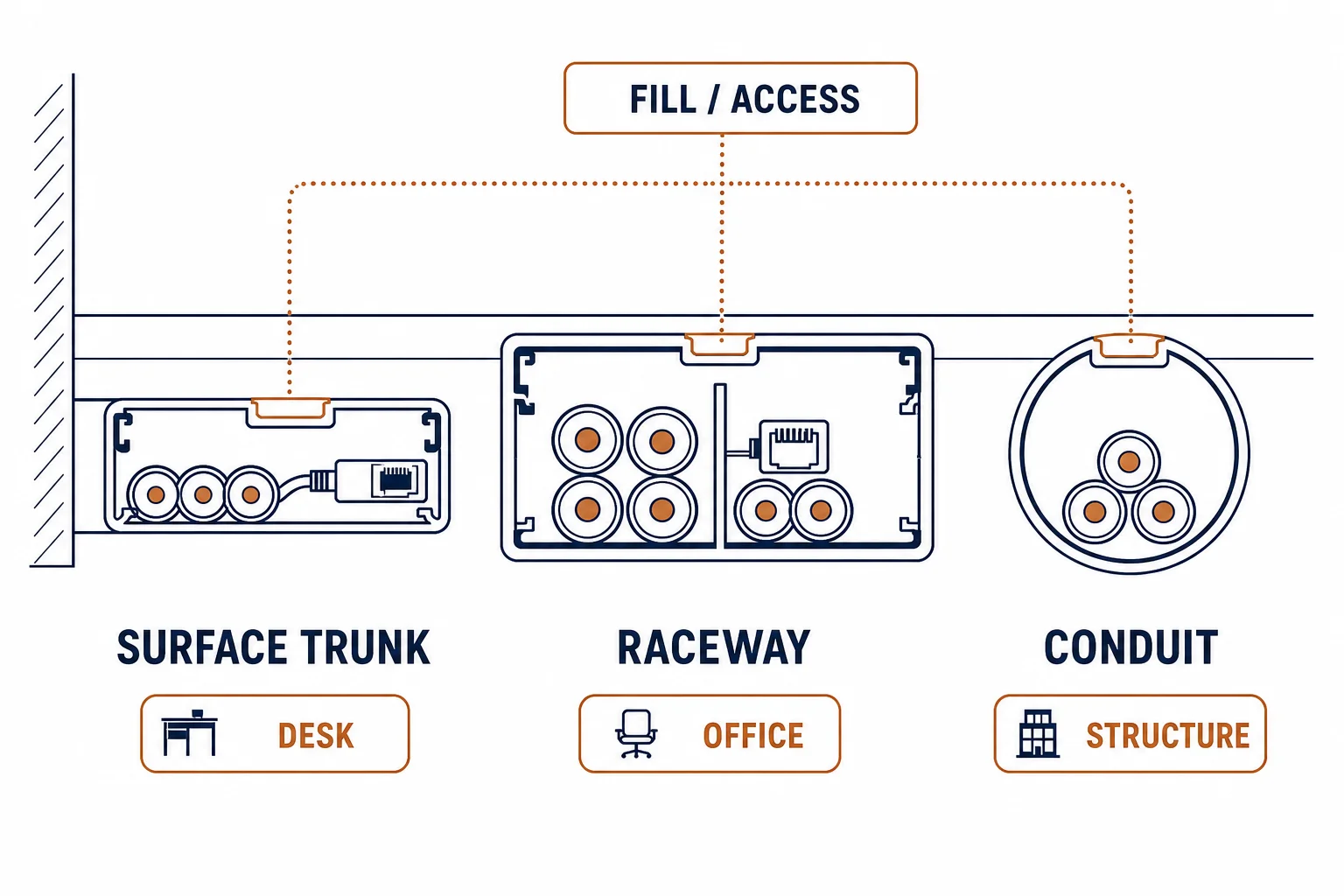
A cable raceway is not decoration: it protects the cable, separates it from power, and – if chosen well – keeps it accessible for the next change. Choosing badly produces a route that is compliant on the day of installation and impossible to modify a year later.
This is the containment guide: the three families, the fill arithmetic, and the access decisions that decide whether a route is maintainable.
The Three Families
| The type | The form | The best use |
|---|---|---|
| Surface trunking | Shallow rectangular channel | Desk runs, retrofits |
| Divided raceway | Channel with a divider | Data and power in one route |
| Conduit | Round tube | Structure, exterior, buried |
The families differ in access: trunking opens along its length, conduit does not.
The Fill Arithmetic
- Keep cable cross-sectional area to roughly 40 percent of the raceway's internal area
- Count future cables before choosing the size
- Respect bend radius at every corner – a tight elbow defeats the purpose
- Leave a pull line in any conduit you install
The fill rule exists so the cable can be added later without damaging what is already there.
Access Decisions
| The decision | The practice |
|---|---|
| Lid type | Screw-fix for permanence, snap for access |
| Bends | Accessible corners, not sealed elbows |
| Junctions | Boxes with lids |
| Fire stops | At rated wall penetrations |
Standards and Verification
| The reference | The relevance |
|---|---|
| Local electrical code | Separation and firestopping |
| TIA-568.2-D | Installation and bend radius |
| Cable datasheet | Diameter for the fill calculation |
Per-market fill percentages and firestop requirements are not provided in the knowledge base. Confirm the local code figure; the 40 percent practice is a common design target, not a universal rule.
Real-World Applications
The open-plan retrofit
A brick-walled office with no ceiling void: surface trunking along the skirting, snap lids, a divider for the power drop – two circuits in one route, both serviceable.
The sealed conduit
A conduit installed with sealed elbows and no pull line: the second cable could not be added without opening the wall. The replacement route used accessible bends – the lesson paid for twice.
Related reading: The cable forms that suit different routes — blogs/news/flat-vs-round-ethernet
Related reading: The outdoor installation methods compared — blogs/news/outdoor-install-methods
Frequently Asked Questions
What is cable raceway?
Containment – trunking, divided raceway or conduit – that routes and protects cable.
How full can a raceway be?
About 40 percent of internal area is a common design target; confirm local code.
Trunking or conduit?
Trunking where access is needed along the run; conduit where protection and structure matter more.
Can data and power share a raceway?
Only with a divider and per local code – separation is the reason divided raceway exists.
Sourcing cables for a project, a store, or a private-label line? Contact our B2B sales team for specifications, certification evidence, and volume terms – FOB and CIF options available. Request a quote or sample.