
12 Port Patch Panel: Small and Sufficient
Quick answer / TL;DR: Short answer: choose a 12 port panel when the cable count is 10 or fewer with modest growth, in a half-U rack or wall-mount format where rack space is scarce. Leave two spare ports for moves, use keystone jacks so the panel can be reconfigured, and label every port at both ends before termination rather than after.
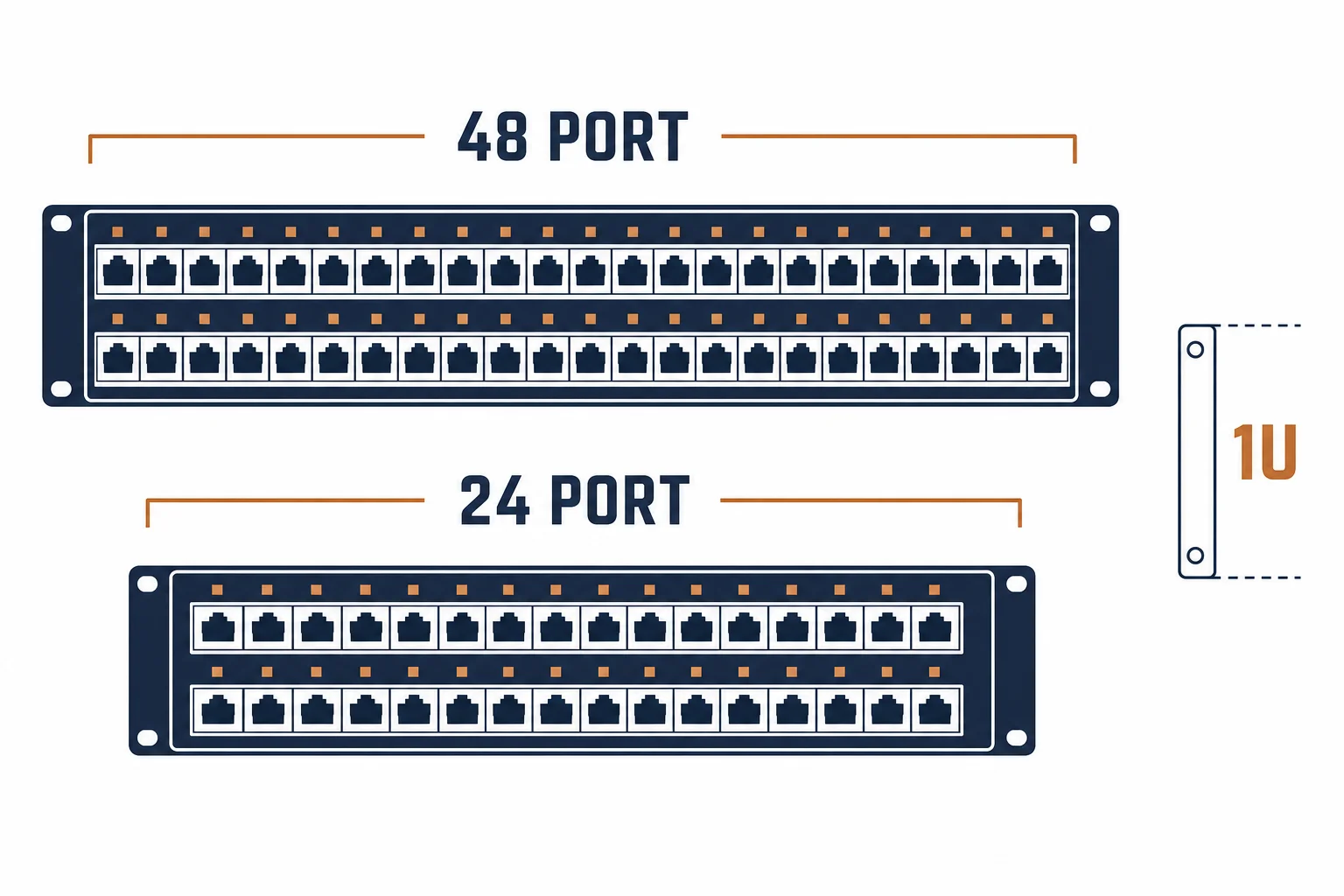
A 12 port patch panel exists for installations that will never fill a 24: a home office, a retail counter, a workshop, a single classroom. Buying the larger panel wastes rack space and invites unlabeled spare ports; buying the smaller one correctly requires thinking about growth before the order.
This is the small-panel guide: the formats, the growth arithmetic, and the labelling that makes a twelve-port panel as useful as a forty-eight.
When 12 Beats 24
| The situation | The panel |
|---|---|
| 10 or fewer cables, little growth | 12 port |
| Between 12 and 20 cables | 24 port |
| Wall-mounted cabinet | 12 port, wall-mount format |
| Rack with spare U | 24 port for the headroom |
The arithmetic is cables plus spares against the panel's cost and space – not against its port count alone.
The Formats
- Half-U rack panel: fits a shallow cabinet where a full U is wasted
- Wall-mount bracket: no rack at all, common in small comms cupboards
- Keystone panel: jacks changeable, so the category can follow the cable
- Fixed-jack panel: cheaper, but the panel's category is permanent
The keystone format is the flexibility argument: a small installation is more likely to change category than a large one.
Labelling
| The practice | The benefit |
|---|---|
| Number ports before termination | No ambiguity later |
| Label both ends | Faster fault-finding |
| Keep a port map | Moves without tracing |
Standards and Verification
| The reference | The relevance |
|---|---|
| TIA-568.2-D | Administration and connecting hardware |
| IEC 60603-7 | The jack interface |
| Field test | Permanent link test per port |
Per-SKU panel dimensions are not provided in the knowledge base. Confirm the rack or wall format before ordering; a half-U panel will not fit a full-U slot without an adapter.
Real-World Applications
The home office
Eight runs from a cupboard: a 12 port wall-mount panel with keystone jacks, four spares – the network documented on a card inside the door.
The retail counter
Four devices at a counter plus a back-office link: a 12 port panel in a small cabinet – no full rack, no unused capacity.
The undersized order
A twelve-port panel bought for a growing office: full within a year, cables left unpatched. Replaced with 24 ports – the growth arithmetic done late.
Related reading: The density decision at the larger end? Read the patch panel buying guide — blogs/news/cat6-patch-panel-buying
Related reading: The jacks that go in it? Read the keystone jack guide — blogs/news/rj45-keystone-jack-buying
Frequently Asked Questions
When should I use a 12 port patch panel?
For ten or fewer cables with limited growth – home offices, counters, small workshops.
Is there a half-U format?
Yes, along with wall-mount brackets for cabinets without a rack.
Keystone or fixed jacks?
Keystone for flexibility – the jacks can be changed as the cable category changes.
How many spare ports?
Two is the practical minimum for moves and additions.
Sourcing cables for a project, a store, or a private-label line? Contact our B2B sales team for specifications, certification evidence, and volume terms – FOB and CIF options available. Request a quote or sample.