
20 Metre Ethernet Cable: Metric Lengths
Quick answer / TL;DR: Short answer: a 20 m ethernet cable leaves about 80 m of channel margin, so the category is a rate decision rather than a distance one. Buy Cat6 for 2.5G headroom or Cat6a for 10G, keep the cords at each end short, and specify category, conductor form and jacket rating explicitly – a metric length does not change any of them.
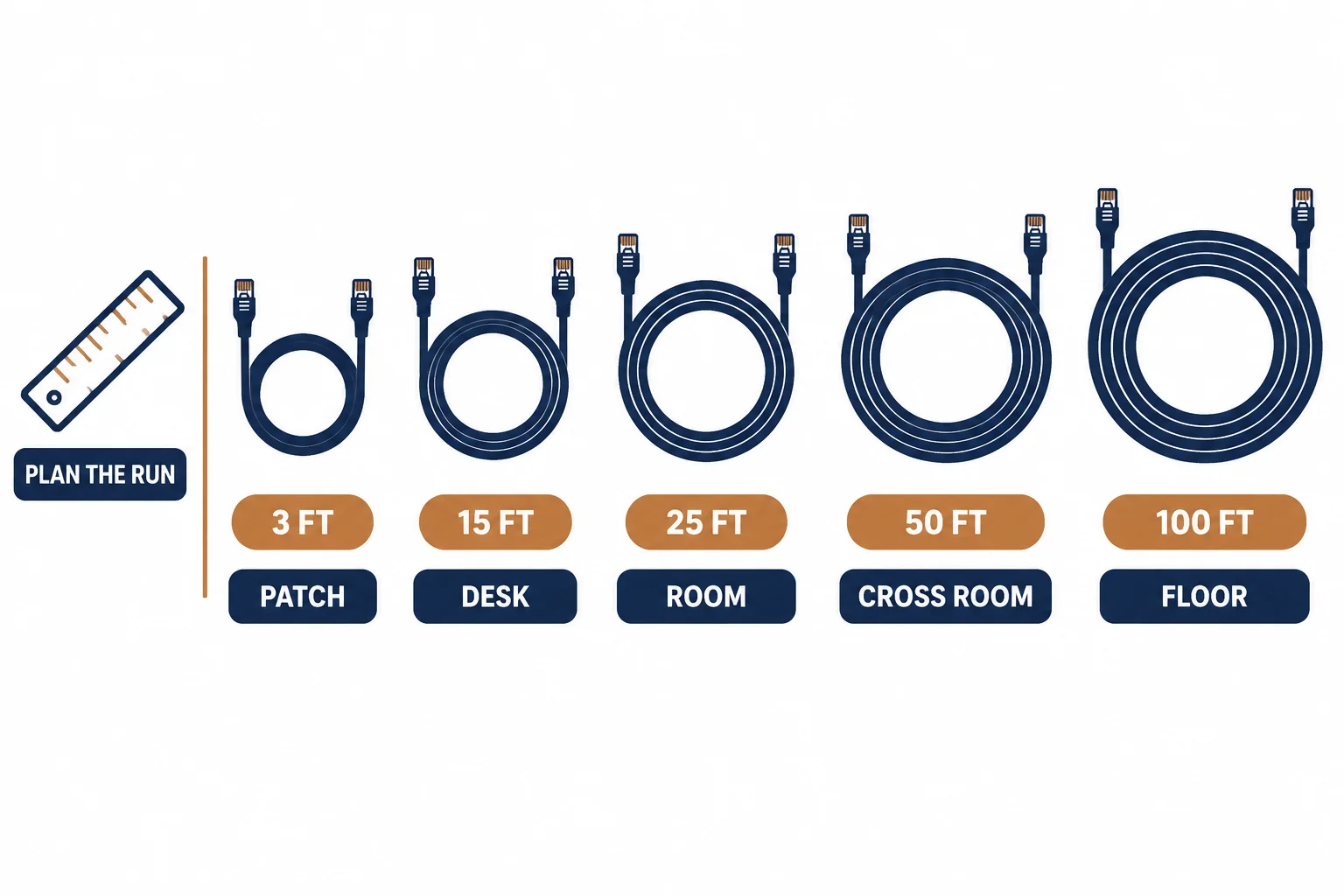
A 20 metre cable is the metric equivalent of roughly 65 feet: comfortably inside the 100 m channel limit, long enough to cross a floor, short enough to stay a cord rather than an installation. The interesting part is not the length but the ordering discipline – metric catalogues mix cable length, conductor and jacket in ways imperial ones do not.
This is the metric-length guide: the channel budget, the category choice, and the specification lines that survive a metric purchase order.
The Channel Budget at 20 m
| The element | The figure | The note |
|---|---|---|
| Cable | 20 m | A fifth of the channel |
| Cords | Add at both ends | Short ones |
| Margin | About 80 m | Ample |
| Joints | Zero | No reason to add any |
At a fifth of the channel the margin is generous, which moves the decision to the rate the cable must support.
Category and Rate
- Gigabit: Cat5e or Cat6
- 2.5G/5G: Cat6
- 10G: Cat6a for full distance, Cat6 only with a short total channel
- PoE: 23 AWG preferred for longer powered runs
The category is set by the future requirement, not by the 20 metres.
Ordering in Metric
| The line | The example |
|---|---|
| Category | Cat6 |
| Length | 20 m, stated as a cord or as bulk |
| Conductor | Stranded for a cord, solid for cable |
| Jacket | CM for general, CMR for a riser |
Standards and Verification
| The reference | The relevance |
|---|---|
| TIA-568.2-D | Channel and cord requirements |
| ISO/IEC 11801-1 | Class definitions (metric by origin) |
| IEEE 802.3 | Rates over twisted pair |
Per-SKU lengths are not provided in the knowledge base. The channel limit is 100 m; 20 m leaves ample margin in any category.
Real-World Applications
The European office
A fit-out specified in metric: 20 m cords to the far desks, bulk cable in 500 m reels – the purchase order written in the units the site measures in.
The imperial substitution
A 20 m run supplied as a 65 ft cord: functionally identical, but the labels disagreed with the drawing. The next order specified metric to match the documentation.
The 10G upgrade
A 20 m run carrying 10G on Cat6: working because the total channel was short. Documented as a short-channel case so the next engineer does not assume Cat6 at full distance.
Related reading: The imperial equivalent of this length? Read the 75 foot guide — blogs/news/75-foot-ethernet-cable
Related reading: The category that guarantees 10G here? Read the Cat6a cable guide — blogs/news/cat6a-ethernet-cable-guide
Frequently Asked Questions
How long is a 20 metre cable in feet?
About 65 feet – roughly a fifth of the 100 m channel limit.
What category for 20 m?
Cat6 for gigabit and 2.5G; Cat6a if 10G must be guaranteed at that length.
Does a metric length change the specification?
No – category, conductor and jacket are unchanged. Only the length unit differs.
Can I use a 20 m cord in a wall?
No – use solid building cable with a rated jacket and terminate at outlets.
Sourcing cables for a project, a store, or a private-label line? Contact our B2B sales team for specifications, certification evidence, and volume terms – FOB and CIF options available. Request a quote or sample.