
PoE Adapter Buying: Three Devices, Three Jobs
Quick answer / TL;DR: Short answer: an injector adds PoE to a non-PoE switch port; a splitter separates power and data at the device end; a midspan adds power mid-run. Match the adapter's class and wattage to the device's draw (802.3af 15.4 W, at 30 W, bt up to 90 W at the PSE), and confirm the adapter passes gigabit data, not just power.
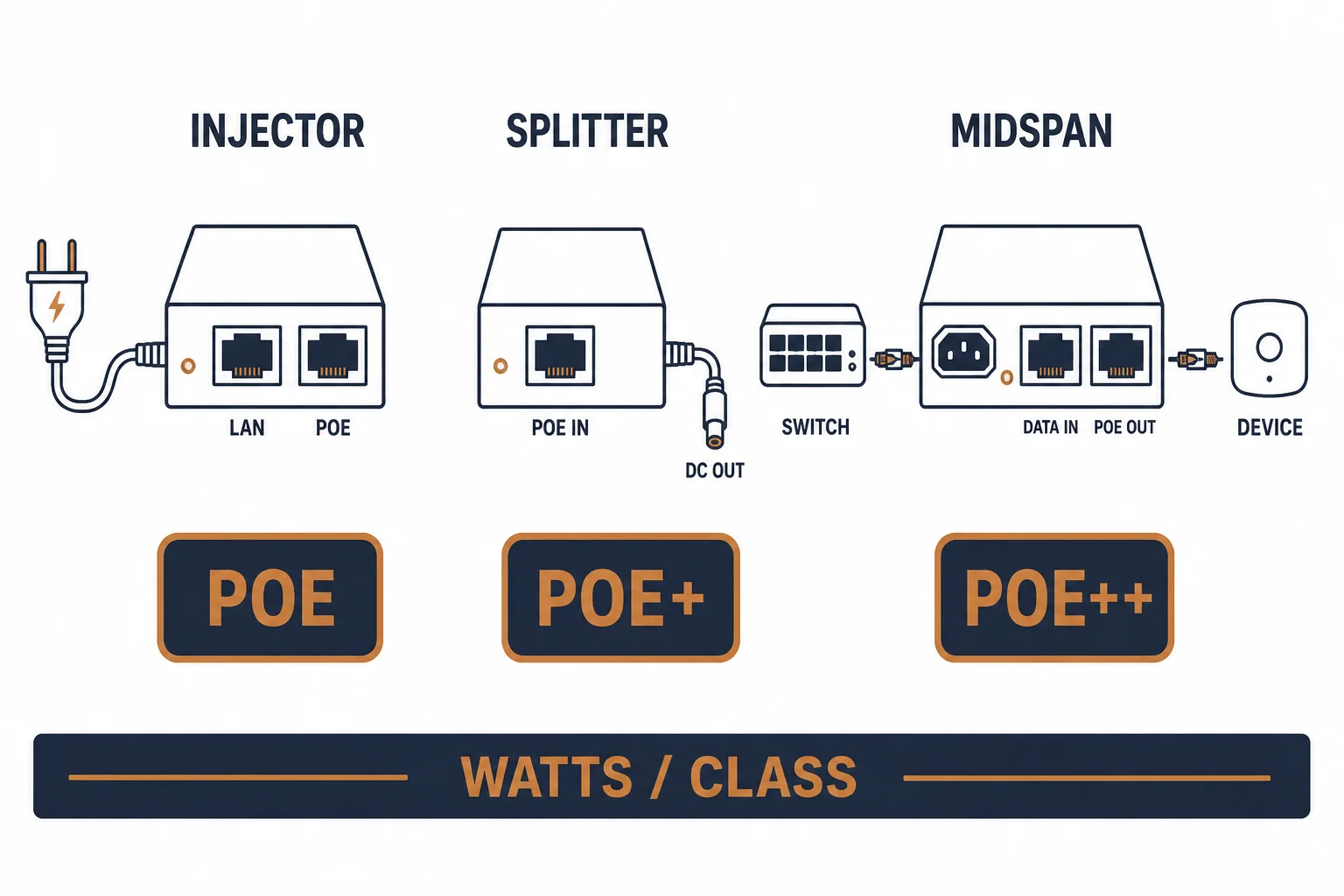
A PoE adapter is one of three devices doing three different jobs: an injector adds power to a cable, a splitter removes it at the far end, and a midspan inserts power into an existing run. Buying the wrong one produces a device that receives no power or a network that loses its data path.
This is the PoE adapter guide: the three devices, the class and wattage arithmetic, and the checks that stop a purchase from being the wrong half of a pair.
The Three Devices
| The device | The job | The position |
|---|---|---|
| Injector | Adds power to a data cable | At the switch end |
| Splitter | Separates power from data | At the device end |
| Midspan | Inserts power into an existing run | Between switch and device |
The positions are fixed: an injector at the source, a splitter at the load, a midspan in the middle.
The Wattage Arithmetic
- 802.3af: about 15.4 W at the source, less at the device after cable loss
- 802.3at (PoE+): about 30 W at the source
- 802.3bt: up to about 60 W or 90 W depending on type
- Read the device's maximum draw, not its idle figure
The arithmetic is source power minus cable loss: a long thin run delivers less than the injector's label promises.
The Data Question
| The check | The question |
|---|---|
| Data rate | Does the adapter pass gigabit, or only 100 Mbps? |
| Pair usage | Does it use all four pairs? |
| Compatibility | Does the device expect a standard or passive PoE? |
| Enclosure | Indoor or outdoor rated? |
Standards and Verification
| The reference | The relevance |
|---|---|
| IEEE 802.3af/at/bt | The PoE classes and power levels |
| TIA-568.2-D | The cable carrying the power |
| IEC 60529 | IP rating for outdoor adapters |
Per-SKU wattage and data ratings are not provided in the knowledge base. The class levels are standard; confirm the adapter's data rate and pairing with the device's expectations.
Real-World Applications
The non-PoE switch
A camera on an older switch without PoE: a single-port injector at the switch end – the camera powered and the data path intact.
The device that needed a splitter
A non-PoE device at the end of a PoE run: a splitter separating 12 V from the data – the device powered without a local supply.
The 100 Mbps adapter
An injector bought for a camera that needed 30 W: the 15.4 W class insufficient and the camera rebooting at night. A PoE+ injector fitted – the class arithmetic done after the fact.
Related reading: The shielding question for powered runs? Read the PoE shielding guide — blogs/news/poe-shielded-cable
Related reading: Cabling an access point on PoE? Read the access point guide — blogs/news/ethernet-cable-for-access-point
Frequently Asked Questions
What is a PoE adapter?
A device that adds power to an ethernet cable (injector, midspan) or separates it at the far end (splitter).
Injector or splitter?
Injector at the switch end to add power; splitter at the device end to remove it. Most installations need one or the other, not both.
How much power can PoE deliver?
About 15.4 W (af), 30 W (at) and up to 60-90 W (bt) at the source, less after cable loss.
Will a PoE adapter slow my network?
Some pass only 100 Mbps. Confirm gigabit passthrough if the link needs it.
Sourcing cables for a project, a store, or a private-label line? Contact our B2B sales team for specifications, certification evidence, and volume terms – FOB and CIF options available. Request a quote or sample.