
Cat6 Direct Burial: Construction and Procedure
Quick answer / TL;DR: Short answer: use cable explicitly rated for direct burial – gel-filled or water-blocked, with a tough jacket – and install it at the depth local code requires, over a bed of sand or in conduit, with warning tape above. Test the run before backfilling; a fault found afterwards means digging it up again.
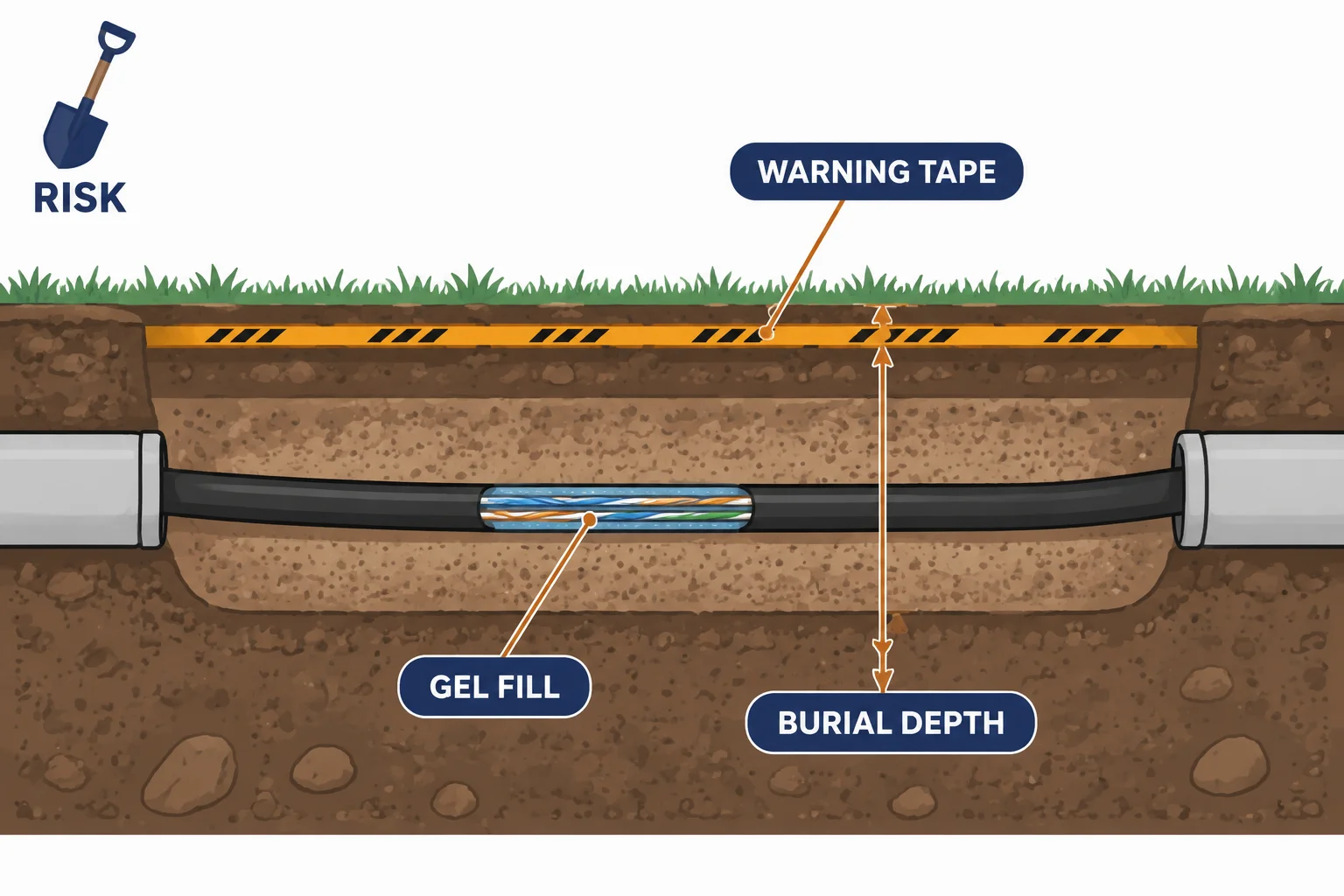
Direct burial Cat6 is a construction and a procedure: the cable must be built for soil contact, and the trench must be prepared so the cable survives. Either half alone fails – a burial-rated cable in a shallow trench is as vulnerable as ordinary cable.
This is the burial guide: what the construction adds, the procedure that protects it, and the checks before backfilling.
What the Construction Adds
| The feature | The purpose | The failure it prevents |
|---|---|---|
| Gel fill or water blocking | Stops water travelling along the cable | Corrosion and freeze damage |
| Tough jacket | Resists abrasion and soil chemicals | Jacket breach |
| UV-stable compound | Where the cable is exposed at the ends | Jacket cracking |
The construction is about water first: most buried cable failures are moisture travelling inside the jacket to the shield or the pairs.
The Procedure
- Depth: per local code, deeper under vehicle traffic
- Bedding: sand or fine soil, no sharp stones against the jacket
- Conduit: at crossings, under paths, and where future access is likely
- Warning tape: above the cable, so a spade meets tape before copper
- Test before backfill: the one check that can only be done once
The procedure is sequenced so that every irreversible step comes after a test.
The Entry Points
| The point | The practice |
|---|---|
| At the building | Seal the entry, drip loop outside |
| At a joint | Avoid; if unavoidable, use a rated enclosure above water |
| At a riser | Transition to a rated indoor jacket |
Standards and Verification
| The reference | The relevance |
|---|---|
| TIA-568.2-D | Exterior cabling practice |
| Local electrical code | Burial depth and protection |
| Field test | Channel test before and after backfill |
Per-market burial depths are not provided in the knowledge base. Confirm the requirement locally; the construction and testing principles are standard.
Real-World Applications
The outbuilding link
A workshop 40 m from the house: gel-filled burial cable at code depth, sand bedding, warning tape – and a test before the trench closed.
The driveway crossing
A run under a gravel drive: conduit through the crossing, burial cable elsewhere – the traffic load carried by the duct.
The unsealed entry
A buried run entering a building through an unsealed hole: water tracked in along the cable and reached the shield. The entry sealed and a drip loop formed – the moisture path closed.
Related reading: The outdoor rating question first? Read is Cat6 outdoor rated — blogs/news/cat6-outdoor-rated
Related reading: The distance the run has to cross? Read the long cable guide — blogs/news/long-ethernet-cable
Frequently Asked Questions
What is direct burial Cat6 cable?
Cable built for soil contact – gel-filled or water-blocked with a tough jacket – installed without conduit at a code depth.
Can ordinary outdoor Cat6 be buried?
No – outdoor rating covers UV and weather, not soil contact and water ingress. Use a burial-rated construction.
How deep should it be buried?
Local code sets the depth; it is deeper under vehicle traffic. Confirm before digging.
Why test before backfilling?
Because a fault afterwards means excavation. The test is the last cheap moment in the project.
Sourcing cables for a project, a store, or a private-label line? Contact our B2B sales team for specifications, certification evidence, and volume terms – FOB and CIF options available. Request a quote or sample.