
Short Ethernet Cable: The Rack's Real Workhorse
Quick answer / TL;DR: Short answer: keep short cords in 0.5 ft, 1 ft, 2 ft and 3 ft, in the same category as the permanent cabling, with snagless boots for density. Excess length in a cabinet blocks airflow and hides faults; the right short cord costs the same as the wrong long one.
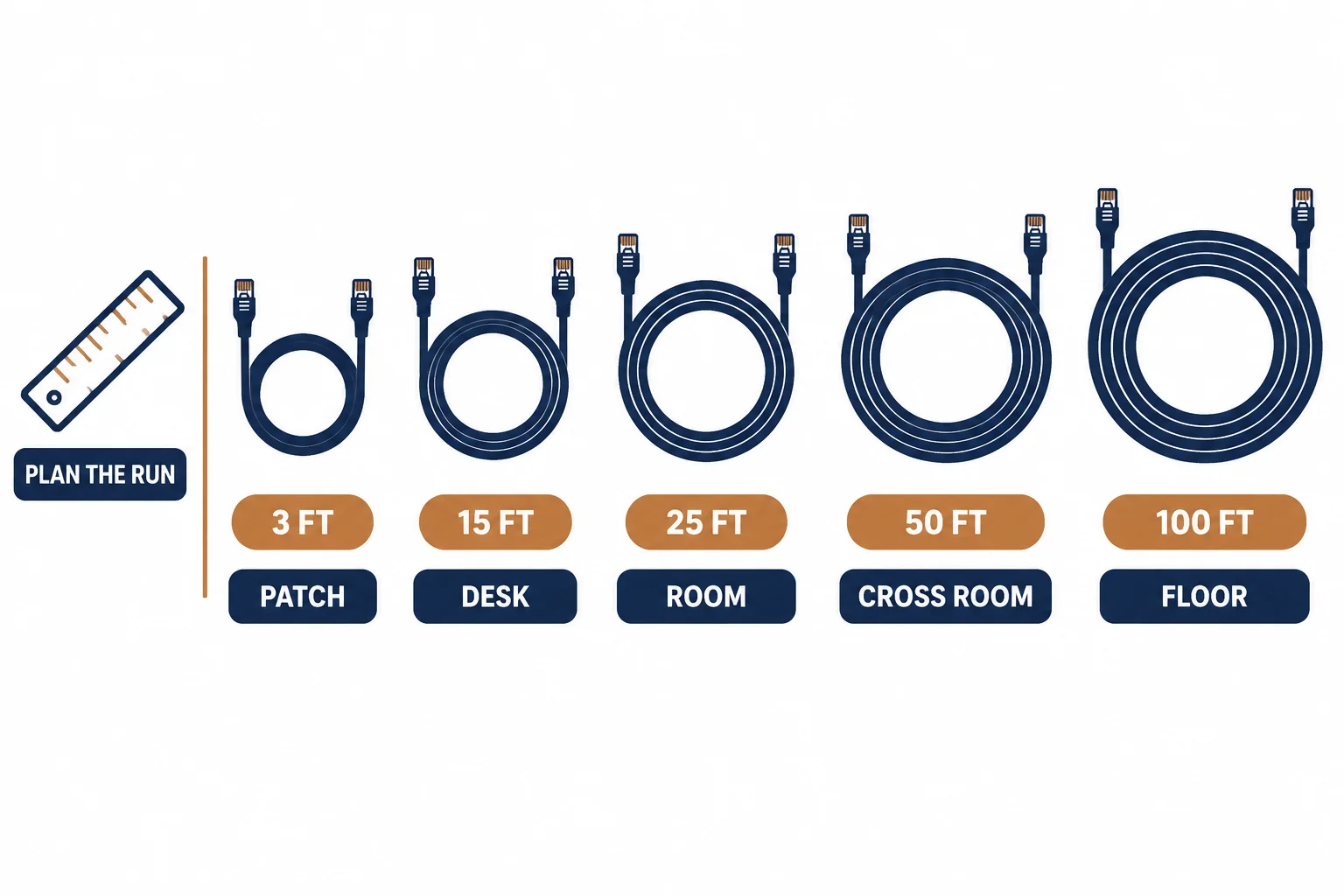
Short cords – one, two and three feet – do the unglamorous work in every rack: they connect panel ports to switch ports, and their length decides whether the cabinet is readable and whether air can move. Buying them well is a stocking decision more than a technical one.
This is the short-cord guide: why length discipline matters, the boot and category choices, and the stock list that covers most cabinets.
Why Short Cords Matter
| The problem | The cost |
|---|---|
| Excess coils | Blocked airflow and harder fault-finding |
| Long cords in a dense panel | Latches snagging on neighbours |
| Mixed unknown lengths | Slower moves and changes |
| Oversized bundles | Heat build-up around PoE ports |
The costs are operational: every extra foot in a cabinet is a foot of cable to trace during an outage.
The Stock List
- 0.5 ft: adjacent ports in the same panel row
- 1 ft: panel to switch in the same U
- 2 ft: panel to switch one or two U apart
- 3 ft: across a cabinet or to a side-mounted switch
Four lengths cover most cabinets; a fifth rarely earns its shelf space.
Boot and Category
| The choice | The recommendation |
|---|---|
| Boot | Snagless in dense panels |
| Category | Match the permanent cabling |
| Colour | Two colours: one for data, one for management |
| Conductor | Stranded, moulded plugs |
Standards and Verification
| The reference | The relevance |
|---|---|
| TIA-568.2-D | Cord requirements within the channel |
| IEC 60603-7 | Plug interface |
| Field test | Channel test with the cords installed |
Per-SKU cord lengths are not provided in the knowledge base. The channel limit is 100 m, so short cords consume almost none of it.
Real-World Applications
The tidy cabinet
Two 48-port panels and a 48-port switch patched with 1 ft cords: the front readable, the airflow clear, the spare lengths in the same colours.
The coil problem
Six-foot cords in a 12-port cabinet: coils tied to the side, ports hidden. Re-patched with 1 ft cords – the outage-finding time halved.
The snagged latch
A 1 ft cord fitted next to a full row: the latch caught on its neighbour during a move and snapped. Snagless cords specified for the rebuild of that row.
Related reading: The cord construction behind the length? Read the patch cord guide — blogs/news/patch-cord-buying
Related reading: Where the cords land? Read patch panel versus switch — blogs/news/patch-panel-vs-switch
Frequently Asked Questions
What is a short ethernet cable used for?
Patching panel ports to switch ports inside a cabinet, where a foot or two is all the run needs.
Does a short cord reduce performance?
No – shorter is electrically easier. The gains are airflow, tidiness and faster fault-finding.
Snagless or standard for short cords?
Snagless in dense panels, where latches catch on neighbouring cords.
How many lengths should I stock?
Four – 0.5, 1, 2 and 3 ft – cover most cabinets; more lengths complicate stock without adding reach.
Sourcing cables for a project, a store, or a private-label line? Contact our B2B sales team for specifications, certification evidence, and volume terms – FOB and CIF options available. Request a quote or sample.