
High Performance Network Cable: What It Buys
Quick answer / TL;DR: Short answer: high performance cable buys band (250 or 500 MHz), 23 AWG copper, a pair separator and shielding. Those matter for long runs, 10G, dense bundles and noisy environments. For a desk cord or a home run they change nothing measurable – match the specification to the distance and the rate, not to the label.
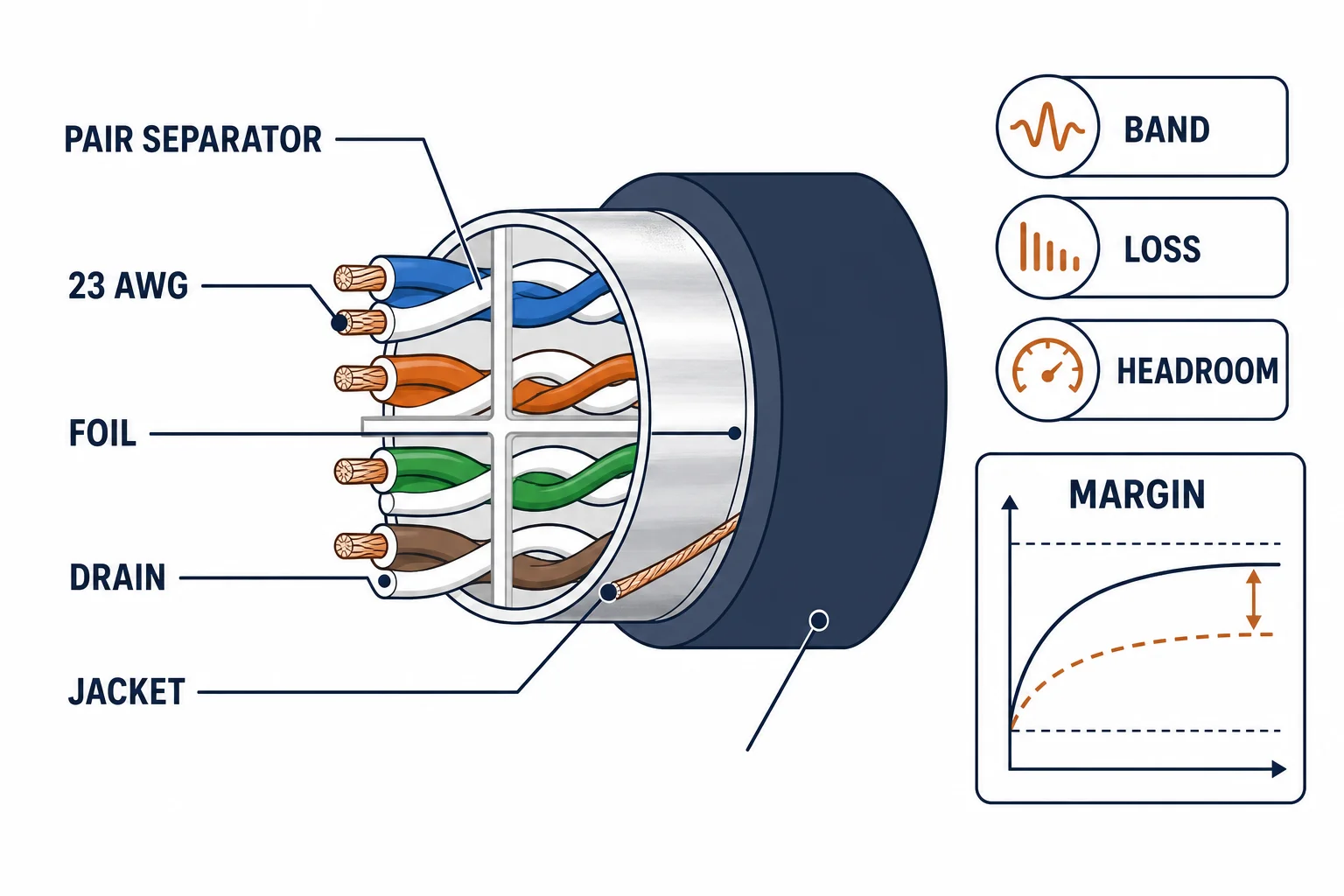
'High performance network cable' is a marketing phrase until it is translated into specifications: a wider band, a larger conductor, a pair separator, a shield. Each adds something measurable – and each adds cost, stiffness and installation demands. The question is which of them your link actually needs.
This is the specification guide: the four things the premium buys, the conditions where they matter, and the cases where they do not.
What the Premium Buys
| The feature | The measurable effect | The cost |
|---|---|---|
| Wider band | More headroom at high rates | Testing and materials |
| 23 AWG copper | Lower attenuation, less PoE drop | Copper and stiffness |
| Pair separator | Better crosstalk margin | Diameter |
| Shield | Interference rejection | Grounding work |
Each line is measurable, which means each can be matched to a requirement rather than bought as a bundle.
When It Matters
- Long runs near the 100 m limit, where attenuation accumulates
- 10G and above, where the band is the entry ticket
- Dense bundles, where crosstalk between cables matters
- Industrial and plant-room paths with drives nearby
The common factor is stress: distance, rate, density or interference. Remove the stress and the premium has nothing to solve.
When It Does Not
| The situation | The verdict |
|---|---|
| Desk cord under 3 m | Standard cord is fine |
| Home gigabit run | Cat5e or Cat6 |
| Short cabinet patch | Any category |
Standards and Verification
| The reference | The relevance |
|---|---|
| TIA-568.2-D | Category performance requirements |
| ISO/IEC 11801-1 | Class definitions |
| IEEE 802.3an/bq | 10G and 25G over copper |
| Field test | The channel result that proves the claim |
Per-SKU performance is not provided in the knowledge base. The specifications are standard; ask for a test report rather than a performance adjective.
Real-World Applications
The long backbone
A 90 m run between cabinets at 10G: Cat6a with a separator and shield – the distance where the premium is the difference between working and not.
The marketing substitution
A 'high performance' cord bought for a desk: no measurable difference from the standard cord. The label explained – the specification had nothing to solve.
The bundle that needed it
Two hundred cables in one tray: crosstalk rising in the dense bundle. Separator-equipped cable specified for the rebuild – density was the stress.
Related reading: The categories compared on band? Read Cat5e versus Cat6a — blogs/news/cat5e-vs-cat6a
Related reading: The dimensions that affect fit? Read the cable size guide — blogs/news/cat6-cable-size
Frequently Asked Questions
What makes network cable high performance?
Wider band, larger copper conductor, pair separator and shielding – each measurable, each with a cost.
Is high performance cable worth it?
For long runs, 10G, dense bundles or noisy environments, yes. For short desk cords, no measurable gain.
Does a separator really matter?
It improves crosstalk margin, which matters in bundles and at high rates – and matters little in a single short run.
How do I verify the claim?
Ask for a test report at the claimed category. Performance adjectives are not specifications.
Sourcing cables for a project, a store, or a private-label line? Contact our B2B sales team for specifications, certification evidence, and volume terms – FOB and CIF options available. Request a quote or sample.