
RJ45 Keystone Jack: The Channel's Weak Link
Quick answer / TL;DR: Short answer: buy keystone jacks rated for the cable's category – Cat6 jack for Cat6 cable – and match the shielding: shielded jacks for shielded cable, with the drain bonded. Choose punch-down (110 style) for volume and tool-less where access is tight, and test every terminated port rather than sampling.
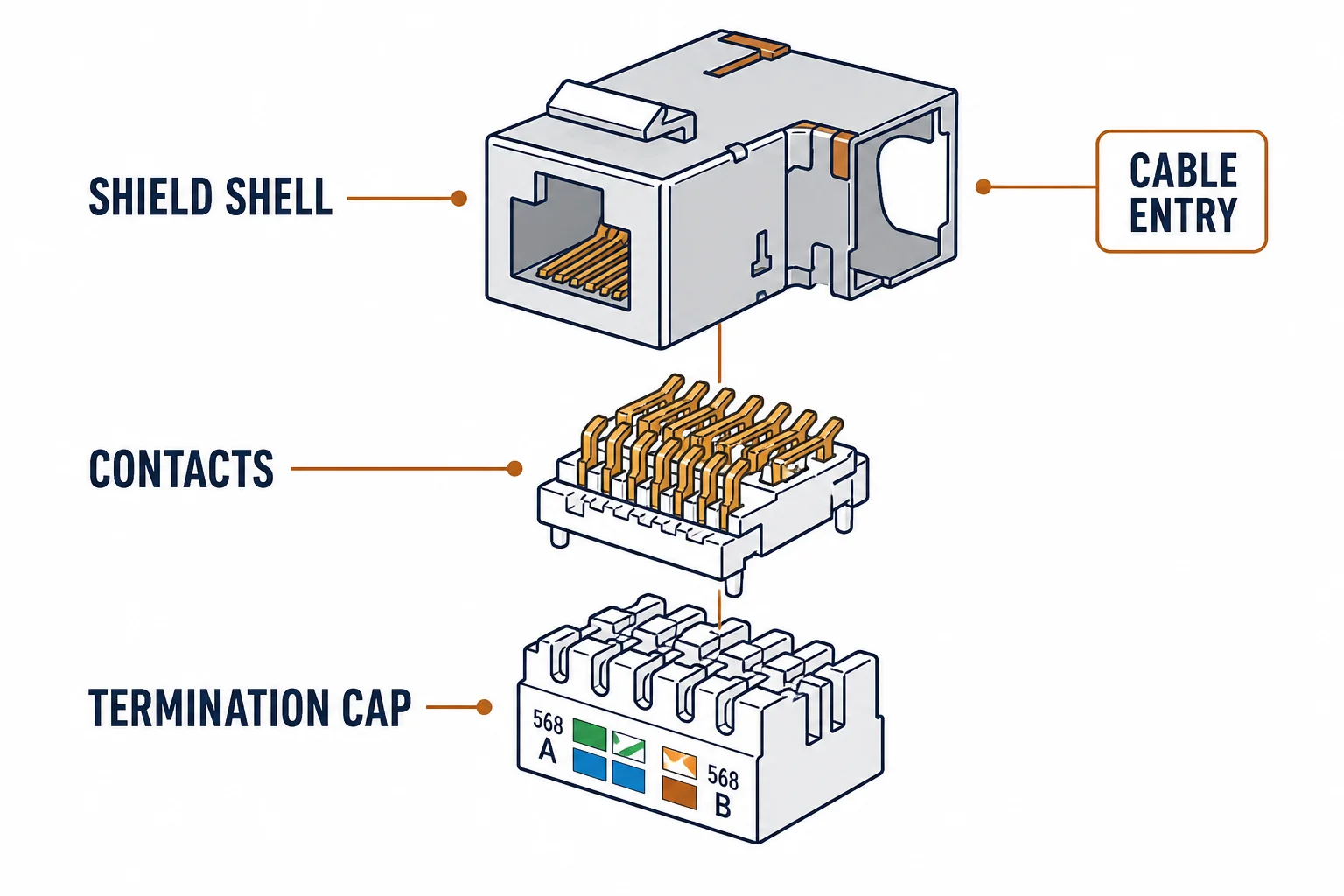
An RJ45 keystone jack is the termination point that turns a cable into an outlet, and it is the component most likely to limit a channel: a Cat5e jack on Cat6a cable, an unshielded jack on shielded cable, or a poorly seated termination. The jack is cheap; the re-termination is not.
This is the jack guide: category matching, the termination styles, and the shielded decision that follows the cable.
Category Matching
| The cable | The jack | The result |
|---|---|---|
| Cat5e | Cat5e | Full channel rating |
| Cat6 | Cat6 | Full channel rating |
| Cat6 | Cat5e jack | Channel limited to Cat5e |
| Cat6a shielded | Unshielded jack | Shield path broken |
The jack does not add performance – it either preserves the cable's rating or caps it. That makes matching the cheapest form of insurance.
Termination Styles
- Punch-down (110 style): the volume choice, needs a punch tool
- Tool-less: faster in tight boxes, slightly higher unit cost
- Toolless with a cap: holds pair geometry during closing
- Field-terminable plugs are a different product – do not confuse them with jacks
The style is a labor decision: at a hundred ports the punch tool pays for itself, at five the tool-less jack is quicker.
The Shielded Decision
| The cable | The jack | The extra step |
|---|---|---|
| U/UTP | Unshielded | None |
| F/UTP, S/FTP | Shielded, metal shell | Bond the drain to the shell |
Standards and Verification
| The reference | The relevance |
|---|---|
| TIA-568.2-D | Connecting hardware requirements |
| IEC 60603-7 | The RJ45 interface |
| Field test | Permanent link test at each outlet |
Per-SKU jack performance is not provided in the knowledge base. Category ratings are standard; confirm the jack's category marking and its shield support.
Real-World Applications
The office termination day
Sixty ports punched down with Cat6 jacks: every port tested, two re-terminated – the sampling shortcut avoided.
The shielded retrofit
F/UTP cable landed on plastic jacks: the shield floating at every outlet. Shielded jacks fitted and bonded – the channel completed.
The mixed-category floor
Cat6 cable with leftover Cat5e jacks: the floor testing at the lower category. Jacks replaced – the specification honoured.
Related reading: The plate these jacks sit in? Read the wall plate guide — blogs/news/ethernet-wall-plate-buying
Related reading: The shielded construction behind the jack choice? Read the shielding families guide — blogs/news/what-is-shielded-cable
Frequently Asked Questions
What is an RJ45 keystone jack?
A modular jack that snaps into a keystone opening in a plate or panel and terminates the cable at an outlet.
Does the jack category matter?
Yes – a lower-category jack caps the channel regardless of the cable's rating.
Shielded or unshielded jack?
Match the cable. Shielded jacks need the drain bonded to the shell to complete the shield path.
Punch-down or tool-less?
Punch-down for volume and consistency; tool-less where access is tight or the count is small.
Sourcing cables for a project, a store, or a private-label line? Contact our B2B sales team for specifications, certification evidence, and volume terms – FOB and CIF options available. Request a quote or sample.