
25 Foot Ethernet Cable: Room to Room
Quick answer / TL;DR: Short answer: a 25 ft Cat6 patch cord suits most room-to-room runs. Any category works electrically at 7.6 m; Cat6 gives headroom for 2.5G. Route along skirting or under a door protector rather than across a walkway, and use a rated cable if the run enters a wall or ceiling void.
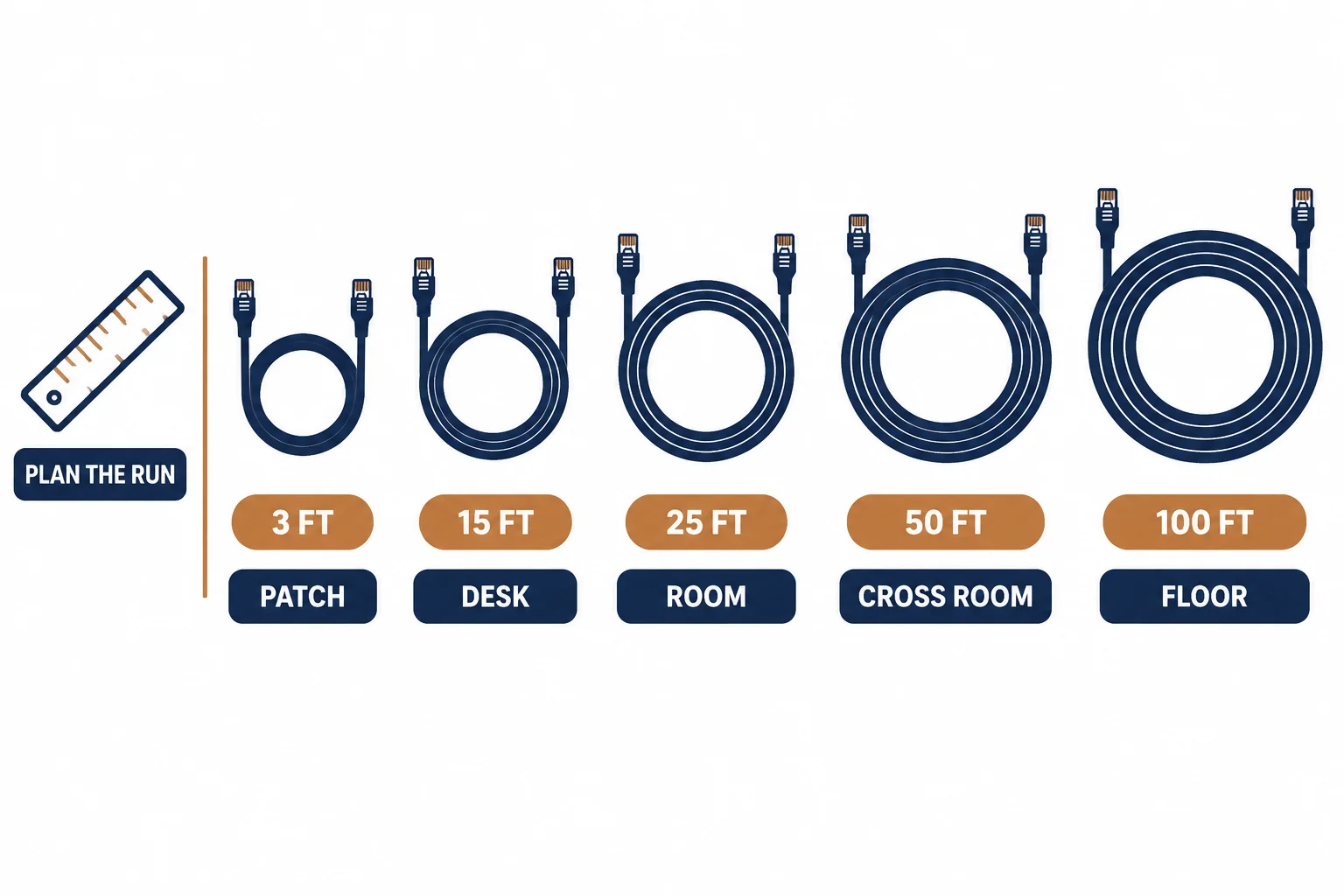
Twenty-five feet covers the common domestic and small-office case: router in one room, device in the next, with enough slack to route around a doorway rather than across it. At 7.6 metres the cable is electrically unremarkable – the decisions are mechanical and practical.
This is the 25 ft guide: category, route and the checks that keep a temporary-looking run from becoming a trip hazard or a compliance problem.
What Changes at 25 Feet
| The factor | The position at 7.6 m | The note |
|---|---|---|
| Signal margin | Large | Any category works |
| Voltage drop for PoE | Minor | Gauge matters more than length |
| Route | The real constraint | Doorways and walkways |
| Form | Stranded cord | Solid only for permanent |
The signal margin is comfortable, which is why the decision shifts entirely to routing and handling.
Routing Around a Doorway
- Along the skirting: clipped or in a trunking, out of the walkway
- Under a door: a flat cable and a protector, never a round cable under a closed door
- Across a room: consider a longer run around the edge instead
- Through a wall: only with a rated cable and a proper outlet
The routing rules exist because a cable across a floor is a trip hazard and a pinched cable is a future fault.
The Checks
| The check | The question |
|---|---|
| Jacket | Does the route pass through a wall or void? |
| Plugs | Moulded, with strain relief? |
| Excess | Is the surplus coiled and fixed, not draped? |
Standards and Verification
| The reference | The relevance |
|---|---|
| TIA-568.2-D | Cord and channel requirements |
| IEEE 802.3ab | Gigabit over twisted pair |
| Local code | In-wall and fire-rating rules |
Per-SKU ratings are not provided in the knowledge base. The channel limit is 100 m; 25 ft leaves ample margin at any category.
Real-World Applications
The flat share
A router in the hallway, a desk in the bedroom: 25 ft routed along the skirting and under one door protector – no drilling, no trip hazard.
The home office upgrade
A video-call desk on Wi-Fi dropout: 25 ft Cat6 to the router – the wired link stable through the working day.
The doorway pinch
A round cable closed in a door: the jacket crushed and a pair damaged. Replaced and re-routed – the door left free.
Related reading: The longer run and its limits? Read the 50 foot guide — blogs/news/50-foot-ethernet-cable
Related reading: The shortest cords for patching? Read the short cable guide — blogs/news/short-ethernet-cable
Frequently Asked Questions
Is a 25 ft ethernet cable fast enough?
Yes – at 7.6 m every category is far inside its rating. Cat6 is the usual choice for headroom.
Can I run a 25 ft cable under a door?
Only with a flat cable and a protector, and never pinched by the door. A round cable will be damaged.
Should I buy Cat6 or Cat5e at this length?
Cat6 for 2.5G headroom; Cat5e if the requirement is fixed at gigabit. Performance at 25 ft is otherwise identical.
Can a 25 ft cord go inside a wall?
No – cords are not rated for in-wall use. Use rated cable to an outlet and a short cord from there.
Sourcing cables for a project, a store, or a private-label line? Contact our B2B sales team for specifications, certification evidence, and volume terms – FOB and CIF options available. Request a quote or sample.