
Ethernet Patch Leads: Naming and Selection
Quick answer / TL;DR: Short answer: a patch lead is a short stranded-conductor assembly with a plug at each end – the same product as a patch cord or patch cable. Choose the boot for the handling (snagless for dense racks, moulded for general use, slim for tight spacing), the length for the actual run, and confirm the category matches the permanent cabling it joins.
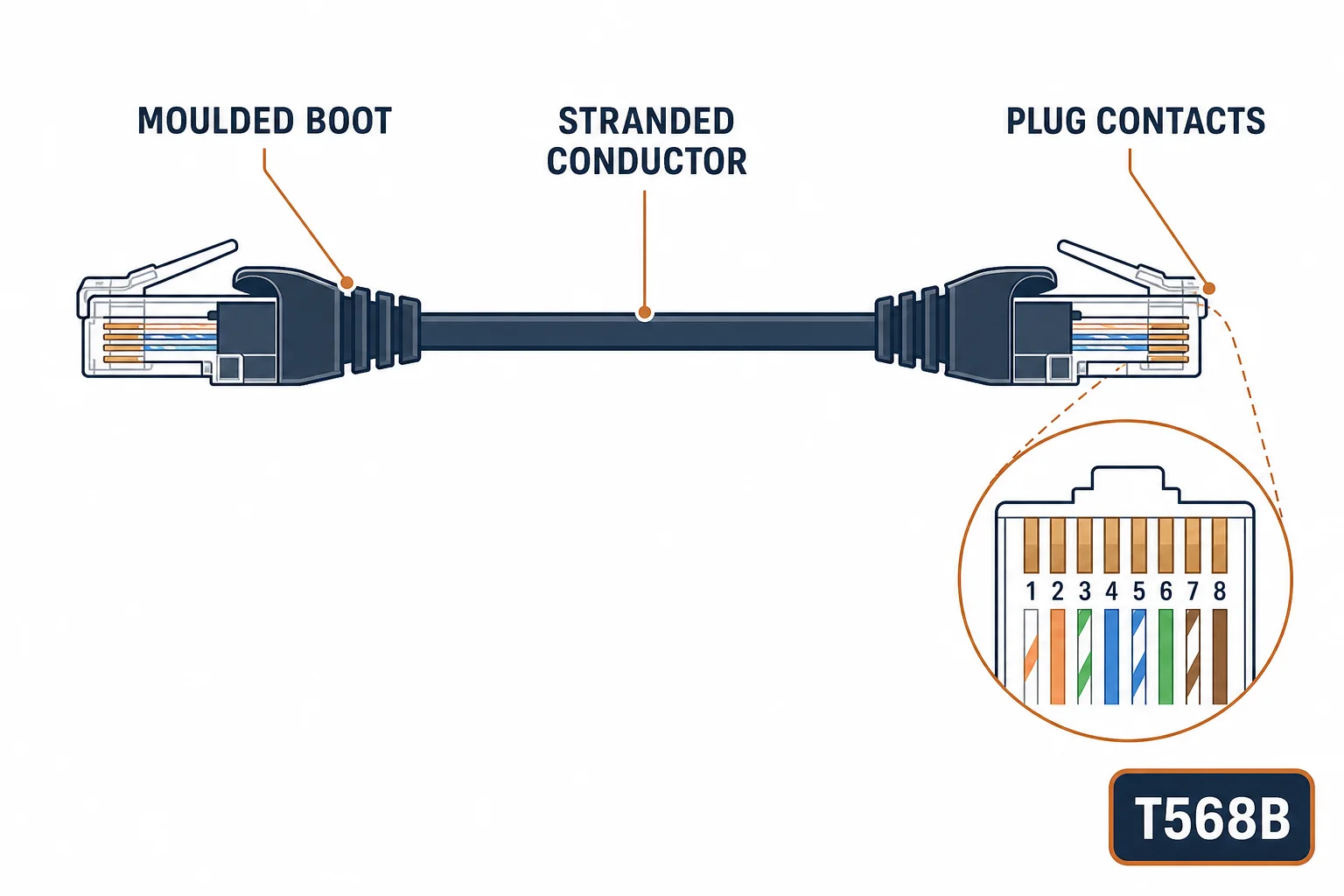
Patch lead, patch cord, patch cable – three names for the same product, which is why search results and supplier catalogues disagree. The practical questions behind the naming are simpler: what boot, what length, and what conductor, because those decide whether the lead survives a year of handling.
This is the patch lead guide: the terminology, the boot styles and their trade-offs, and the length discipline that keeps a cabinet tidy.
The Terminology
| The term | The region | The meaning |
|---|---|---|
| Patch lead | UK, AU | A short assembly with plugs both ends |
| Patch cord | US | The same product |
| Patch cable | Both | The same, sometimes used for bulk too |
The terminology is regional, not technical: three words, one product. The ambiguity matters only when comparing catalogues.
Boot Styles and What They Solve
- Snagless: a moulded hood over the latch – stops the clip catching when pulled through a dense rack
- Standard moulded: the cheapest, fine where leads are rarely moved
- Slim: reduced plug body for high-density panels – useful when ports are close
- Field-terminable: only where a custom length is genuinely needed
The boot is the part that fails first in service: a snapped latch turns a working lead into a cable that will not stay seated.
Length Discipline
| The position | The lead length |
|---|---|
| Switch to panel in the same cabinet | 0.5-1 m |
| Adjacent cabinets | 1-2 m |
| Desk to wall outlet | 2-3 m |
| Long desk run | Up to 5 m, then reconsider the design |
Standards and Verification
| The reference | The relevance |
|---|---|
| TIA-568.2-D | Cord requirements within the channel |
| IEC 60603-7 | The plug interface |
| Field test | Channel test with the leads in place |
Per-SKU boot and conductor data are not provided in the knowledge base. The naming and construction rules are standard; confirm the category on the plug or the packaging.
Real-World Applications
The dense cabinet
A 48-port panel cabled in one afternoon: snagless 0.5 m leads – the latches surviving the density and the next change.
The desk refresh
Two hundred desks re-cabled with 2 m leads in three colours: the colour coding making the patch field readable at a glance.
The long lead compromise
An 8 m lead used to reach a moved desk: signal fine, cable looped across a walkway. A proper outlet added – the length problem solved at the wall.
Related reading: The conductor form inside a lead? Read solid versus stranded — blogs/news/solid-vs-stranded-cat6
Related reading: Patch cords as a product line? Read the patch cord guide — blogs/news/patch-cord-buying
Frequently Asked Questions
What is an ethernet patch lead?
A short stranded-conductor cable with a plug at each end, used to connect equipment to outlets or panels. Same product as a patch cord.
Snagless or standard boots?
Snagless in dense racks and where leads get moved; standard moulded elsewhere. The latch is the first part to break.
What length patch lead do I need?
The shortest that reaches comfortably – 0.5-1 m in a cabinet, 2-3 m at a desk.
Can I use a patch lead as permanent cabling?
No – patch leads are stranded and not rated for in-wall runs. Use solid cable to outlets.
Sourcing cables for a project, a store, or a private-label line? Contact our B2B sales team for specifications, certification evidence, and volume terms – FOB and CIF options available. Request a quote or sample.