
Cat6a Ethernet Cable: The 500 MHz Line
Quick answer / TL;DR: Short answer: Cat6a is rated to 500 MHz and supports 10GBASE-T to 100 m. It is typically F/UTP or S/FTP, so specify shielding, conductor (23 AWG solid), jacket rating and box length together. Buy it for 10G backbones and long-life installs; Cat6 covers 10G only to about 55 m and costs less.
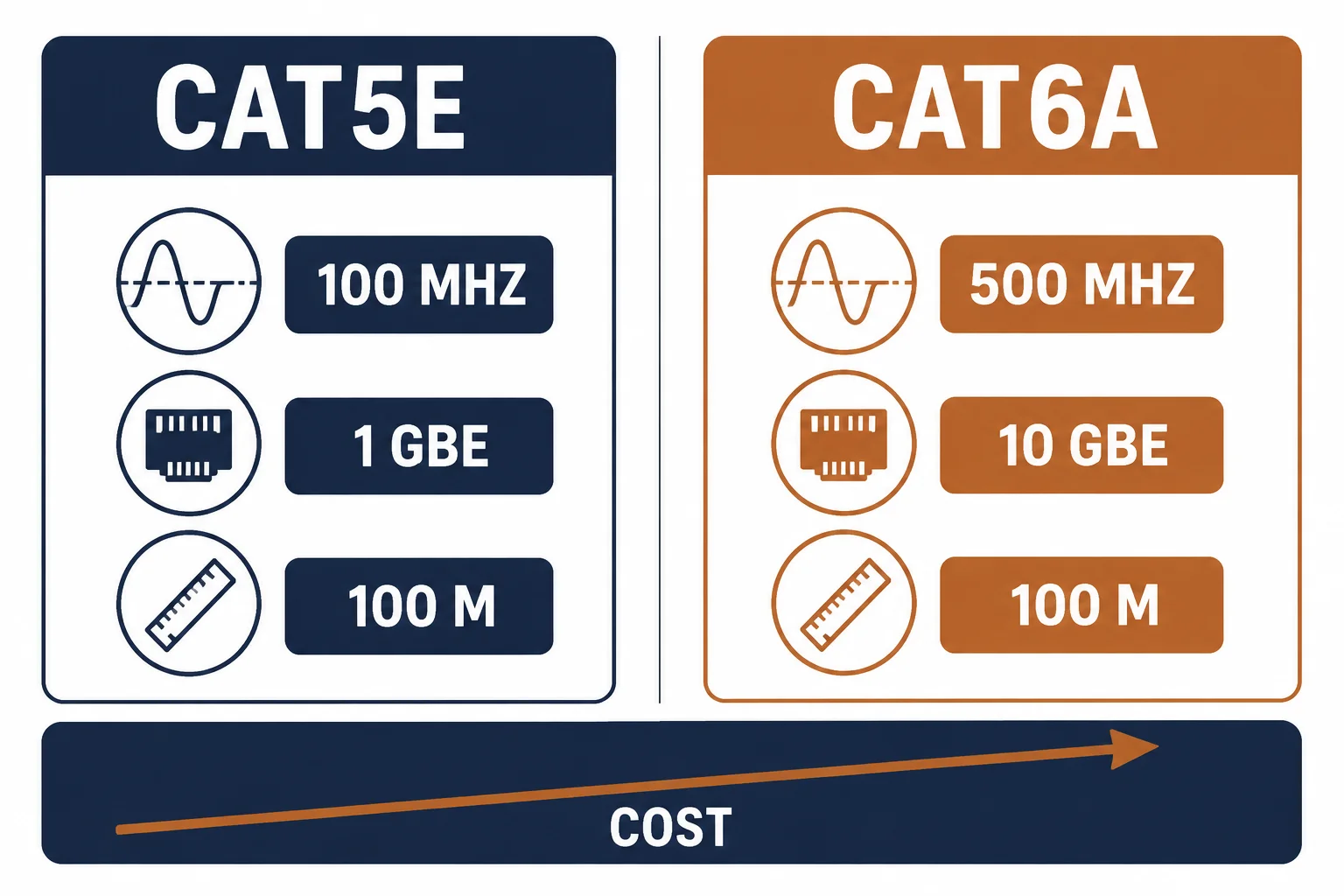
Cat6a is the copper category that carries 10GBASE-T to the full 100 metres – twice the band of Cat6 and five times Cat5e. It is also the category where the installation starts to matter as much as the cable, because most Cat6a is shielded and shielding brings obligations.
This is the Cat6a buying guide: what the extra band buys, the construction you will actually receive, and the four lines to put on the order.
What the Extra Band Buys
| The category | The band | 10G distance | The typical build |
|---|---|---|---|
| Cat5e | 100 MHz | Not rated | U/UTP |
| Cat6 | 250 MHz | About 55 m | U/UTP or F/UTP |
| Cat6a | 500 MHz | 100 m | F/UTP or S/FTP |
The distance column is the practical difference: Cat6a removes the length arithmetic that Cat6 forces on a 10G design.
The Build You Will Receive
- Shielding: most Cat6a is F/UTP (overall foil) or S/FTP (braid plus pair foils)
- Conductor: 23 AWG solid bare copper, larger than many Cat5e SKUs
- Diameter: noticeably stiffer and thicker than Cat6 – check conduit fill
- Grounding: the drain must bond at the panel or the shield does nothing
The build follows the band: to hold 500 MHz in a bundle, manufacturers add screening, and screening adds the grounding step to the installation.
The Four Order Lines
| The line | The example |
|---|---|
| Category | Cat6a |
| Shield | F/UTP |
| Conductor | Solid, 23 AWG |
| Jacket and length | CMR, 305 m box |
Standards and Verification
| The reference | The relevance |
|---|---|
| TIA-568.2-D | Category 6A requirements |
| ISO/IEC 11801-1 | Class EA |
| IEEE 802.3an | 10GBASE-T |
| Field test | Channel test at the installed category |
Per-SKU attenuation and shield data are not provided in the knowledge base. The category figures are standard; request a test report and confirm the build on the jacket print.
Real-World Applications
The 10G backbone
A studio moving shared storage to 10G: Cat6a between switches at 80 metres – the distance Cat6 could not cover at that rate.
The long-life fit-out
A new office specifying a 20-year horizon: Cat6a to every desk, shielded panels bonded – the upgrade path left open.
The ungrounded shield
Cat6a installed with the drains left loose: the channel testing short of its category. The panel bonds added – the shield finally part of the circuit.
Related reading: How Cat6a compares with the tier below? Read the Cat5e versus Cat6a guide — blogs/news/cat5e-vs-cat6a
Related reading: The shielded construction in detail? Read the FTP primer — blogs/news/what-is-ftp-cat6
Frequently Asked Questions
What is Cat6a ethernet cable?
A 500 MHz twisted-pair category supporting 10GBASE-T to 100 m, usually built as F/UTP or S/FTP.
How far does Cat6a run at 10G?
100 metres – the full channel limit, which is its advantage over Cat6's roughly 55 m.
Does Cat6a have to be shielded?
In practice most Cat6a is shielded. If it is, the drain must be bonded at the panel.
Is Cat6a worth the extra cost?
For 10G at distance and for long-life installs, yes. For gigabit access layers, Cat6 costs less and performs the same.
Sourcing cables for a project, a store, or a private-label line? Contact our B2B sales team for specifications, certification evidence, and volume terms – FOB and CIF options available. Request a quote or sample.