
Shielded System Supply: One Chain, One Supplier
Quick answer / TL;DR: Short answer: buy the shielded chain as a set – F/UTP cable, shielded jacks, shielded patch cords, and a bonded panel – from one specification so the shield continuity holds end to end. Mixed sourcing is possible but requires each component's shield support to be verified; one unshielded cord or jack breaks the channel's shield path.
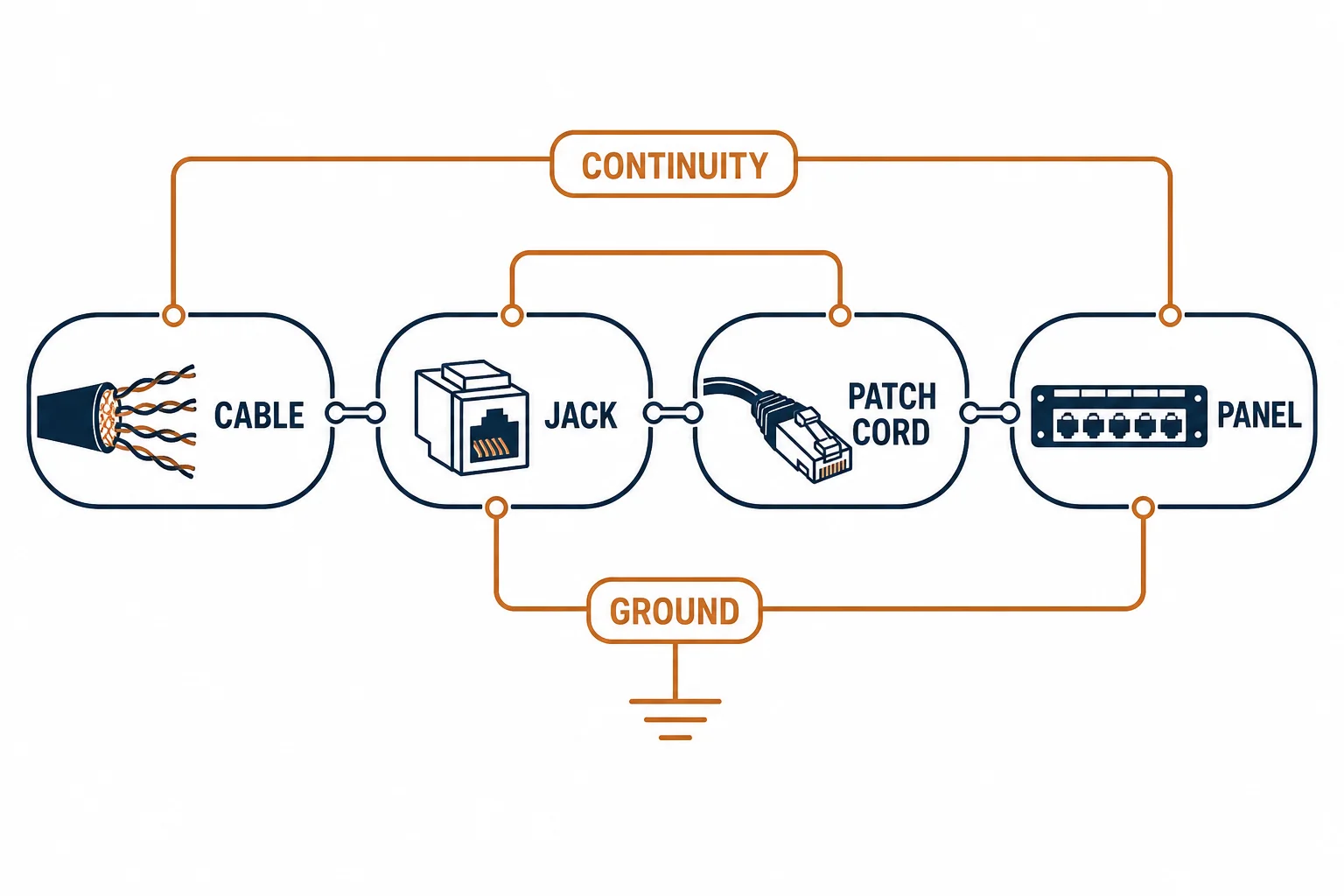
A shielded channel is a chain of four components: cable, jack, patch cord, and panel. Each must carry the shield, and the chain fails at the weakest link – usually the component bought separately and assumed compatible. This is the supply argument for buying the chain together.
This is the system-supply guide: the four components, the continuity requirement, and the procurement approach.
The Four Components
| The component | The shield's job | The failure |
|---|---|---|
| Cable | Carries the foil and drain | Unshielded cable – no path |
| Jack | Bonds the foil to the plate | Plastic jack – the shield stops |
| Patch cord | Carries the shield to the panel | Unshielded cord – the gap |
| Panel | Bonds and grounds the runs | Unbonded bar – floating shield |
The table is the chain: each row is a link, and one unshielded component ends the path. The channel's performance depends on all four agreeing.
Why Buying Together Helps
- One specification: the same screening class across components
- One supplier's compatibility: jacks that accept the cable's diameter, cords that fit the jacks
- One continuity responsibility: the chain tested as a system
- Fewer substitutions: the component that 'looks the same' is the usual failure
Mixed sourcing is not forbidden – it is a coordination cost. The buyer who mixes must verify each component's shield support, and the verification is the labor the single-supplier route avoids.
The Continuity Test
| The test | The scope |
|---|---|
| Cable shield | End to end |
| Jack to panel | Bond at the termination |
| Cord shield | Plug shell to plug shell |
| Channel | All links together, then the field test |
Standards and Verification
| The reference | The relevance |
|---|---|
| TIA-568.2-D | Shielded channel and grounding practice |
| ISO/IEC 11801-1 | Screening classes |
| Field test | The channel result after assembly |
Per-SKU component compatibility is not provided in the knowledge base. The chain principle is standard; confirm each component's screening class and shield support with its datasheet.
Real-World Applications
The single-supplier project
A hospital wing cabled as one shielded system: cable, jacks, cords and panels from one specification – the continuity tested once, the file complete.
The mixed-source correction
A project with shielded cable and unshielded cords: the channel's shield broken at the rack – the cords replaced, the chain closed.
The spare-parts discipline
A maintenance store labeling shielded and unshielded components separately: the substitution error retired – the chain holding through repairs.
Related reading: The factory audit behind the cable? Read FTP factory sourcing — blogs/news/ftp-factory-sourcing
Related reading: The grounding the chain ends at? Read the grounding guide — blogs/news/shielded-cat6-grounding
Frequently Asked Questions
Do all components in a shielded channel need shielding?
Yes for the shield to work end to end – cable, jack, patch cord, and panel. One unshielded component breaks the path.
Can I mix brands in a shielded system?
Possible but coordination-heavy: each component's screening class and shield support must be verified, and the chain tested as a system.
How do I test a shielded channel?
Continuity from cable shield through jack and panel, cord shell to shell, then the standard field test.
Is shielded patching really necessary?
If the channel is shielded, yes – an unshielded cord at the rack leaves the shield floating at the most accessible point.
Sourcing FTP (F/UTP) Cat6 for a project, a store, or a shielded system? Contact our B2B sales team for shield construction data, category reports, and volume terms – FOB and CIF options available. Request a quote or sample.